

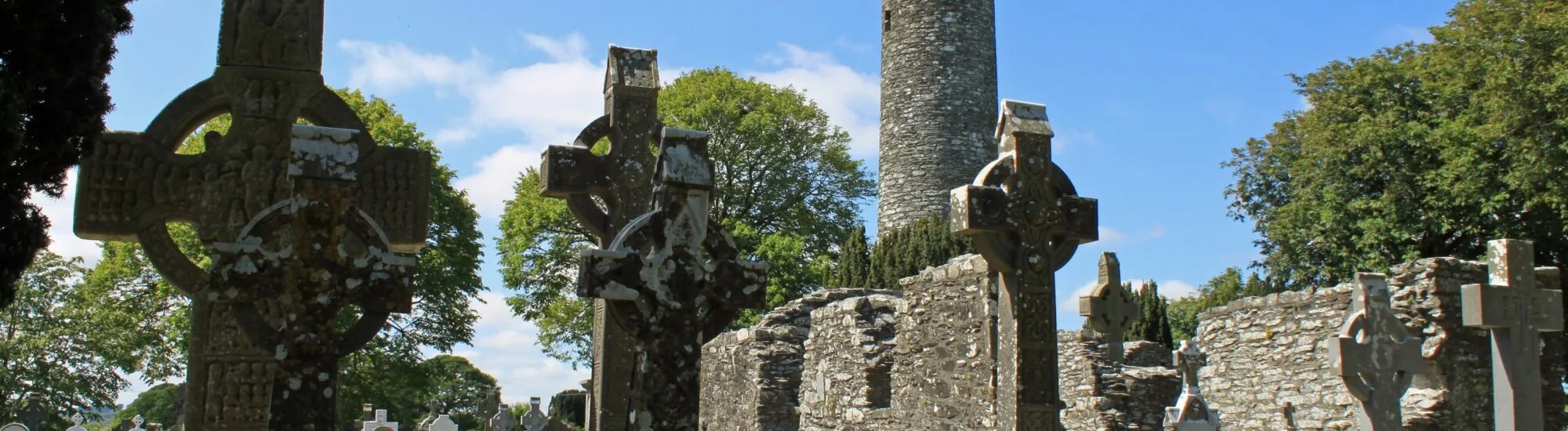
In the countryside of County Louth, around 8 kilometres north of Drogheda, Monasterboice brings together some of the most remarkable surviving examples of medieval Christian Ireland. A round tower rises above the graveyard, while towering carved crosses recount biblical episodes in stone. The site is compact, but its details reward a closer look.
Known in Irish as Mainistir Bhuithe, meaning ‘the monastery of Buite’, Monasterboice is a former monastic settlement rather than a small abbey preserved in its entirety. Visitors come chiefly to admire Muiredach’s Cross and the West Cross: two distinct monuments, one notable for its carvings and the other for its height.
Tradition attributes the founding of Monasterboice to Saint Buite, also known as Boetius, around the year 500, at the turn of the 5th and 6th centuries. The specific date of 521 should not be presented as an established certainty.
The settlement became an important religious centre. The monuments visible today, however, belong to several periods: the early foundation does not mean that the surviving churches, crosses and burials all date from the community’s beginnings.
This distinction helps put a visit into context. Monasterboice is not a complex built all at once, but a place transformed over the centuries, whose remains bear witness to the continuity of religious and funerary practices.
A fire in 1097 destroyed books and precious objects kept in the round tower. The episode is a reminder of the role these structures played in safeguarding the possessions of monastic communities.
From the 12th century onwards, Monasterboice gradually declined in importance, notably following the foundation of nearby Mellifont in 1142. Today’s landscape is defined above all by the great crosses, the tower and the ruins of two churches, set within a graveyard whose purpose should be respected.

Muiredach’s Cross — photo: Felipe Garcia, CC licence
Muiredach’s Cross, also known as the South Cross, is one of the site’s centrepieces. Standing around 5.5 metres high, it is renowned for the quality of its relief carvings. It is not, however, Ireland’s tallest high cross: that distinction belongs to the West Cross, on the same site.
Come close enough to make out the figures, then step back to understand the arrangement of the panels. Scenes from the Old and New Testaments are distributed across the monument, while the ring characteristic of Irish high crosses links the arms at their intersection.
The carvings are not simply decorative. They give visible form to religious narratives, in a context where images held an essential place. To appreciate them fully, walk slowly around the cross: a face seen against the light may become far easier to read from another angle.
The name Muiredach comes from an inscription requesting a prayer for him. It is generally associated with an abbot of Monasterboice who died in 924. Near the base, small cat figures provide an unexpected detail amid this monumental religious programme.
The West Cross, or Tall Cross, is distinguished first and foremost by its proportions. It is recognised as Ireland’s tallest high cross. Published measurements vary by source, ranging from around 6.5 to 7 metres: the key point is not to confuse it with Muiredach’s Cross.
Its height accommodates numerous carved scenes. Some are less easy to read from the ground because of their position and the weathering of the stone. Binoculars can be useful for viewing the upper sections without attempting to touch or climb the monument.
These high crosses should not be described merely as gravestones reserved for the most distinguished individuals. They belong to the religious space of the former monastery and have a broader significance, linked to devotion and Christian imagery.
The round tower reaches around 30.5 metres, despite the loss of its upper section. It is among the tallest towers of its kind in Ireland, though it is not the country’s tallest.
Its slender shaft provides a vertical landmark across the site and gives a sense of the medieval settlement’s ambition. Irish round towers are generally associated with use as bell towers; they may also have been used to store and protect valuable possessions.
The fire of 1097 is documented, but it does not conclusively explain the present absence of the conical roof. Avoid automatically attributing every missing element to that event. The tower can be viewed from outside: visits do not include a climb.
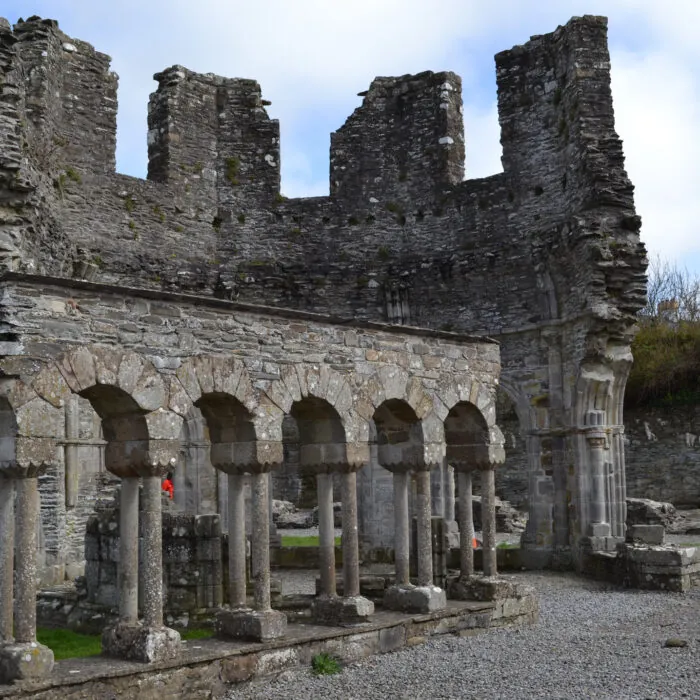
Two churches survive as ruins. Their walls, openings and alterations are reminders that Monasterboice continued to evolve long after its foundation.
Take a few minutes to distinguish these buildings from the tower and crosses, rather than seeing them as a uniform backdrop. The visit becomes more interesting once you identify the site’s different functions: praying in a church, ringing bells, gathering around a cross or preserving the memory of the dead.
Allow around 45 minutes to an hour to take in the two high crosses, the tower and the churches without rushing. A shorter stop is enough to see the main monuments, but leaves little time to appreciate the relief carvings.
The site is entirely outdoors. Bring a jacket suited to the weather and comfortable footwear, particularly when the ground is wet. Side lighting brings out the carvings more effectively than frontal light: if you enjoy photography, take time to compare the different faces rather than seeking only an overall view.
The site makes a good stop from Drogheda or as part of a heritage day out in the region. Nearby Mellifont offers a complementary insight into Irish monastic history, with different architecture and organisation.
Heritage Ireland describes Monasterboice as a site without OPW-guided tours. Prepare a few points of reference before your visit to better understand the monuments. The official Monasterboice page helps identify the crosses and the main stages of its history.
On site, be discreet around graves and people who have come to pay their respects. Do not touch the reliefs, climb on the structures or use gravestones as supports for photographs. The delicacy of the carvings is central to the visit’s appeal; their preservation also depends on these simple actions.
Essential information to help you plan your visit, including key landmarks, access information, and booking options.
prendre la M1, et suivre la direction de Monasterboice, Drogheda, County Louth, Republic of Ireland, Tourist sites in Ireland
53.781447, -6.425647