

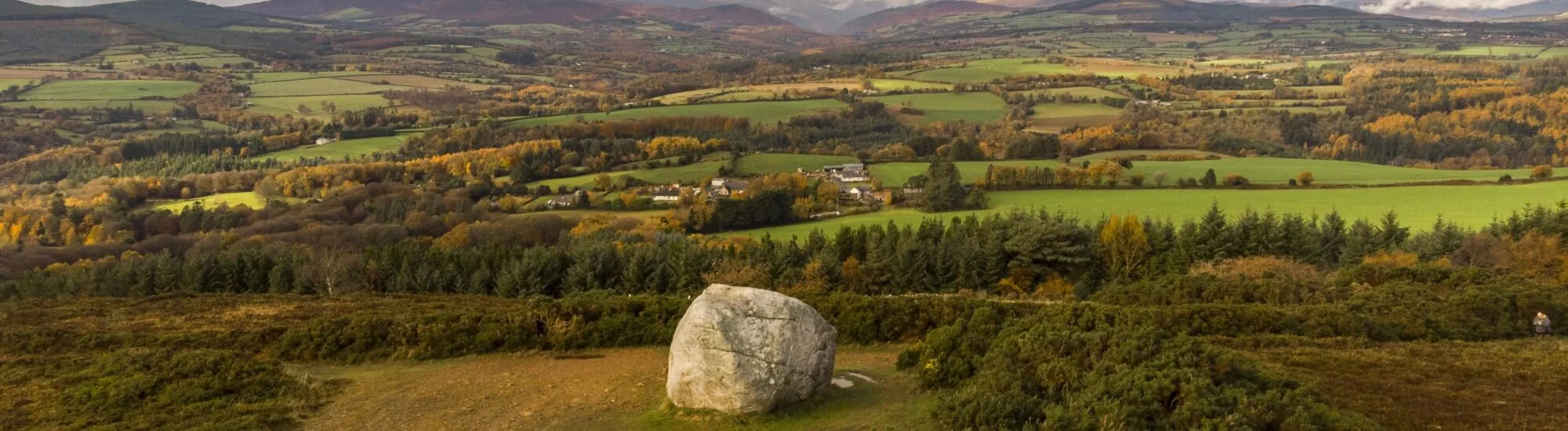
High above Cronebane, near Avoca in County Wicklow, the Mottee Stone looks as though it was placed there by a giant. This isolated block of granite commands the surrounding countryside, drawing visitors both for its striking form and the views from the hillside. It is a brief but worthwhile stop, combining geology, folklore and a chance to explore the landscape.
The stone owes its presence to glaciers. Local tales, however, prefer to credit Fionn Mac Cumhaill, hero of Irish mythology. They offer two ways of expressing the same sense of wonder: how could such an imposing rock have arrived here?
The Mottee Stone is a glacial erratic: a rock torn from its original setting, carried by ice and deposited as the glacier retreated. It is a visible reminder of the forces that shaped the Wicklow landscape during the last Ice Age.
Its granite differs from the rocks found in the surrounding area, particularly the schists associated with the Avoca mining district. This contrast helps explain its journey: the boulder did not simply result from erosion of the bedrock where it now lies.
The Mottee Stone is therefore neither a menhir erected by a prehistoric community nor a funerary monument. Its interest is above all geological. Take a moment to observe its shape and mass, then imagine the force required to carry such a rock across the landscape.
Folklore offers a more spectacular explanation. According to a local tale, Fionn Mac Cumhaill sent the stone from the summit of Lugnaquilla. In one version of the story, the hero uses it as a hurling ball, striking it all the way to the hill where it now stands.
Another legend tells that, every first of May, the rock goes down to drink at the Meeting of the Waters, the nearby confluence. These stories belong to the traditions associated with the site; they are not, of course, an explanation of its origins.
The link between an impressive natural phenomenon and the feats of a hero gives this curiosity its particular charm. On site, geology explains the stone’s journey; legend gives it a personality.
The site is in the Cronebane area, near Avoca and Conary. The access point is signposted from the road linking Avoca and Rathdrum, close to the Meeting of the Waters. A path then leads up to the rock on the hillside.
Access and parking are listed as free by the national tourism office. Nevertheless, follow any signs on site and avoid obstructing passageways or access to neighbouring land.
Allow around 30 to 45 minutes for an unhurried visit, including the approach, time to look at the stone and a pause to take in the view. This estimate depends on where you park and your pace. The site is better suited to a stop while exploring the Avoca area than to a full-day outing.
The rock’s position offers open views across the countryside and the Wicklow hills. Visibility makes all the difference: on a clear day, the view stretches far into the distance; beneath low cloud, the focus shifts more towards the stone and its immediate surroundings.
There is no need to turn the visit into a sporting challenge. Walk a few steps around the boulder to compare the views and see how it stands out against the landscape. A photograph taken from the ground will often show its scale better than one taken from its summit.
Metal rungs have been fixed into the rock to allow people to climb it. Their presence does not, however, guarantee their condition or the safety of the ascent. The summit is exposed and is not a protected platform: do not climb if the stone is wet, if it is windy or if you do not feel entirely comfortable. With children, it is best to explore it from the ground.
Wear shoes with good grip and bring a jacket for wind or rain. The ground can be wet, and the hillside is more exposed than the valley roads. To make the most of the panorama, choose a day with good visibility where possible.
Keep to the access path, respect any fences and leave no litter behind. If you are travelling with a dog, keep it under control, particularly around livestock.
You can combine a visit with a stop at the Meeting of the Waters or time in Avoca. Simply leave some flexibility in your itinerary: the Mottee Stone is best enjoyed as a small exploration, with time to take in the rock and the landscapes around it.
Expect to find a remarkable rock and a viewpoint, rather than a site with an exhibition or museum trail. Its appeal lies in the simplicity of the encounter: a mass of granite, a hill and the stories handed down around the place.
Want to extend your visit without having to rush around? Here are a few well-located places to stay near the must-see attractions.
Essential information to help you plan your visit, including key landmarks, access information, and booking options.
vers Cronebane, sur la route d'Avoca-Rathdrum, County Wicklow, Republic of Ireland, Tourist sites in Ireland
52.887047, -6.208170