

Overlooking a bend in the Boyne, Slane Castle cuts a silhouette that encapsulates several sides of Ireland. The estate has been an aristocratic residence, a witness to Anglo-Irish history, the scene of a devastating fire and, since the 1980s, one of Europe’s most celebrated rock venues. Behind its battlemented towers and grand reception rooms, the castle tells a far more eventful story than the valley’s tranquillity might suggest.
Slane Castle lies just minutes from the village of Slane in County Meath. The house occupies a commanding position at the heart of a vast estate that slopes down towards the Boyne. This setting is no accident: it places the castle centre stage in the landscape, with long views across meadows, woodland and the valley.
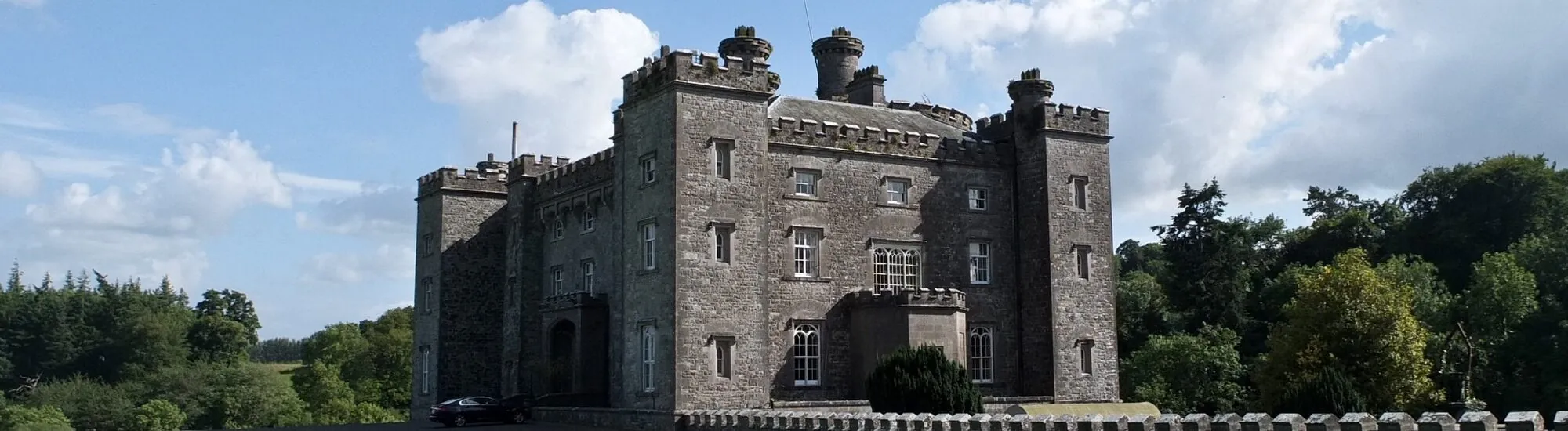
Despite its name and romantic appearance, Slane Castle is not a medieval fortress. The building seen today is largely the result of construction and remodelling carried out between the late 18th and early 19th centuries. Its architecture combines the proportions of a grand aristocratic house with Gothic Revival features: battlements, towers, tall windows and decorative details designed to impress visitors.
This distinction is important in understanding the site. Slane Castle is not visited as a defensive ruin, but as a still-inhabited historic home, shaped by the tastes, ambitions and trials of one family over several generations.
The Slane estate has been associated with the Conyngham family since the early 18th century. Construction of the present residence began a few decades later, at a time when Ireland’s great families were transforming their properties into homes capable of asserting their social standing and influence.
The architect James Gandon, whose Dublin works include the Custom House and the Four Courts, was involved in the design of the castle. Francis Johnston later contributed to its development. A major figure in Irish architecture, he helped accentuate its Gothic Revival character and adapt its reception rooms to the requirements of the 19th century.
The visit of King George IV in 1821 was one of the best-known episodes of this period. Alterations were made to receive the monarch, particularly in the state rooms. The grand Gothic ballroom still recalls that social ambition today, with a setting designed for receptions and ceremonies.
Slane Castle belongs to the generation of grand houses through which the complex history of the Anglo-Irish aristocracy can be explored. The castle bears witness to an old social system founded on landownership, as well as to the profound changes Ireland underwent during the 19th and 20th centuries.
The fact that the Conyngham family remains connected with the estate gives a particular character to a visit. The portraits, furniture and mementoes are not simply part of a museum reconstruction: they tell the story of the continuity of a family home that has had to find new purposes in order to survive. Receptions, accommodation, events and concerts now all contribute to that balance.
On 28 November 1991, a major fire devastated part of Slane Castle. The blaze, which began in a restaurant within the building, spread quickly and destroyed, in particular, the eastern section of the house. The damage was considerable: ceilings collapsed, rooms were gutted, decorative schemes were lost and the structure was weakened.
The disaster could have condemned the castle for good. Instead, it prompted a lengthy restoration project. The work required the building to be strengthened, some decorative features to be reinstated and spaces to be adapted for new uses without erasing their historic character. This rebirth is now an integral part of Slane Castle’s story.
Knowing this episode changes the way the interiors are seen. The castle is not merely an 18th-century legacy: it is also the result of a rescue effort undertaken at the end of the 20th century, with all the choices and compromises involved in a major restoration.
The guided tour passes through a selection of reception rooms and private spaces opened for the occasion. It offers an insight into the building’s evolution, portraits of the Conyngham family and several interiors restored after the fire. The Gothic Revival ballroom is among the most remarkable spaces, both for its proportions and for the role it continues to play during events held at the castle.
The appeal of the visit does not lie in an accumulation of precious objects. Rather, it lies in the way architecture, family memories and the estate’s key moments intertwine. Guides discuss George IV, the rebuilding work and the artists who have performed in front of the castle.
Slane Castle remains a living property. The spaces open to visitors may therefore vary according to receptions, stays and private events. This can sometimes limit the route, but it also prevents the impression of a house frozen in an artificially reconstructed era.
The castle truly comes to life when discovered with a guide. Family anecdotes, behind-the-scenes stories of the concerts and the account of the fire add a depth that observing the façades alone cannot convey. Exploring the grounds independently can be pleasant, but it is no substitute for access to the historic rooms.
The estate appeals equally to architecture enthusiasts and travellers drawn to contemporary history and music. This diversity is its great strength: one place provides an opportunity to explore the Irish aristocracy, the heritage of the Boyne Valley and several decades of popular culture.
Slane Castle’s international reputation rests largely on the concerts staged in its parkland. The ground slopes naturally towards the stage, forming a vast open-air amphitheatre. The castle rises in the background while the Boyne runs through the estate: few concert venues can match such a setting.
The first major concert took place in 1981, with Thin Lizzy headlining. The event laid the foundations for a tradition that would turn Slane into a place of pilgrimage for rock fans. At the largest editions, the estate can accommodate around 80,000 people—the equivalent of an entire town gathered in the castle’s meadows.
The list of artists who have appeared at Slane is staggering. U2, Queen, David Bowie, The Rolling Stones, Bruce Springsteen, Bob Dylan, Madonna, Oasis, Metallica, Guns N’ Roses and the Red Hot Chili Peppers have all, among others, played in front of the castle. Some editions have entered Ireland’s collective memory, to the point that Slane is now inseparable from the country’s musical history.
U2 has a particular connection with the site. The group performed there from the early 1980s and also used the castle when recording the album The Unforgettable Fire. This association has enhanced Slane’s aura for several generations of fans.
Concerts are not held on a fixed annual schedule. Each edition is an exceptional event, with logistics and access arrangements entirely different from those of an ordinary day. The rest of the time, the meadows return to their calm, and it becomes difficult to imagine the crowds that can fill them.
The historic buildings of the former stables and outbuildings now house the Slane Irish Whiskey Distillery. The project has given new purpose to part of the estate’s heritage while reconnecting with the valley’s agricultural history, where barley and the waters of the Boyne have an important place.
The distillery and the castle are, however, two distinct experiences. The former focuses on the making and ageing of whiskey; the latter explores the history of the family, the house and the concerts. Combining them can make for a coherent day out, but each visit has its own arrangements.
The proximity of the two sites illustrates the estate’s ability to evolve. Slane no longer rests on a single purpose: heritage, music, accommodation, agriculture and whiskey production coexist within an ensemble that continues to change.
The surroundings of the castle offer fine views of the Boyne and the parkland. Routes are occasionally available through the estate, including towards the Hermitage of St Erc and the remains of Carrickdexter Castle. Their accessibility depends on activity at the property and on events held there.
The landscape deserves as much attention as the building. The river, woodland and meadows explain the choice of this location and contribute to the castle’s staging. They also place Slane within a region where history can be read at every scale, from prehistoric monuments to the houses of the 18th and 19th centuries.
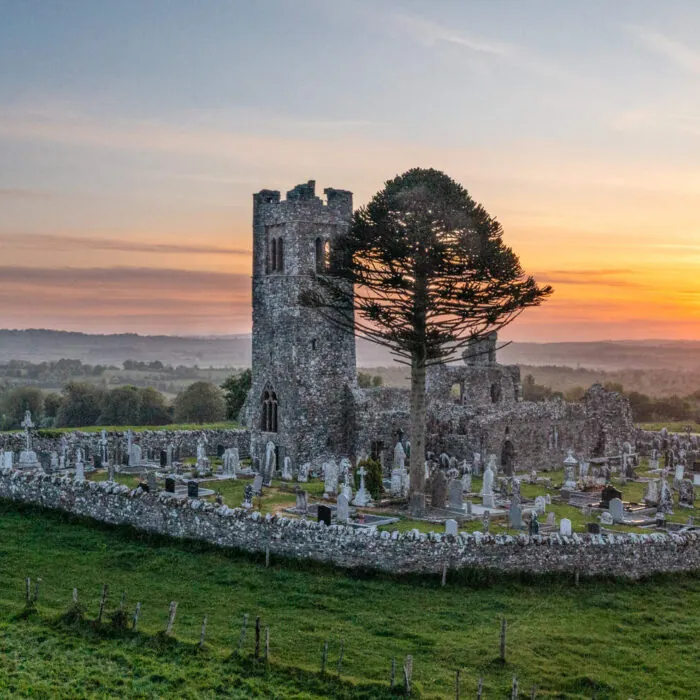
The village of Slane is close at hand. Its square, Georgian houses and the Hill of Slane offer further opportunities to explore. According to tradition, St Patrick lit an Easter fire on this hill in 433, symbolically defying the power of the High King at Tara. The story blends history and religious tradition, but the hill retains a major place in the Irish imagination.
Slane Castle can also form part of a day devoted to the Boyne Valley. The Neolithic monuments of Brú na Bóinne, including Newgrange and Knowth, rank among Europe’s most important archaeological sites. The castle provides a fascinating contrast with these prehistoric tombs: just a few kilometres are enough to travel across several millennia of history.
Allowing around two hours is reasonable for exploring the castle and its surroundings at a leisurely pace. A visit combining the castle and the distillery takes half a day. To add the village, the Hill of Slane or a Brú na Bóinne site, it is best to devote a full day to this part of County Meath.
The estate regularly hosts weddings, receptions and events. Access to certain areas may therefore change from one date to another. Planning ahead helps avoid arriving to find that the interior spaces are not open.
A car remains the most practical way to reach the estate and then continue on to other Boyne Valley sites. From Dublin, the journey heads north-west towards County Meath. Traffic can be heavier around the capital and during major events held at Slane.
The village is served by road connections, but public transport does not always offer the flexibility needed to combine several visits in a single day. On concert days, special arrangements replace the usual organisation: road closures, drop-off areas and shuttle services may be imposed.
The castle states that there is lift access to the floors open to visitors, as well as toilets on the lower level. Arrangements may nevertheless vary according to the spaces included on the tour and the nature of the event under way. Visitors with specific needs are advised to mention them before their visit.
Dogs are permitted in certain outdoor areas, including the courtyard, but not inside the castle. On the estate, they must be kept under control out of respect for other visitors, wildlife and farming activities.
Ultimately, Slane Castle deserves far more than a stop in front of its façade. The house reveals itself through contrasts: aristocratic splendour and the scars of fire, the quiet of the Boyne and memories of enormous concerts, historic architecture and a contemporary distillery. It is precisely this ability to bring together such different stories that makes a visit memorable.
Want to extend your visit without having to rush around? Here are a few well-located places to stay near the must-see attractions.
Essential information to help you plan your visit, including key landmarks, access information, and booking options.
53.709615, -6.561432
private property
Check the opening hours and admission requirements before you leave, especially during peak season or on Irish public holidays.