On the banks of the Boyne, Trim Castle cuts a silhouette that eight centuries have done little to soften: a massive keep, walls pierced by narrow openings and an outer enclosure that still seems to hold the town under its protection. In the centre of Trim, this County Meath fortress tells the story of the establishment of Anglo-Norman power in Ireland. Its significance extends far beyond its appearance in Braveheart: its architecture reveals how a territory was defended, administered and used to display authority.
Before you travel: according to Heritage Ireland, the castle is closed for works from 1 November 2026 to 1 April 2027. Interior visits will therefore not be available during this period; do not assume that the castle grounds will be open either. Find further details in our article on the temporary closure of Trim Castle and its implications for travellers.
The castle’s history begins in the 1170s, shortly after the Anglo-Normans arrived in Ireland. In 1172, Henry II of England granted the territory of Meath to Hugh de Lacy. He chose Trim as the centre of his lordship. The crossing over the Boyne gave the site strategic importance: controlling the crossing also meant monitoring movement and trade.
A first timber fortification preceded the stone castle. Attacked and destroyed in 1174 by the forces of Ruaidhrí Ua Conchobair, it was replaced with a more durable structure. Work on the keep began around 1175–1176. Hugh de Lacy, followed by his son Walter, contributed to the construction and alteration of the complex, most of which took shape between the late 12th and early 13th centuries.
Trim Castle was not merely a military refuge. It embodied the hold of a new elite over the territory. For its occupants, the walls offered security and prestige; for the people subject to this authority, they also expressed the power of conquest.
The castle subsequently passed through the hands of several influential families, including the de Genevilles and the Mortimers. Geoffrey de Geneville had a great hall built near the keep, a reminder that life on the estate was not limited to defence: receiving guests, governing and displaying one’s status were all among the site’s functions.
By the end of the Middle Ages, Trim remained a stronghold on the edge of the territory controlled by English power around Dublin. Its role changed, some buildings fell into disrepair and the castle gradually lost its original purpose. The surviving remains nevertheless reveal much of its medieval layout.
The centrepiece of Trim Castle is its three-storey keep, built on a cruciform plan. Projections extend from a central core, giving the building its twenty-sided profile. This unusual shape immediately sets Trim apart from simpler rectangular towers.
To appreciate its scale, look at the relationship between the height of the walls, the openings and the thickness of the masonry. The building was designed to accommodate domestic and administrative activities while protecting its occupants. It should therefore be imagined as an inhabited space, divided into rooms and fitted with floors, rather than as the great stone shell visible today.
Around the keep, curtain walls, towers and fortified entrances formed a second line of defence. Ditches and moats completed the system. The interior also housed the buildings needed for the running of the lordly residence.
When exploring the site after it reopens, begin by taking in the whole before focusing on the details. The distances between the gates, the keep and the other remains help explain how people moved around the site. Interpretation panels then make it possible to picture the vanished buildings.
The information below describes the castle’s usual operation, outside periods of closure for works. The grounds can be explored with the help of interpretation panels, while access to the keep is by guided tour. Modern walkways inside allow visitors to observe the spaces and masonry from several levels.
The ascent offers another way of reading the monument: it gives a better sense of the height of the spaces, the layout of the former rooms and the relationship between the castle and its surroundings. To plan your day, allow one to two hours on site as a precaution, including any possible waiting time. This is a planning allowance, not an official visit duration.
During busy periods, the OPW warns that access may be limited and is not guaranteed. Arriving early in the day is therefore preferable. Actual arrangements should be checked again on the official Trim Castle website as the reopening approaches.
The keep has steep, narrow staircases. Its interior route is not wheelchair accessible, and the OPW also notes that movement around the grounds may be limited. If you have mobility difficulties, contact the team before planning a visit: contemporary adaptations do not remove the constraints of the medieval structure.
Wear sturdy shoes and bring clothing for rain and wind. If visiting with young children, bear in mind the stairs and elevated spaces. The visual guide offered by Heritage Ireland can help visitors who wish to know what to expect along the route in advance.
The castle was used as a filming location for Braveheart, directed by Mel Gibson and released in 1995. The site was used to depict various medieval Scottish and English locations. Cinema has therefore added a new identity to a fortress whose real history is deeply tied to Meath.
This connection is an enjoyable introduction for film enthusiasts, but the castle is also worth seeing in its own right. On site, distinguish between the film set and the historic remains: they tell neither the same story nor that of the same territory.
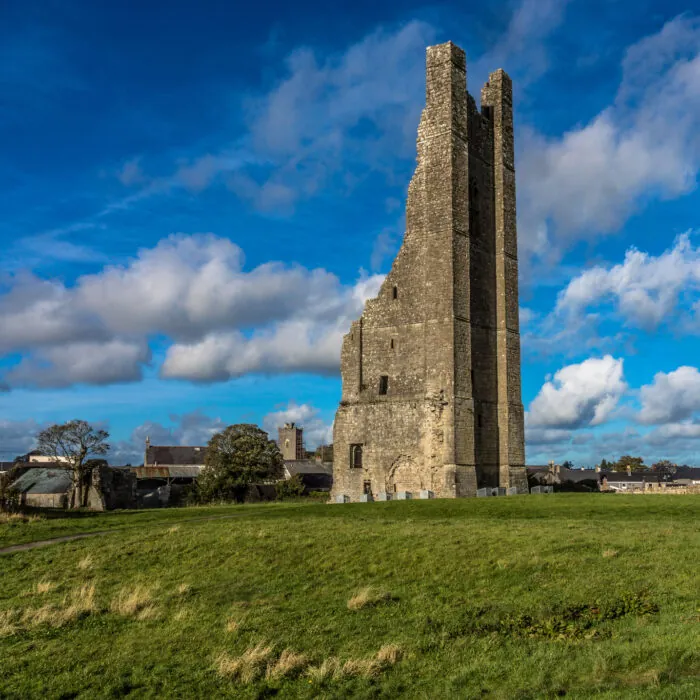
The closure of Trim Castle does not affect the whole town. The Trim Historic Trail offers a way to discover its heritage through its streets and several monuments. Landmarks include the Yellow Steeple, the tower of the former St Mary’s Abbey, and the Sheep Gate, a surviving gateway from the town’s fortifications.
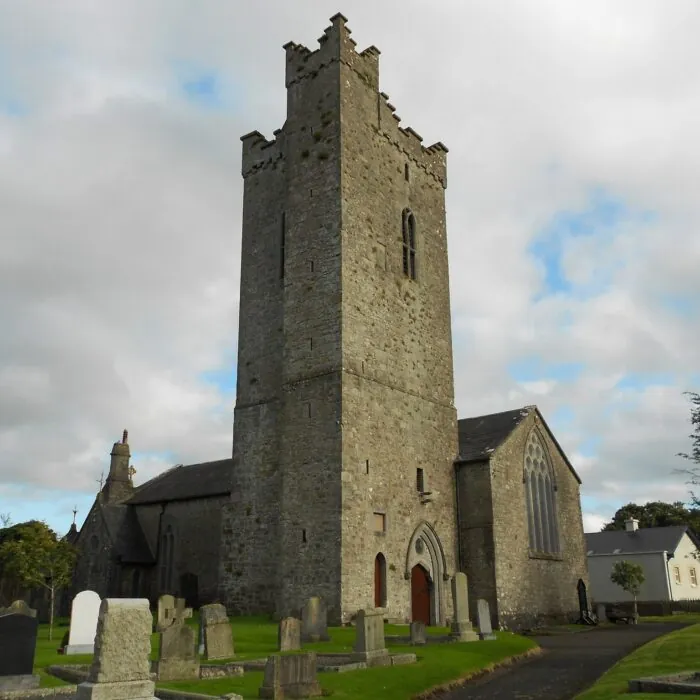
The Newtown Trim area contains other remains, including those of the medieval Cathedral of St Peter and St Paul. To plan your walk, consult the local trail and any restrictions in place that day. During the works, opportunities to view the castle depend on which access points remain open: do not go around barriers to reach a viewpoint.
The castle is on Castle Street, in central Trim, C15 HN90. If travelling by car, use the town’s authorised parking spaces. For public transport, search for your journey on your chosen date through Transport for Ireland, taking account of the return journey and any connections.
If booking a trip from Dublin, ask what the “Trim Castle” stop includes: a visit to the keep, entry to the grounds or simply a stop in town. This check is essential during the temporary closure.
To extend your exploration of Meath, the Hill of Tara offers another perspective on Irish heritage. However, avoid packing in too many stops without checking their access conditions: in winter, shorter days call for a more flexible itinerary.
Want to extend your visit without having to rush around? Here are a few well-located places to stay near the must-see attractions.
Essential information to help you plan your visit, including key landmarks, access information, and booking options.
Castle St, Trim, County Meath, Republic of Ireland, Tourist sites in Ireland
53.554412, -6.789400
Temporarily closed for works from 1 November 2026 to 1 April 2027. This official notice takes precedence over the usual seasonal opening hours. Do not plan a visit to the keep or access to the grounds during this period without explicit confirmation from the OPW.
The resumption of visits and the opening hours applicable in spring 2027 should be checked with Heritage Ireland before you travel.
Check the opening hours and admission requirements before you leave, especially during peak season or on Irish public holidays.
The site is currently closed for works. The prices below are those listed by Heritage Ireland on 3 November 2026 and do not permit visits to the castle during the closure.
Guided tour of the keep: adult €5; senior or group €4; child or student €3; family €13. Access to the grounds is normally free outside closure periods.
This information does not confirm prices or visiting arrangements when the site reopens in 2027. Check with the OPW before your visit.