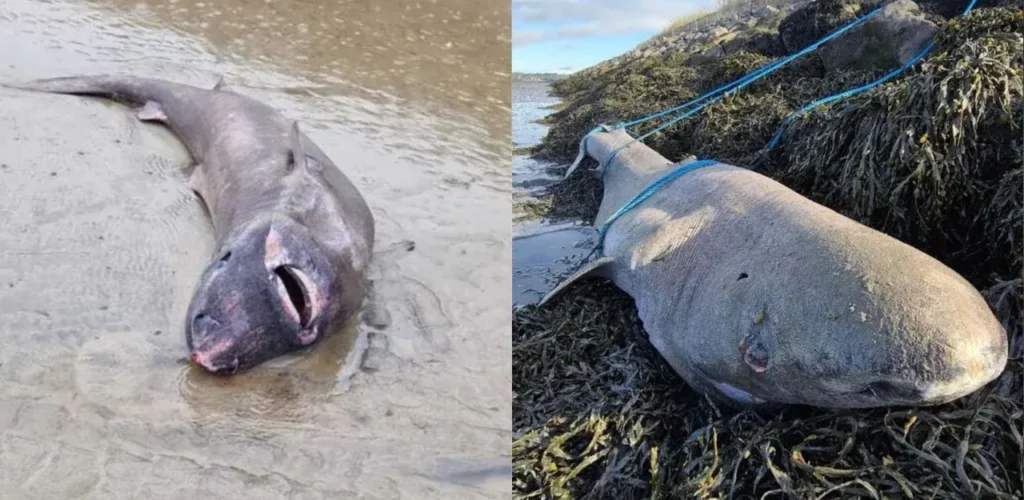
This discovery has even surprised the scientific community. A Greenland shark, one of the most mysterious species in the world, was found stranded on a beach in County Sligo, in the northwest of Ireland. This event is exceptional: it is the first officially recorded stranding of this species on Irish shores.
The Greenland shark (Somniosus microcephalus) has fascinated biologists for decades. Living in the icy depths of the North Atlantic and Arctic Ocean, it is almost impossible to observe in its natural habitat. Its extraordinary longevity, which can exceed 400 years and reach around 500 years according to some scientific estimates, makes it the oldest known vertebrate on Earth.
The discovery made in Sligo thus opens a rare window for studying a still largely unknown species.
An Exceptional Discovery on Ireland’s West Coast
The First Documented Stranding in the Country
The shark was found on the Finisklin coastline in County Sligo by two walkers who initially thought it was a basking shark, a species much more common in Irish waters.
After examining photographs, specialists from the Irish Whale and Dolphin Group quickly identified it as a Greenland shark, an extremely rare species in this part of Europe.
The news immediately mobilized several Irish organizations. The National Museum of Ireland, Sligo County Council, veterinary services, and the Department of Agriculture organized a major operation to recover the animal before the tides could carry it away.
The specimen, about three meters long, was then transported to the museum’s laboratories where it is now undergoing in-depth analysis.
The Oldest Known Vertebrate on Earth
An Animal That Defies Time
What makes the Greenland shark so fascinating is primarily its incredible lifespan. Unlike most large sharks, which live a few decades, this species operates on a completely different timescale.
Researchers estimate that some individuals live over four centuries. The oldest specimens studied may have even lived more than five hundred years. In other words, some Greenland sharks were already swimming in the oceans when Christopher Columbus crossed the Atlantic.
This exceptional longevity is largely explained by an extremely slow metabolism, adapted to the very cold waters of the Arctic.
Why a Three-Meter Shark Can Still Be Considered “Young”
One of the Slowest Growth Rates in the Animal Kingdom
The shark found in Ireland measured nearly three meters. An impressive size, but it does not necessarily mean it was particularly old.
Scientists estimate it could have been around 150 years old. This seems enormous on a human scale, yet this individual would have been only near sexual maturity.
In this species, males and females generally start reproducing only around 150 years of age. Their growth is so slow that they gain only a few millimeters to about one centimeter per year.
This life strategy makes the species particularly vulnerable: when an individual disappears, it takes several human generations before it can be replaced.
How Do Scientists Determine Its Age?
The Secret Lies in Its Eyes
Determining the age of a fish is often relatively simple thanks to structures found in its bones or fins. For the Greenland shark, the method is completely different.
Researchers analyze the eye lens, a tissue formed before birth that hardly ever renews. Using carbon-14 dating, it is possible to estimate the animal’s age with enough precision to reconstruct its history.
This technique has revolutionized knowledge about the species and confirmed that the Greenland shark probably holds the world record for longevity among vertebrates.
An Almost Invisible Deep-Sea Dweller
Why Is It So Rarely Seen?
The Greenland shark usually lives between several hundred and over two thousand meters deep, in waters where the temperature remains close to zero degrees Celsius.
It moves slowly, often at less than two kilometers per hour, which has sometimes earned it the title of the slowest shark in the world.
Despite this apparent slowness, it can catch surprisingly fast prey. Studies have shown it feeds on fish, squid, marine mammal carcasses, and even seals, probably caught while sleeping.
Its discreet lifestyle explains why sightings remain exceptional, even in regions where it naturally occurs.
Why Did This Shark Strand in Ireland?
A Question That Puzzles Researchers
At this stage, scientists do not know exactly why this animal ended up on a beach in County Sligo.
Several hypotheses are considered: illness, injury, disorientation, or weakening related to age.
The autopsy conducted by the National Museum of Ireland should help better understand the circumstances of its death. Researchers also hope to gather information about its diet, health status, genetic heritage, and any pollutants present in its body.
Each specimen of this species represents an exceptional scientific opportunity given how rare observations are.
An Important Discovery for Irish Biodiversity
A New Chapter for Marine Research
This discovery is not just a spectacular news item. It also enriches knowledge about Ireland’s marine wildlife.
The National Biodiversity Data Centre had not previously recorded any confirmed Greenland shark strandings on the country’s coasts. This specimen thus becomes a major scientific reference for years to come.
Tissue samples will be preserved to allow future research, while the museum hopes to one day exhibit this shark to the public.
Can You Encounter Sharks in Ireland?
Yes, But Not This One
Ireland is home to more than forty shark species, but most live offshore or in deep waters.
The best known is the basking shark, the second largest fish in the world after the whale shark. Harmless to humans, it regularly feeds on plankton off the coasts of Donegal, Kerry, Clare, and Cork between spring and autumn.
The Greenland shark, however, remains almost invisible. Its presence in the deep waters of the North Atlantic explains why encounters are exceptionally rare.
A Species Still Full of Mysteries
A Silent Giant of the Oceans
Many aspects of the Greenland shark remain unknown. Scientists do not yet know the exact size of its population, its seasonal movements, or the effects of climate change on its habitat.
The stranding observed in County Sligo is therefore much more than a curiosity. It offers a unique opportunity to improve knowledge about a species that was already living in the oceans long before many modern states were born.
For Ireland, this discovery also highlights the extraordinary richness of the waters surrounding the island. Behind the cliffs, beaches, and wild landscapes lies a largely unexplored marine world, where some creatures seem to belong to another era.