A French violin dating from the early 19th century and originating from the family of the Irish poet William Butler Yeats is about to go under the hammer. More than just a musical instrument, this rare piece brings together the history of French violin making and that of one of Ireland’s most influential artistic families.
Estimated between £6,000 and £8,000, the violin will be auctioned on July 16, 2026, by the British auction house Dominic Winter Auctioneers. Its prestigious provenance is expected to attract both collectors of antique instruments and enthusiasts of Irish literature and culture.
A Violin from the W. B. Yeats Family Soon at Auction
An Instrument from a Private Irish Collection
The violin belonged to the collection kept at Cliff House, Dalkey, County Dublin. This residence was home to Michael Yeats, son of W. B. Yeats, and his wife Gráinne Yeats.
Michael Yeats, born in 1921 and deceased in 2007, notably had a political career as a member of Seanad Éireann, the upper house of the Irish Parliament. Gráinne Yeats, born in 1925 and passed away in 2013, was a renowned harpist deeply committed to preserving traditional Irish music.
The instrument was acquired in November 2017 during a sale dedicated to the Yeats family collection, held in Kilkenny by Fonsie Mealy Auctioneers. It then joined a private collection, where it remained for nearly a decade before reappearing on the market.
A Rare Mirecourt Violin Made in the Early 19th Century
An Instrument Attributed to the Era of Didier Nicolas the Elder
The violin is presented as a full-size French instrument made in Mirecourt, a small town in the Vosges regarded as one of the main cradles of French violin making.
It bears the stamp “A la Ville de Cremonne / Nicolas Aîné.” According to experts at Chapel Violins, its manufacture dates back to the years 1810 to 1820. This period corresponds to the activity of Didier Nicolas the Elder, a French luthier born in 1757 and died in 1833.
Didier Nicolas the Elder was a leading figure of the Mirecourt school. His workshop produced many instruments inspired by the great Italian masters, intended for both professional musicians and wealthy amateurs.
A Design Inspired by Stradivari Violins
Carefully Selected Materials
The violin linked to the Yeats family was crafted following a model inspired by the instruments of Antonio Stradivari. Its back is made from a single piece of highly figured maple, a wood prized for its acoustic qualities and striking appearance.
The ribs and scroll feature similar maple, while the soundboard is crafted from a single piece of evenly grained spruce. The instrument also stands out for its finely carved f-holes, carefully worked edges, and varnish with golden and honeyed hues.
Several construction details recall the Italian tradition of Cremona, notably the presence of a lower rib made from a single piece. These features testify to the craftsmanship developed by the French workshops of Mirecourt in the early 19th century.
Is the W. B. Yeats Violin Authentic?
Established Family Provenance but Some Uncertainties
It would be an overstatement to present this instrument as W. B. Yeats’s personal violin. Available documents trace its provenance to the collection of his son Michael Yeats and daughter-in-law Gráinne Yeats, but there is no evidence that the poet himself owned or used it.
W. B. Yeats was not known for musical talents. The poet reportedly had little musical ability, and no historical record confirms he played the violin.
Nevertheless, the instrument may have been part of the Nobel laureate’s family environment. It remains associated with the Yeats family history, even if a direct link to William Butler Yeats cannot be definitively established.
The Yeats Family: An Irish Artistic Dynasty
Much More Than the Legacy of a Great Poet
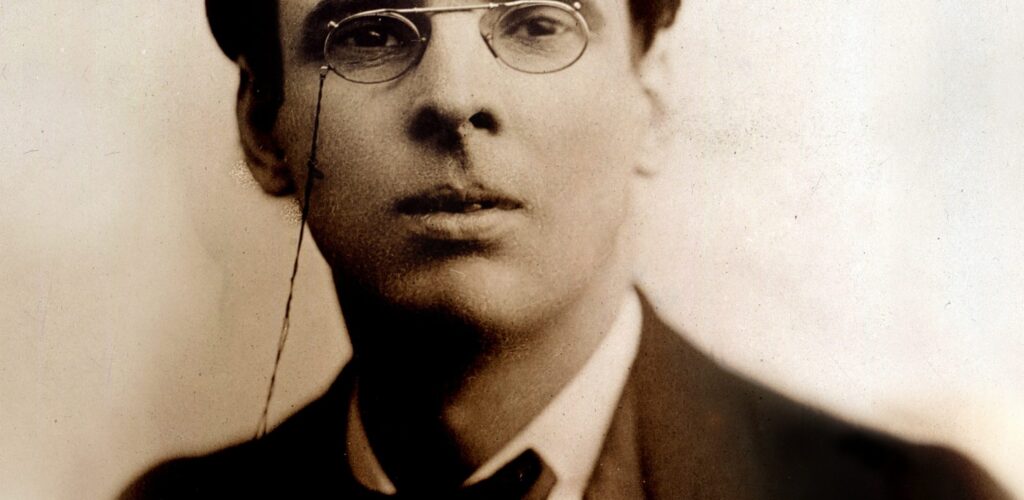
The Yeats family holds an exceptional place in Ireland’s cultural history. William Butler Yeats, born in Dublin in 1865, is considered one of the greatest English-language poets of the 20th century.
A figure of the Irish literary revival, he also helped found Dublin’s Abbey Theatre. He received the Nobel Prize in Literature in 1923 for a body of work deeply marked by Irish mythology, Celtic folklore, spirituality, and the political upheavals of his time.
His brother, Jack B. Yeats, was one of the most famous Irish painters of the 20th century. Their father, John Butler Yeats, was also a painter and portraitist. The poet’s wife, Georgie Hyde-Lees, played an important role in his literary and esoteric work.
This family thus spans several generations of poets, painters, illustrators, musicians, and publishers. The Yeats provenance gives the violin a cultural dimension far beyond its instrumental value.
An Antique Instrument Still Playable
Several Restorations Over Its History
Like many violins over two centuries old, the instrument has undergone several restorations. It notably features a neck graft, an ebony fingerboard, and repairs aimed at reinforcing the edges of its soundboard.
These repairs are common for a violin of this age. They help extend its lifespan while preserving as much as possible its sound qualities and original elements.
According to information provided before the sale, the violin remains fully playable. It has been professionally set up and could be acquired by either a collector or a musician wishing to play a historic instrument.
Estimated Between £6,000 and £8,000
Lot 479 at the Dominic Winter Auction
The violin will be presented as lot 479 during the “Historic Textiles, Antiques & Violins” sale on July 16, 2026, by Dominic Winter Auctioneers in South Cerney, Gloucestershire.
Its estimate is set between £6,000 and £8,000, approximately €7,000 to €9,300 depending on the exchange rate at the time of sale.
The final price could exceed this range. The value of an antique instrument depends on many factors, including its condition, acoustic qualities, attribution, rarity, and ownership history.
In this case, the provenance linked to the Yeats family is an additional argument likely to encourage bidding.
Where Irish Literature Meets Music
An Object at the Crossroads of Several European Heritages
This violin tells a story that crosses Ireland’s borders. Made in a major French violin-making center, inspired by Italian Cremonese methods, and preserved by a famous Irish family, it brings together several European artistic traditions.
It also illustrates how everyday objects can become precious witnesses to history. Without necessarily having belonged directly to W. B. Yeats, the instrument shared the intimacy of a family that profoundly influenced poetry, painting, publishing, and music in Ireland.
For admirers of W. B. Yeats, this sale offers a new opportunity to explore the writer’s personal and family world. For musicians, it presents a fine example of early 19th-century Mirecourt craftsmanship.
Following in W. B. Yeats’s Footsteps in Ireland
From Dublin to County Sligo
Travelers wishing to deepen their knowledge of W. B. Yeats’s history can visit several sites associated with the poet during a trip to Ireland.
In Dublin, the Abbey Theatre recalls his major role in the Irish theatrical revival. The National Library of Ireland also holds important archives dedicated to his life and work.
County Sligo remains the area most intimately linked to his imagination. The landscapes of Benbulben, Lough Gill, and Glencar inspired several of his poems. W. B. Yeats is buried at Drumcliffe, at the foot of Benbulben mountain, in a setting that has become a true literary pilgrimage site.
The sale of this violin reminds us that Yeats’s legacy extends beyond books. It is also found in houses, landscapes, artworks, and family objects that continue to tell one of the greatest cultural stories of modern Ireland.