At the Giant’s Causeway, visitors are no longer just invited to admire the landscape. They are now called upon to help protect it. Faced with the growing number of visitors to this iconic Northern Ireland site, the National Trust is focusing on education rather than restrictions. This strategy aims to preserve the famous basalt columns, which have become fragile due to certain tourist behaviors.
A UNESCO World Heritage Site, the Giant’s Causeway attracts several hundred thousand visitors each year along the Antrim coast. This popularity offers a fantastic showcase for Northern Ireland but also puts constant pressure on this volcanic landscape that is tens of millions of years old.
Giant’s Causeway Facing the Impact of Overtourism
A Natural Site Victim of Its Own Success
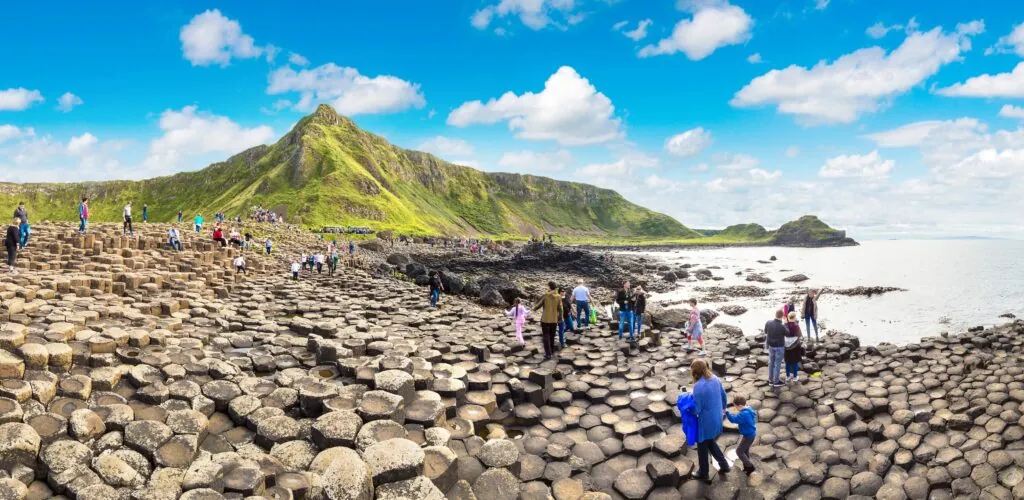
Just a few minutes on site reveals its magnetic appeal. At the foot of the Antrim cliffs, nearly 40,000 basalt columns appear to form a stone staircase stretching out towards the Atlantic Ocean.
Visitors climb on the blocks, photograph the most spectacular formations, and get as close as possible to the sea. During peak times, the same areas can be occupied simultaneously by hundreds of people.
In 2024, the Giant’s Causeway welcomed around 648,000 visitors. Before the pandemic, the site even surpassed one million annual entries recorded by its visitor center.
This tourist concentration causes gradual wear on pathways, increased pressure on natural habitats, and a rise in inappropriate behaviors. The issue is not just the number of visitors but also how each person behaves once on site.
Visitors Invited to Protect the Giant’s Causeway
The National Trust Prioritizes Education
To address this pressure, the Giant’s Causeway managers have chosen to focus on raising awareness. The goal is not to turn the landscape into an inaccessible museum or prevent the public from approaching the columns but to remind everyone that this spectacular setting remains a vulnerable natural environment.
Teams on site engage directly with tourists, explaining the geological formation of the site and detailing the consequences of seemingly harmless actions.
Volunteers and visitors can also take part in preservation activities. Collecting litter, monitoring erosion, maintaining certain areas, and reporting damage allow the public to become active participants in conservation.
This approach is based on a simple idea: a visitor who understands a site’s value and fragility is generally more likely to respect it.
Coins That Cause Basalt to Crack
A Tourist Tradition Turned Dangerous
Among the most concerning behaviors is the habit of wedging coins into the cracks of basalt columns. Some tourists place them as good luck charms or symbolic souvenirs of their visit.
The gesture seems harmless, but its consequences are far from it.
Exposed to moisture, salty sea spray, and a mix of metals, the coins corrode. As they rust, they can expand to several times their original thickness. The pressure inside the cracks eventually weakens and causes the rock to split.
Copper, nickel, and iron also leave colored stains on the columns. These streaks alter the natural appearance of the basalt and require delicate intervention by conservation specialists.
An initial experimental operation removed coins from about ten areas. A full cleanup of the site could cost around £30,000, nearly €35,000.
Managers therefore ask travelers to keep their coins in their pockets and follow a now central principle in natural areas: leave no trace of your visit.
A Volcanic Landscape About 60 Million Years Old
How Was the Giant’s Causeway Formed?
The columns of the Giant’s Causeway formed following intense volcanic activity about 60 million years ago, during the opening of the North Atlantic Ocean.
Lava flows covered part of the Antrim plateau. As the basalt cooled, it contracted and cracked. This process produced thousands of interlocking columns, mostly hexagonal, although some have four, five, seven, or eight sides.
Recent scientific studies have placed the formation of the Giant’s Causeway within a much larger volcanic event. Northern Ireland’s rocks are linked to the same geological activity period as formations found in Scotland, the Faroe Islands, and even Greenland.
The site therefore holds significance far beyond its tourist appeal. It serves as a natural archive helping scientists better understand the geological history of the North Atlantic.
A UNESCO World Heritage Site Since 1986
Forty Years of International Recognition
The Giant’s Causeway and its surrounding coast were inscribed as a UNESCO World Heritage Site in 1986. The designation recognizes both the spectacular beauty of the landscape and its exceptional value for studying volcanic phenomena.
The site is mainly managed by the National Trust, which oversees the protection of the coastline, geological formations, and natural habitats. The area is home to various seabird species and flora adapted to cliffs exposed to Atlantic winds.
Conservation thus concerns not only the columns photographed by visitors but also the cliffs, coastal meadows, trails, and the entire surrounding ecosystem.
Distributing Visitors Rather Than Closing the Site
Booking Helps Reduce Peak Crowds
The National Trust now encourages visitors to book their visit through the visitor center. This system allows teams to anticipate arrivals and better spread visitor numbers throughout the day.
Access to the natural landscape remains free. Tickets mainly cover the visitor center experience, parking, exhibitions, audio guides, and some on-site services.
Booking is therefore not just about managing site revenue. It is also a tool to limit excessive crowding at certain times and improve visiting conditions.
To enjoy the Giant’s Causeway in a calmer atmosphere, it’s best to arrive early in the morning or late afternoon. Visiting outside the high season also offers a more peaceful experience, provided you dress appropriately for wind and rapidly changing weather.
How to Visit the Giant’s Causeway Without Damaging It?
Simple Actions for More Responsible Tourism
Preserving the site doesn’t mean giving up walking on the columns when conditions allow. It mainly relies on following guidelines and taking basic precautions.
It’s essential not to wedge anything in the cracks, not to remove any stones, and to take your litter with you. Visitors should also avoid leaving paths in sensitive areas or disturbing birds nesting on the cliffs.
Shoes with good grip are highly recommended. Basalt can become extremely slippery when wet, and some waves quickly reach the first columns.
Choosing public transport, carpooling, or including the visit as part of a broader itinerary along the Causeway Coastal Route also helps reduce travel impact.