


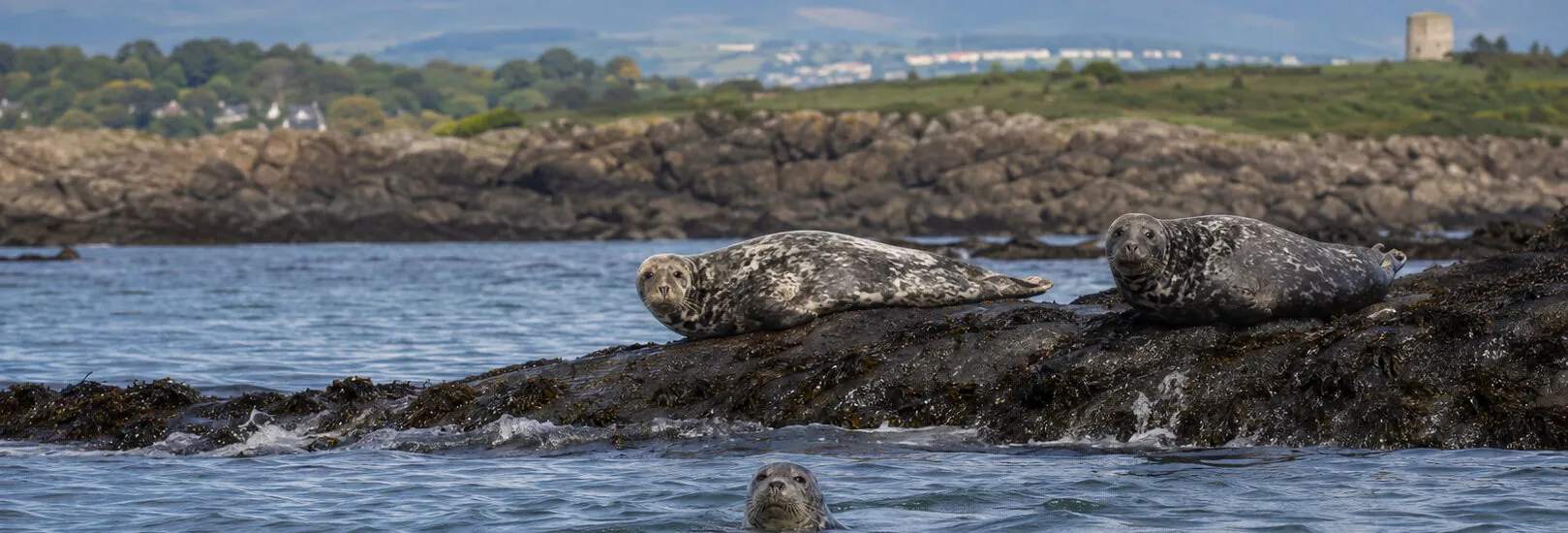
Just a few kilometres from Dublin city centre, the urban landscape gives way to a bay opening onto the Irish Sea. Around Howth, Dalkey Island and the rocky islets along the coast, you may spot seals swimming among the boats or resting out of the water. It is a wild and sometimes unexpected encounter, accessible from the shore or on a trip out to sea.
Sightings are never guaranteed: seals are free-ranging animals whose movements depend on the tides, weather and availability of food. Choosing a suitable viewing spot and keeping a sufficient distance will nevertheless allow you to enjoy the experience without disturbing these protected marine mammals.
Dublin Bay has several areas frequented by seals. In the north, the harbour at Howth is the easiest place to try spotting them from land. Individuals regularly appear among the fishing boats or near the quays. Their presence is unpredictable, but a walk around the harbour can bring some lovely surprises.
Never lure seals with fish. Doing so alters their feeding habits, accustoms them to approaching people and can lead to dangerous interactions with boats. The best approach is simply to watch the water naturally, using binoculars and without trying to entice them closer.
To the south of the bay, Dalkey Island is known for its grey seals. This small uninhabited island, off the coast of Dalkey, has rocks and quiet areas where the animals can haul out to rest. Seals are generally seen from a boat or on a guided kayaking excursion.
Sightings are also possible around Ireland’s Eye, off Howth, as well as from certain stretches of coastline. A walk along the Great South Wall may offer a glimpse of a seal in the water, though the distance and sea conditions make binoculars particularly useful.
Two species live along the Irish coast: the grey seal and the harbour seal, also known as the common seal. The grey seal is the species most often associated with the colonies seen around Dalkey Island.
Grey seals generally have an elongated head and an almost straight muzzle, sometimes compared to a horse’s profile. Adult males can become particularly imposing and have a dark coat marked with lighter spots. Females often have a lighter grey coat covered in dark spots.
The harbour seal has a rounder head, large eyes and nostrils that form an approximate ‘V’ shape. Despite its name, it is not necessarily the easiest species to identify during a brief sighting. When a seal is swimming, often only its head rises above the surface, making identification difficult.
Howth offers the most accessible opportunity to watch seals without booking an excursion. The village is easy to reach from Dublin, and its harbour can be explored on foot. Sometimes all it takes is waiting near the basins, while keeping back from the edge and without throwing food into the water.
Seals may appear close to the boats, then disappear beneath the surface almost immediately. Their ability to remain underwater and move silently calls for a little patience. Binoculars also allow you to watch more distant rocks without trying to get closer.
The Howth Cliff Walk offers a remarkable view over Ireland’s Eye and the bay. It does not guarantee better seal sightings, as the animals are often too far away when viewed from the heights, but it broadens the experience to include seabirds and the coastal scenery.
A cruise allows you to explore a larger stretch of the bay and get closer to the rocky areas frequented by wildlife, while keeping a respectful distance. Some routes connect Dublin, Dún Laoghaire and Howth, passing near Dalkey Island, Howth Head or Ireland’s Eye.
Panoramic crossings generally last around 75 minutes, though schedules, routes and fares vary according to the season and weather conditions. Seals may be seen around Dalkey Island or in the water, but operators cannot guarantee their presence.
The trip also offers views of lighthouses, Martello towers, the Poolbeg chimneys and the varied contours of the Dublin coast. Several species of seabird frequent the bay and, with a great deal of luck, porpoises or dolphins may also be reported.
Sea kayaking offers a quieter, more immersive approach. Guided outings are organised along the Dalkey coast and around the island when weather conditions allow. From the water, the rocky landscape, birds and seals reveal themselves from an entirely different perspective.
This activity must only be undertaken without pursuing the animals or deliberately trying to close the distance. A curious seal may approach of its own accord, but kayakers should remain calm, avoid sudden movements and leave the animal a clear route away.
Conditions on the bay can change quickly. For visitors unfamiliar with the area, an outing supervised by a professional is the safest option. Equipment, buoyancy aids and safety instructions are generally included, but services should be checked when booking.
Seals frequent Dublin Bay throughout the year. However, there is no time of day or season that guarantees their presence. Sightings depend on the tidal cycle, sea conditions, fish movements and levels of human activity.
Low tide can make seals easier to spot when they use exposed rocks to rest. Relatively calm water also improves the chances of seeing a head or silhouette at the surface. Soft light in the morning or late in the day makes for more pleasant viewing, but these times are not an absolute biological rule.
The pupping, breeding and moulting periods require extra vigilance. A seal lying on a beach or rock is not necessarily ill: it may simply be resting. Never try to push it back into the water.
Seal Rescue Ireland recommends keeping at least 100 metres away from a wild seal. This precaution protects the animal from stress and reduces the risk of a bite. Seals may appear peaceful, but they have powerful jaws and can defend themselves when they feel threatened.
Never touch, feed or surround a seal. Dogs must be kept on a lead and away from animals on the shore. Using a zoom lens or binoculars gives you a better view without moving any closer.
A change in posture, an attempt to escape towards the water, repeated vocalisations or sudden agitation indicate that the animal feels disturbed. In this case, move back immediately. Boats and kayaks should slow down, avoid cutting across a seal’s path and never separate a pup from its mother.
Full guidance on how to respond when encountering a wild seal, or report an animal that may be in difficulty, is available from Seal Rescue Ireland.
Main areas: Howth Harbour, Dalkey Island, Ireland’s Eye and Dublin Bay sea routes.
When to go: sightings are possible all year round, but are not guaranteed.
Watching from the shore: free.
Boat trips: schedules and fares vary according to the operator, season and route.
Kayaking trips: booking recommended; activity dependent on weather and sea conditions.
Recommended equipment: binoculars, a waterproof jacket, warm clothing and suitable footwear.
Recommended distance: at least 100 metres when a seal is resting on the shore or rocks.
Accessibility: Howth and Dalkey are served by the DART from Dublin city centre.
Want to extend your visit without having to rush around? Here are a few well-located places to stay near the must-see attractions.
Essential information to help you plan your visit, including key landmarks, access information, and booking options.