
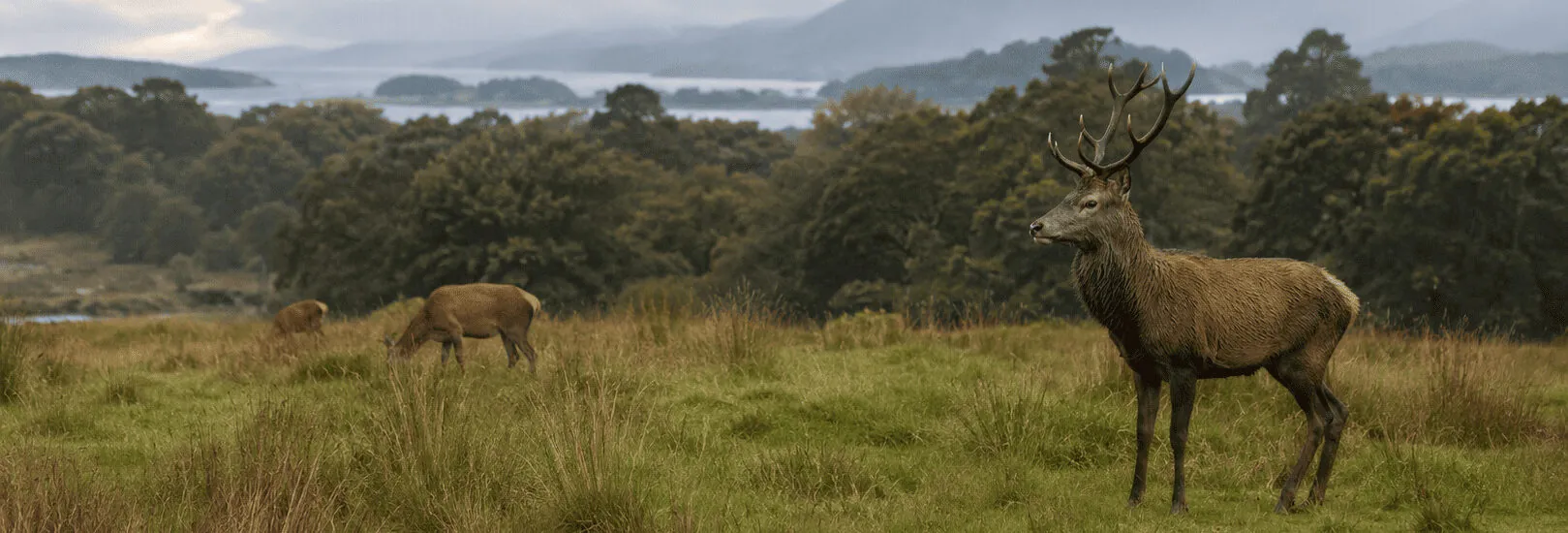
In the meadows of Knockreer, around a bend on a forest path or on the mist-covered heights, deer are among the most memorable sights in Killarney National Park. Their presence is far more than a tourist attraction: these wild animals range freely across an area of more than 10,000 hectares.
Killarney is home to two main species. Red deer, regarded by the National Parks & Wildlife Service as Ireland’s last indigenous herd, share the park with sika deer, which were introduced in the 19th century. To have a chance of seeing them, choose the right area, walk quietly and accept that nature never appears on demand.
The meadows of Knockreer are the best place to start if you hope to spot deer without venturing far from Killarney. The estate can be reached on foot from Killarney House and Gardens and the town centre.
The Knockreer loop is around 5 km long and crosses open land edged by woodland. Animals may come to feed in these meadows, particularly while the park is still quiet. The open views make it possible to spot them from a distance without leaving the paths or approaching their resting areas.
Early morning and late afternoon are generally the most favourable times. In the middle of the day, visitor numbers, passing cyclists and activity around the main access points can make sightings more unpredictable.
Why choose Knockreer? The area is easy to reach, close to town and well suited to visitors who do not want to undertake a long walk.
The Muckross House estate combines gardens, meadows, wooded shores and ancient forests. This variety of habitats makes it another interesting area for observing the park’s wildlife.
Deer may be seen around the meadows at Muckross, along the paths leading towards Dundag Point or in the more wooded area of Muckross Peninsula. The Muckross Lake loop passes through Reenadinna Wood, a remarkable yew forest where red deer and sika deer are regularly recorded.
In the woods, deer are harder to spot than in the meadows. A movement between the trunks, a dark silhouette or the sound of a branch may nevertheless reveal their presence. It is essential to stay on the paths, both to avoid disturbing the animals and to protect the particularly fragile vegetation in these forests.
Why choose Muckross? This area combines wildlife watching with a walk around the lake, a visit to Muckross House or the discovery of Muckross Abbey.
Red deer also frequent the park’s higher ground. The Old Kenmare Road, accessible from the upper Torc car park, passes through forests before reaching heathland and upland meadows. These open landscapes can offer good opportunities for sightings, particularly in autumn.
The route soon becomes more remote than the walks at Knockreer or Muckross. The ground can be muddy and uneven, while the weather changes quickly at higher elevations. Binoculars will help you look for animals on the slopes without trying to close the distance.
The immediate surroundings of Torc Waterfall are often very busy. To watch wildlife, it is better to continue along the permitted trails and move quietly away from the car park rather than wait near the waterfall.
Why choose Torc and the Old Kenmare Road? This area is for walkers wishing to discover wilder scenery and equipped with suitable footwear.
Around Derrycunnihy, south of Upper Lake, the ancient oak woods provide a quieter setting. The Mass Path descends from Derrycunnihy Church towards Lord Brandon’s Cottage, crossing woodland, streams and less-visited areas.
Deer may be present here, but they are harder to spot amid the vegetation. This route should therefore not be undertaken solely in the hope of an encounter. The path is around 4 km one way and can become very wet, or even partly flooded, in winter.
Why choose Derrycunnihy? To enjoy a more secluded woodland walk, while bearing in mind that sightings here are unpredictable.
Killarney’s red deer are among Ireland’s most emblematic animal populations. The National Parks & Wildlife Service describes them as the country’s last indigenous herd of red deer, with a continuous presence dating back to the Neolithic period.
The red deer is Ireland’s largest wild land mammal. The adult male, known as a stag, has an imposing build and carries branching antlers that are renewed each year. The female, known as a hind, is smaller and has no antlers.
Its coat generally takes on reddish-brown tones in summer and becomes darker during winter. Seen from a distance, its large size and pale rump often distinguish it from the sika deer.
Native to East Asia, the sika deer was introduced to Ireland in the 19th century. Smaller and more compact than the red deer, it often has a dark coat in winter. In summer, pale spots may appear on its back, although they can sometimes be difficult to see.
The sika also has a clearly defined white patch around the tail. Males carry antlers that are generally shorter and less branched than those of large red deer stags.
Both species can be encountered in the park. Identifying them from a distance is not always easy, particularly in low light or when the animals are partly concealed by vegetation.
Autumn, and October in particular, is the most spectacular season. During the rut, male deer make powerful calls to signal their presence and challenge rivals. These vocalisations can carry a long way across the park’s meadows and valleys.
The rut increases the chances of spotting deer, but it also makes males more territorial and unpredictable. Never place yourself between a male and a group of hinds, or try to provoke a reaction for a photograph.
Autumn colours, the first mists and low light add to the beauty of the scene. This period also attracts many photographers. If several people are already watching the animals, it is best to keep back and avoid surrounding them.
Deer remain present throughout the year, but their behaviour and use of the landscape change. In spring and summer, denser vegetation can make them harder to spot in the forests.
Early summer is a sensitive period for hinds and their calves. A young animal lying still in long grass is not necessarily abandoned: its mother may be nearby and will return when she considers the area quiet enough. Do not touch it or try to move it.
Dawn and the final hours before sunset are generally the most favourable. Deer take advantage of the quiet and softer light to come into the meadows and feed.
There is no need to venture into the park in the middle of the night. Arriving shortly after sunrise offers good conditions while allowing you to walk safely. In autumn and winter, plan for nightfall to come quickly and allow enough time to return to a main path.
Light rain does not necessarily prevent sightings. Strong winds, severe weather and poor visibility, however, make walking less comfortable and can mask the animals’ movements or calls.
A deer that suddenly raises its head, fixes its gaze on visitors, moves away or stops feeding is showing that it has detected your presence. You should then stop moving forward and increase the distance.
As a precaution, a minimum distance of around 50 metres is recommended when watching wild deer. During the rut, or when an animal appears agitated, it is safer to remain at least 100 metres away. Binoculars and telephoto lenses allow you to observe natural behaviour without causing stress.
Dogs are permitted in Killarney National Park, but they must be kept on a lead. Even a usually calm dog may chase a deer, cause it to flee or put itself in danger when faced with a male during the rut.
This rule also protects nesting birds, young animals and other visitors. In areas where deer are visible, it is best to shorten the lead and give the group a wide berth.
A telephoto lens is preferable to approaching closely. Position yourself on a path, watch the direction the animals are taking and wait without trying to follow them. The finest images often show deer in their surroundings: a wet meadow, a woodland edge or the mountains of Killarney in the background.
The park prohibits recreational drone use. Their noise disturbs wildlife, particularly nesting birds, and detracts from other visitors’ experience. Commercial or organised filming may also require prior permission.
For details of any restrictions and nature activities organised in autumn, visit the official Killarney National Park website.
Essential information to help you plan your visit, including key landmarks, access information, and booking options.
52.058990, -9.520460
2h30
Pedestrian access to Killarney National Park is open 24 hours a day, all year round. However, to watch deer in good conditions and walk safely, choose daylight hours and the quietest times of day.
Sunrise and sunset times vary considerably with the season. Always allow enough time to return before dark, particularly on the Old Kenmare Road and the paths around Derrycunnihy.
Sightings depend on the weather, visitor numbers and the animals’ natural movements.
Check the opening hours and admission requirements before you leave, especially during peak season or on Irish public holidays.
Entry to Killarney National Park and independent wildlife watching are free. No ticket or booking is required to explore Knockreer, the Muckross estate or trails open to the public.
Guided outings, photography workshops or activities focused on the rut may occasionally be organised. Access arrangements and any charges depend on the programme announced by the park.
The presence of wild animals can never be guaranteed.