What if, for one night only, some of Ireland’s most unexpected doors opened without putting a strain on your bank card? On Friday 18 September 2026, Culture Night — Oíche Chultúir in Irish — returns for its 21st edition. Museums, former prisons, libraries, galleries, workshops, historic buildings and pop-up stages will take part in this major cultural evening, held in cities and villages alike.
All official events are free, although some require booking. The programme is vast: rather than listing the most obvious events, here is a selection of genuinely distinctive experiences from several parts of the island.
Culture Night 2026: one night, all of Ireland on stage
A national cultural event that is entirely free
Culture Night is delivered by the Arts Council, alongside local authorities and cultural organisations across Ireland. The idea is simple: to make the arts, heritage and creativity accessible to as many people as possible for one evening, through extended opening hours and events created especially for the occasion.
The programme encompasses major institutions as well as tiny, lesser-known venues. You might hear an orchestra in a former prison, learn how to make a frame-by-frame film, discover abandoned buildings through a photographer’s work, or join an evening gathering in an Irish-speaking community.
The official Culture Night map lets you filter events by county, time, age, accessibility and language. Check it before setting out: some activities are already fully booked, while others remain open without registration.
Hear an orchestra in Cork’s former prison
Cork City Gaol takes on an entirely different atmosphere
With its cell wings, galleries and 19th-century architecture, Cork City Gaol already has an impressive theatrical presence. For Culture Night 2026, it will host the Cork Light Orchestra. The contrast between the music and the former prison makes this one of the evening’s most evocative experiences.
It is an opportunity to discover one of Cork’s major landmarks from a different perspective. The building’s acoustics, stonework and scale lend the concert a dimension not found in a conventional concert hall. The official listing states that booking by telephone with the venue is required.
If tickets are no longer available, Cork’s programme remains particularly packed. Cork Public Museum, for instance, is extending its opening hours for a presentation on the world of private collections, while libraries, galleries and arts spaces are offering workshops and talks throughout the city.
Explore abandoned Northern Ireland from Belfast
Forgotten buildings recounted by a photographer
In Belfast, the Linen Hall Library welcomes Rebecca Brownlie, creator of the photographic project Abandoned NI. Her work documents homes, schools, businesses and industrial buildings left derelict across Northern Ireland. Behind their crumbling walls lie family, social and economic stories often absent from guidebooks.
The talk provides an indirect window onto fragile or private places that would be neither legal nor sensible to explore independently. Advance registration is required. The Linen Hall Library is also well worth a visit: founded in 1788, it holds important collections on local history, politics and literature.
Those drawn to darker atmospheres can continue the evening with Spirits of Belfast, a walk led by historian Andrew Johnston. Starting at the Linen Hall Library, the route winds through the city centre in search of shadowy tales and forgotten figures.
Join a genuine evening gathering in Donegal’s Gaeltacht
Tea, cards and creativity at Áislann Ghaoth Dobhair
Culture Night takes on a very different character in Gweedore, Donegal. The event Airneál revives the tradition of the evening gathering: people come together to chat over a cup of tea, play cards or try an artistic activity. The experience takes place at Áislann Ghaoth Dobhair, in the heart of a region where Irish remains a living everyday language.
The evening accompanies the final days of Déanta i nDún na nGall, an exhibition dedicated to the county’s craftspeople. It is a chance to experience Irish culture without elaborate staging, through language, craft and local conviviality.
Other events are taking place around Gweedore, including stories and clay activities for families, as well as a concert at Amharclann Ghaoth Dobhair. Some activities offer accommodations for neurodivergent or autistic visitors, indicated directly on the Culture Night map.
Create a giant animated film in Sligo
A workshop where every drawing becomes a frame
In Sligo, Handmade Animation invites 13- to 17-year-olds to draw and paint directly onto a huge strip of paper. Each creation becomes a frame in a collective film, which is then laminated and digitised to bring the whole piece to life.
Led by artists Andy Parsons and Edel Doherty with Binder Arts, the workshop offers an insight into the principles of animation without complicated software. No prior artistic ability is required. The enjoyment comes as much from making it by hand as from discovering the finished work in motion.
The activity takes place at the ATU Innovation Centre, and registration requirements should be checked. For families travelling with teenagers, it is a welcome alternative to more traditional heritage visits.
Step inside an award-winning green library
Culture and sustainability at MTU Kerry
At Munster Technological University’s North Campus in Kerry, Cultural Currents turns the library into a cultural laboratory. Architecture, materials, landscape, music, dance, animation and sustainability come together in a deliberately cross-disciplinary programme.
The venue will notably present its project recognised at the International Federation of Library Associations’ Green Library Award 2026. Its theme explores the union of biophilia and sustainability: in other words, how a library can incorporate nature, promote wellbeing and reduce its environmental impact.
This visit will particularly appeal to lovers of contemporary architecture and travellers curious to see how Irish institutions are rethinking their public buildings. It also shows that Culture Night is not confined to the fine arts: design, ecology and innovation are all fully part of the evening.
Attend a concert in a former Quaker meeting house
Great musical-theatre duets in Clara
In County Offaly, the Clara Musical Society takes over the former Friends Meeting House for an evening devoted to duets. Singers accompanied on piano will perform familiar and rarer songs from musical theatre.
The building lends all its charm to this intimate concert. Quaker meeting houses are generally distinguished by their architectural simplicity, designed for reflection rather than spectacle. That simplicity brings the voices directly to the fore.
No booking is listed, but seating is limited. Arriving early therefore seems sensible. Clara also offers other cultural activities, making it possible to put together a short evening without immediately getting back in the car.
Dance in Dublin’s streets
More than 300 events in the capital
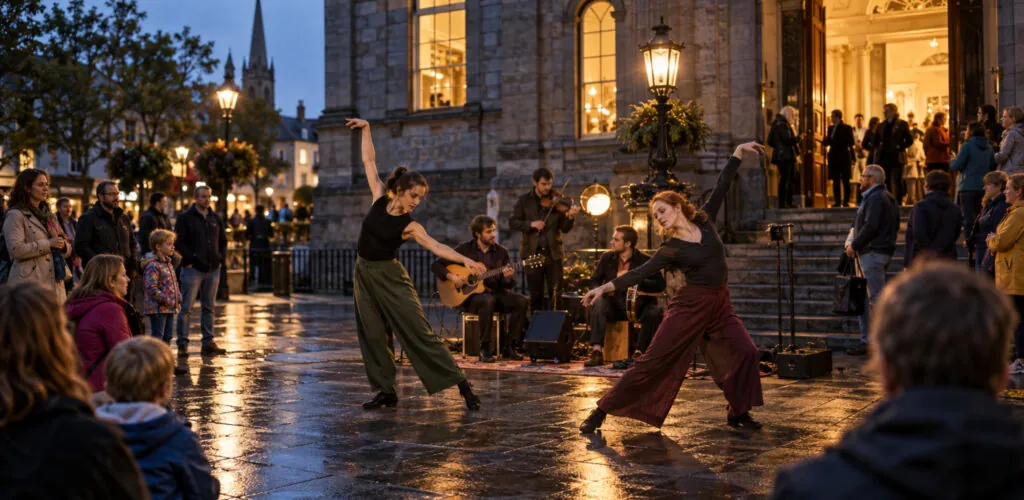
Dublin Culture Night brings together more than 300 events in 2026. The outdoor programme is being expanded around Wood Quay Amphitheatre, Meeting House Square, Central Plaza and Capel Street. Music, theatre, poetry, tango, street dance and street parties will turn public space into one vast stage.
Irish breaking champion Leon « Aleon » Dwyer is among the figures associated with this Dublin edition. The programme also brings cultures into conversation through, among other things, Calpulli Mictlan’s Mexican ceremonial dance, the Dublin Gay Men’s Choir and several artists from the contemporary music scene.
To make the most of the capital, choose one area rather than moving between a series of far-flung venues. Temple Bar and Meeting House Square suit a packed evening; Merrion Square and Kildare Street are better for museums and heritage; Capel Street offers an urban, late-night atmosphere.
Discover Irish culture after 9pm
Culture Night Late extends the evening
Culture Night does not end when museums close their doors. The Culture Night Late programme brings together concerts, performances, screenings and late-night events beginning at around 9pm or continuing beyond it.
Entry conditions vary by venue. An activity may not require booking but may have limited capacity, while a late-night establishment may impose an age limit. The fact that the official programme is free does not remove the need to read each listing before travelling.
In Dublin, Belfast or Cork, check your journey home as well. Public transport services do not all run to the same timetables, and some street events may cause local traffic changes.
How should you plan your Culture Night in Ireland?
Book sparingly, walk a lot and leave room for the unexpected
The best itinerary does not include ten events booked to the minute. Choose one priority experience, add two nearby options and leave part of the evening free. Queues, chance encounters and performances discovered by accident are all part of the event.
On the official map, use the filters for city, age group, accessibility and time. Save your favourites, then check the day before in case conditions have changed. The label fully booked should be taken seriously: turning up without a place for a full activity will generally not get you in.
Bring a waterproof jacket and comfortable shoes. Events often alternate between indoor and outdoor settings, and a brief shower is not enough to bring an Irish evening to a halt. A portable charger is also useful for keeping tickets, routes and timetables accessible until you return.
What you need to know about free entry
Free activities, sometimes with compulsory booking
All events included in the official Culture Night programme are free to attend. That does not mean every door is open without checks: small venues, workshops and guided tours often use free ticketing in order to manage capacity.
Transport, meals and drinks remain at visitors’ expense. Some institutions may also offer paid services or spaces alongside the official programme. Always check exactly what is included in the Culture Night listing.
The 21st edition takes place across Ireland on 18 September 2026. In the days leading up to the event, bookings change quickly: the official map remains the only reliable source for confirming times, accessibility and the last available places.