
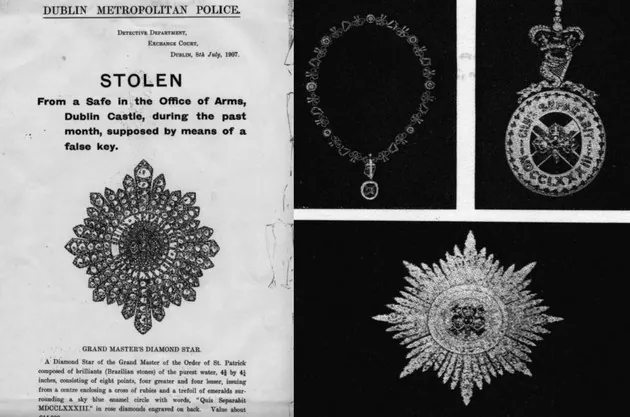
On 6 July 1907, at Dublin Castle, an employee found a safe that was closed but unlocked. Inside, the case containing the Irish Crown Jewels was empty. The jewels had vanished from the very heart of the British administration, within a compound guarded by soldiers and police officers. Four days later, Edward VII was due to arrive in Ireland. More than a century after this embarrassing theft, the stones remain missing and no one has been convicted of their disappearance.
The phrase readily conjures images of a medieval crown, a sceptre and the treasures of Gaelic rulers. Yet the objects stolen in 1907 belonged to the ceremonial regalia of the British monarchy in Ireland. They were the insignia of the Grand Master of the Order of St Patrick, an office held by the Lord Lieutenant, the sovereign’s representative on the island.
Founded in 1783, the order brought together an aristocratic elite linked to power. In Ireland, it occupied a position comparable to that of the Garter in England or the Thistle in Scotland. Sky-blue mantles, banners and coats of arms lent the ceremonies a spectacular dimension. St Patrick’s Cathedral in Dublin served as its chapel, while installations of knights were also held in the castle’s Great Hall, now St Patrick’s Hall.
William IV had the precious insignia sent to Dublin in 1831 for the Lord Lieutenant’s use. They were called the “Crown Jewels” because they belonged to the Crown. The name therefore referred to a set of official ornaments worn on formal occasions.
The diamond-set star was the most striking piece. It combined gleaming rays with a red cross and an emerald shamrock against a background of blue enamel. Oval-shaped insignia and gold elements completed the set. Surviving descriptions and portraits of the Lords Lieutenant still offer an idea of its appearance.
These jewels brought together Irish symbols and those of royal power. The shamrock, harp and Cross of St Patrick asserted an identity carefully staged during ceremonies. To see them today, one must look to historical documents. The objects themselves have disappeared, along with five gold collars of the order taken in the theft.
The insignia were held by the Office of Arms, the department responsible for coats of arms, genealogies and part of the official ceremonial. At its head was Sir Arthur Vicars, Ulster King of Arms. This title denoted a prestigious heraldic office, with very practical responsibilities for safekeeping.
In 1903, the department moved into Bedford Tower, in the Upper Castle Yard. A strongroom had been fitted out for valuables. But a problem of space undermined part of the arrangement. The safe containing the jewels would not fit into this secure room, so it remained in the department’s library.
This detail casts the burglary in a different light. The castle walls protected the seat of government, but inside, the security of the jewels depended on doors, locks and a handful of keys. The prestige of the address did not guarantee rigorous oversight of every office.
The jewels were last seen with certainty on 11 June 1907. The theft could therefore have taken place in the weeks that followed. This uncertainty over the timing weighed on the entire investigation. Being away from Dublin on the day of the discovery was not enough to explain what might have happened beforehand.
On the afternoon of 6 July, Vicars asked the department’s messenger to place an object in the safe. The employee found it unlocked. The case had been emptied. Private jewellery belonging to the Vicars family was also missing. No signs of forced entry on the lock made it possible to reconstruct exactly how the theft had been carried out.
Two keys to the safe were in Vicars’s care: one he kept on his person, the other at his home. The possibility that someone had gained access to the keys, or made a duplicate, became central to the investigation. Police had to look among those able to approach the premises and their custodian.
The approaching royal visit made the affair especially humiliating. The insignia were to be used at a ceremony connected with the Order of St Patrick during Edward VII’s visit. News of the theft soon turned a jewellery robbery into an international scandal.
Suspicion focused in particular on Francis Richard Shackleton, known as Frank, the younger brother of the explorer Ernest Shackleton. As Dublin Herald, he worked in Vicars’s circle and shared his home in Clonskeagh. This closeness gave him access to a very restricted milieu and to the habits of the man responsible for the jewels.
Shackleton lived beyond his means. His financial difficulties and familiarity with the premises fuelled suspicion, but no sufficient evidence allowed the theft to be attributed to him. His name nevertheless remained attached to the case. Vicars still accused him in his will.
Shackleton’s subsequent path sustained his reputation. In 1913, he was convicted of a separate financial fraud. This episode, however, offered no evidence about the burglary at the castle. Accounts portraying him as the identified thief go beyond what the investigation established.
Vicars was a respected genealogist and antiquarian. He had developed his department’s archival collections and organised major official ceremonies. The scandal brought this career to an end. A vice-regal commission concluded that he had failed to exercise sufficient vigilance in safeguarding the insignia. He was removed from office in January 1908.
The penalty concerned his responsibility as custodian. It did not resolve the theft. Vicars continued to feel that he had been made a scapegoat and denounced the protection allegedly afforded to others. This conviction fuelled a long controversy, without bringing the jewels to light.
In 1913, he won a libel action against the Daily Mail, which had published allegations about his role. He died in 1921, killed at Kilmorna during the War of Independence. His death did no more to clarify the Dublin case.
The name of Arthur Conan Doyle lends this case an almost irresistible air of fiction. A distant relative of Vicars, the writer offered his help. His involvement, however, appears to have been limited to examining a plan of the premises and offering personal support. He did not solve the case or lead the police investigation.
The Dublin Metropolitan Police and Scotland Yard were called in. Other avenues owed more to belief. Clues attributed to mediums led to fruitless searches in cemeteries. These episodes reveal the feverish atmosphere surrounding a disappearance that conventional methods could not explain.
Parliamentary records show how far the case extended beyond the circle of investigators. On 13 August 1907, the government was questioned in the House of Commons about whether the jewels might have been recovered. The reply confirmed that they had neither been found nor bought back. An MP then attempted to give the supposed culprits a political colouring.
In April 1909, questions still concerned police reports, those under suspicion and information the authorities were said to have concealed. The government disputed these allegations. These exchanges document the tensions surrounding the investigation. They do not prove the existence of a conspiracy.
In a country marked by debates over self-government, the disappearance of royal objects from the seat of the administration made an ideal subject for controversy. Every silence could be seen as suspicious protection, every new rumour as a sweeping explanation.
The jewels have never been found. Their dismantling and the dispersal of the stones is a plausible theory, often put forward by historians of the case. It remains impossible to verify. A single stone removed from its setting would have lost much of what could identify it as part of the insignia.
One physical object has nevertheless survived. The mahogany case, reinforced with brass and lined with velvet, retains the spaces for the three pieces it held. Delivered to the castle on 15 March 1831, it bears a plaque describing the insignia intended for the Lord Lieutenant. The case was returned by post to the Office of Arms in 1928, without explanation. This late return was not matched by that of the jewels.
Dublin Castle’s online documentary trail allows visitors to discover the case, portraits and a 1907 wanted poster. The National Library of Ireland also holds letters and documents connected with the case. These traces make it possible to follow the people involved and the investigations, contradictions and all.
At the castle, look for Bedford Tower in the Upper Castle Yard. Its façade gives a precise location to this tale of keys and vanished jewels. Castle records place the former library on the ground floor, to the right of the entrance archway. Access to the interior spaces depends on the visitor route available.
St Patrick’s Cathedral extends this discovery through the history of the order and its ceremonial. For archival items and objects associated with the theft, check current exhibitions before travelling. The Splendour & Scandal exhibition mentioned in older castle articles was temporary. Its online version remains a way to examine the treasure’s last physical witnesses up close.