Reservations are recommended


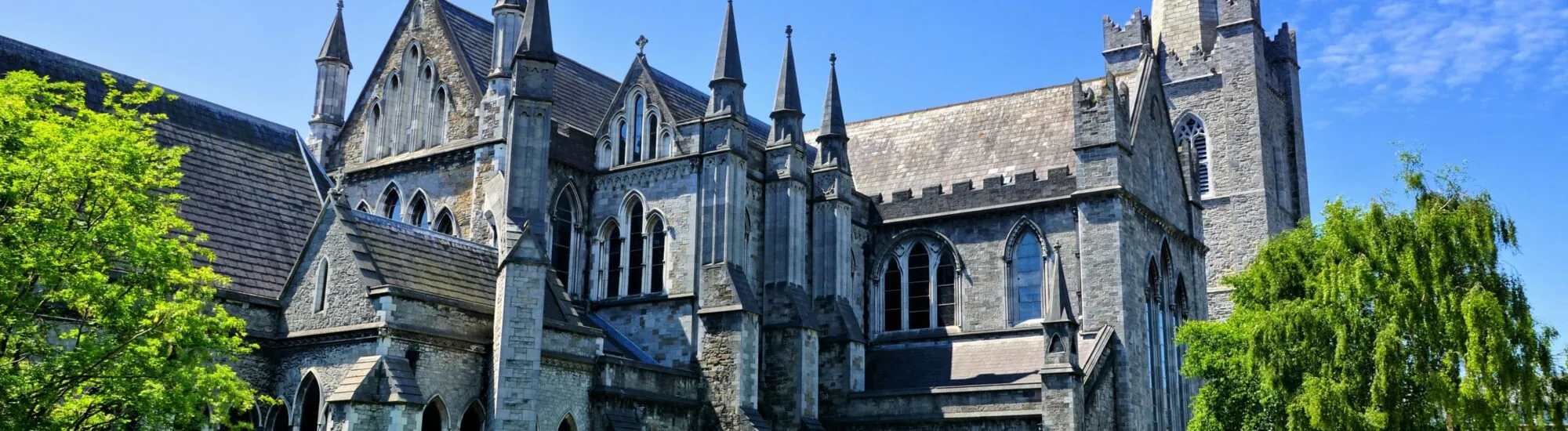
Standing at the heart of the historic Liberties district, St Patrick’s Cathedral, Dublin is the largest cathedral in Ireland. Its Gothic nave, stained-glass windows, funerary monuments and flags tell more than eight centuries of religious, political and literary history.
Known in English as Saint Patrick’s Cathedral and in Irish as Ard-Eaglais Naomh Pádraig, it is said to have been built near an ancient well used by St Patrick to baptise Dublin’s first Christians. Still a place of worship, it is now the national cathedral of the Church of Ireland, a member of the Anglican Communion.
Dublin has a rather unusual feature: the city has two medieval cathedrals belonging to the Church of Ireland. Christ Church Cathedral is the cathedral of the Diocese of Dublin and Glendalough, while Saint Patrick’s Cathedral holds national cathedral status.
St Patrick’s is therefore not a Roman Catholic cathedral, despite its name and its dedication to Ireland’s patron saint. Since the Protestant Reformation of the 16th century, it has belonged to the Church of Ireland, which follows the Anglican tradition.
Dublin’s principal Catholic cathedral is St Mary’s Pro-Cathedral, on Marlborough Street. It is worth knowing this distinction before your visit, as it helps to make sense of the capital’s complex religious history.
According to tradition, St Patrick used a nearby well to baptise converts to Christianity in the 5th century. A small wooden church was subsequently built on the site to preserve the memory of these baptisms.
However, there is no archaeological evidence to state with certainty that St Patrick personally officiated at this location. The story therefore belongs chiefly to local Christian tradition.
In 1191, John Comyn, Archbishop of Dublin, granted the church collegiate status. Its conversion into a cathedral truly began in the early 13th century. Most of the present building was constructed between 1220 and 1260 in the Early English Gothic style.
St Patrick’s Cathedral, Dublin – © Sharkshock
The cathedral was built on marshy ground crossed by the underground River Poddle. Damp and flooding soon weakened its foundations. Unlike many great European cathedrals, St Patrick’s has no crypt, as the nature of the ground made its construction particularly difficult.
A fire damaged the tower and several parts of the building in the 14th century. The Minot Tower, still visible today, was built from 1370 onwards. Its stone spire, more than 40 metres high, was added in the 18th century, giving the cathedral its present silhouette.
The Protestant Reformation profoundly transformed the way it operated. From the 16th century onwards, St Patrick’s came under the authority of the Church of Ireland. The building subsequently went through periods of deterioration, successive repairs and several alterations that were at times insensitive to its medieval architecture.
By the middle of the 19th century, the cathedral’s condition had become a cause for concern. The walls were unstable, the roof was deteriorating and some sections were in danger of collapse.
Between 1860 and 1865, Benjamin Lee Guinness, a member of the famous brewing family, funded a complete restoration of the building. He invested a considerable sum in the project without directly imposing his own choices on the architect overseeing the work.
This campaign probably saved St Patrick’s from ruin. It nevertheless transformed part of its interior appearance. Several medieval elements disappeared or were reinterpreted in line with the 19th-century Gothic Revival vision.
A statue of Benjamin Lee Guinness now stands in the neighbouring park. It recalls the essential role played by the philanthropist in preserving one of Dublin’s most important monuments.
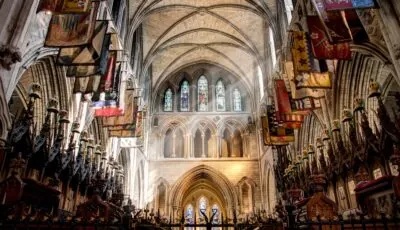
The visit begins in a vast nave nearly 90 metres long. Its tall arcades, stone pillars and dark roof structure immediately create a sense of depth and solemnity.
The floor is covered in tiles with geometric patterns inspired by medieval designs. Memorial plaques, sculptures, tombs and monuments dedicated to religious, military and political figures line the walls and chapels.
Numerous military flags and standards also hang in the nave. Some are extremely fragile and bear witness to the cathedral’s former role in national and military ceremonies.
The choir, its carved stalls and high altar reveal the monument’s continuing life. St Patrick’s is not a static museum: services, concerts and ceremonies are held here throughout the year.
Built around 1270, the Lady Chapel stands behind the choir. Dedicated to the Virgin Mary, it is one of St Patrick’s most elegant spaces, with its slender columns, vaulting and stained-glass windows.
In the 17th century, it was made available to Huguenot refugees who had left France after the revocation of the Edict of Nantes. For several decades, these French-speaking Protestants were able to worship there in their own language.
This chapter of its history is a reminder that the cathedral also welcomed certain European communities who came to settle in Dublin.
The cathedral is inseparable from Jonathan Swift, writer, satirist and author of Gulliver’s Travels. He served as Dean of St Patrick’s from 1713 until his death in 1745.
Swift was not merely a clergyman. His writings denounced poverty, social injustice and the treatment of the Irish population. His celebrated pamphlet A Modest Proposal uses particularly dark irony to criticise the indifference of the ruling classes towards destitution.
The writer is buried in the cathedral alongside Esther Johnson, known as Stella, who held a central place in his life. Their gravestones can be seen near the entrance. A Latin epitaph written by Swift himself is displayed nearby.
The visit also offers the chance to see several objects associated with the author, including a cast of his skull and a death mask. St Patrick’s is therefore an essential stop for travellers interested in Irish literature.
Among the cathedral’s most unusual objects is the Door of Reconciliation. It is associated with a feud between the Butler and FitzGerald families in 1492.
According to the traditional account, James Butler and his men took refuge in the cathedral’s chapter house. Gerald FitzGerald, Earl of Kildare, wished to end the conflict, but Butler feared it was a trap and refused to open the door.
FitzGerald then had an opening cut into the wood and put his arm through the door to offer a handshake. In doing so, he risked having his arm cut off. Butler eventually accepted the gesture and the two families were reconciled.
The episode is said to be the origin of the Irish expression to chance your arm, meaning to take a risk or try your luck. The pierced door is now displayed in the nave.
The monument dedicated to Richard Boyle, the first Earl of Cork, is among the cathedral’s most imposing works. Erected in the 17th century, it depicts several members of the Boyle family kneeling and surrounded by sculpted figures.
The memorial originally stood in the choir. It was moved after a dispute with Thomas Wentworth, King Charles I’s representative in Ireland, who considered its position too intrusive.
Its scale, colours and profusion of figures make it one of the most striking features of the visit today.
St Patrick’s Cathedral holds daily services open to all. Evensong, a sung service particular to the Anglican tradition, offers a particularly moving way to experience the building.
Music is provided by the cathedral choir, whose origins date back to the Middle Ages. The choir school associated with St Patrick’s, founded in 1432, is considered Ireland’s oldest school.
Attending a service is free and should not be confused with a tourist visit. Those attending are asked to respect the religious nature of the celebration and may not move freely around the cathedral during the liturgy.
A visit of 45 minutes to an hour allows time to admire the nave, the Lady Chapel, Jonathan Swift’s tomb, the Door of Reconciliation and the principal monuments. Those with an interest in architecture, religious history or literature could easily spend longer here.
Interpretive panels and digital resources help visitors understand the different parts of the building. Guided tours may also be available at certain times, depending on staff availability and the religious calendar.
The ticket generally allows visitors to explore the areas open to the public freely. Some chapels may, however, be temporarily closed during a service, rehearsal, concert or private ceremony.
After your visit, Saint Patrick’s Park offers one of the finest views of the cathedral’s façade and tower. Its lawns, flower beds and benches make it a welcome stop in the heart of the Liberties.
The garden occupies an area once made up of substandard housing. It was laid out in the early 20th century with the support of the Guinness family, before being opened to the public.
The park is also home to the Literary Parade, a series of plaques paying tribute to several Irish writers. Access to the garden is free and separate from the cathedral ticket.
Essential information to help you plan your visit, including key landmarks, access information, and booking options.
53.339512, -6.271487
30 minutes
Sunday opening times are split to allow services to take place. The cathedral may also close temporarily for a ceremony, concert or exceptional event.
Services are held daily. Evensong, or evening prayer, is generally celebrated at 5.30 pm on weekdays. On Sundays, the usual times include Eucharist at 9.15 am and 11.15 am, followed by Evensong or evening prayer at 3.15 pm. The schedule may vary according to the season.
Check the official visiting times and the service timetable before you travel.
Check the opening hours and admission requirements before you leave, especially during peak season or on Irish public holidays.
The tourist ticket contributes to the cathedral’s upkeep, heating, security and conservation. The cathedral receives no regular public funding to cover all these costs.
Admission is free for those attending a service. However, this access does not include a tourist visit during the celebration.
A combined ticket with Marsh’s Library may be available. Saint Patrick’s Cathedral is also included in certain Dublin Pass options.
As prices may change, check the rates on the official Saint Patrick’s Cathedral ticket office.
Compare tickets, guided tours, and excursions available through our partner platforms.