
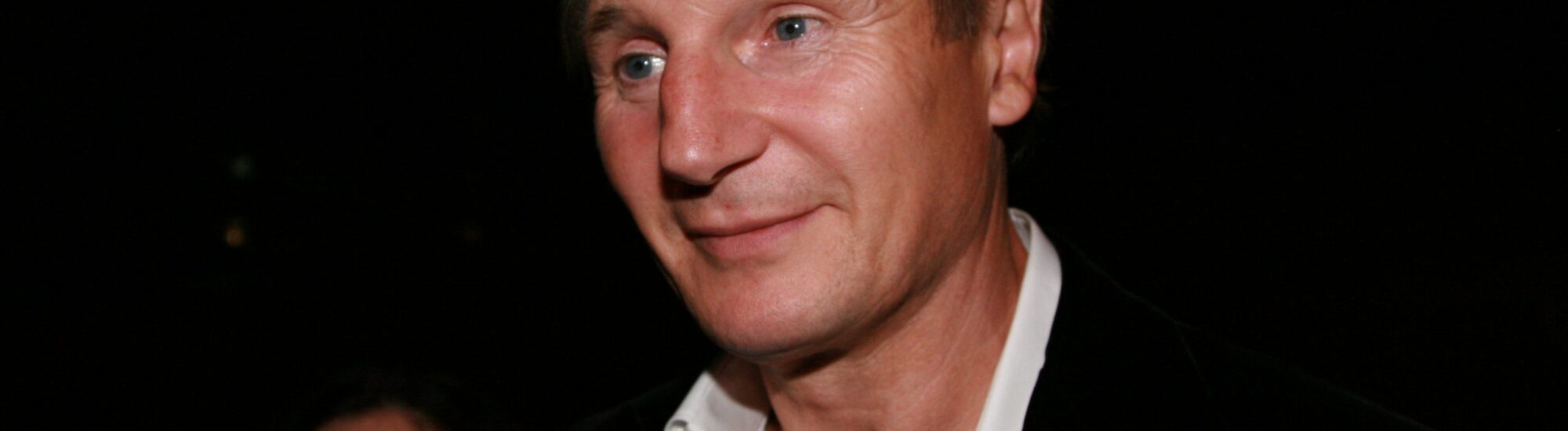
Born in Ballymena, Northern Ireland, Liam Neeson has established himself as one of the most recognisable Irish actors of his generation. His imposing height, deep voice and understated acting style have enabled him to play historical figures, mentors, grieving fathers and action heroes drawn into desperate battles alike.
Brought to public attention by Schindler’s List, for which he was nominated for the Academy Award for Best Actor, Liam Neeson has built an especially eclectic filmography. He has played Michael Collins for Neil Jordan, Qui-Gon Jinn in Star Wars, Alfred Kinsey, Ra’s al Ghul in Batman Begins and Bryan Mills in the Taken franchise.
Yet behind this Hollywood career stands an actor with a deep attachment to Ireland. Several of his roles engage directly with the country’s history, political violence, the weight of memory and the wounds left by the Northern Irish conflict.
Liam Neeson –
El Hormiguero – cc
William John Neeson was born on 7 June 1952 in Ballymena, County Antrim. He grew up in a Catholic family in a town whose population was then predominantly Protestant. His father, Bernard Neeson, worked as a school caretaker, while his mother, Katherine Brown, was a cook.
Liam Neeson’s childhood came before the most violent years of the Troubles, which truly erupted in the late 1960s. Nevertheless, he grew up in a society deeply divided along religious, political and community lines. That Northern Irish reality would later inform some of his most personal roles.
At the age of nine, young Liam began boxing at Ballymena’s All Saints Youth Club. He practised the sport for several years and took part in amateur bouts. This training helped develop his physical presence, discipline and the distinctive way he occupies space that would become one of his signatures on screen.
Before becoming an actor, Liam Neeson worked a succession of jobs. He was, among other things, a forklift driver at the Guinness brewery in Dublin, as well as a lorry driver and architectural assistant. For a time, he considered becoming a teacher, before theatre ultimately took hold.
In 1976, Liam Neeson joined Belfast’s Lyric Players’ Theatre. For two years, he trained through stage work, the classical repertoire and a professional company. He then continued his apprenticeship at Dublin’s Abbey Theatre, a major institution in Irish culture.
It was in the theatre that the essence of his style was forged. Liam Neeson learned to project his voice without weighing it down, to work with silence and to bring depth to understated characters. That classical training would remain apparent throughout his career, even in his most spectacular action films.
While playing Lennie in an adaptation of Of Mice and Men, he was spotted by director John Boorman. Boorman cast him as Gawain in Excalibur, released in 1981. The film marked his true entry into international cinema.
After Excalibur, Liam Neeson appeared in several ambitious productions. He featured in The Bounty in 1984, alongside Anthony Hopkins and Mel Gibson, followed by Roland Joffé’s The Mission, with Robert De Niro and Jeremy Irons.
In Suspect, released in 1987, he played a deaf-mute Vietnam veteran accused of murder. The role allowed him to develop a physical performance in which gestures, looks and silences largely replace speech.
In 1990, director Sam Raimi gave him his first major popular role in Darkman. Liam Neeson played a disfigured scientist turned vigilante. Behind the conventions of the fantasy film, the figure that would dominate part of his career was already emerging: a wounded, isolated man determined to pursue his mission to the end.
In 1993, Steven Spielberg chose Liam Neeson to play Oskar Schindler in Schindler’s List. The actor brought his stature and ambiguity to the German industrialist who saved more than a thousand Jews during the Holocaust.
Liam Neeson created a difficult-to-pin-down character: seductive, opportunistic and a member of the Nazi Party, Schindler gradually changes in the face of persecution. The actor avoids grand gestures, allowing doubt, guilt and awareness to emerge in successive touches.
His performance earned him an Academy Award nomination for Best Actor, as well as Golden Globe and BAFTA nominations. Contrary to a frequently repeated error, Liam Neeson did not win the Oscar for this role: that year, the statuette went to Tom Hanks for Philadelphia.
The film gave the actor international stature. He could now take on leading roles without abandoning theatre or demanding historical productions.
In 1996, Liam Neeson reunited with Irish director Neil Jordan to play Michael Collins. The film traces the Irish revolutionary’s struggle, his role in the War of Independence and the divisions caused by the Anglo-Irish Treaty of 1921.
For Neeson, the role goes beyond a straightforward historical reconstruction. Michael Collins remains a central, admired yet controversial figure in Irish political memory. The actor lends him an almost physical energy, while revealing the contradictions of a man caught between armed struggle, negotiation and the risk of civil war.
The film takes certain liberties with the facts and continues to fuel debate among historians. Nevertheless, it helped introduce an international audience to a decisive period in Irish history. For his performance, Liam Neeson received the Volpi Cup for Best Actor at the Venice Film Festival.
Liam Neeson returned directly to the Northern Irish conflict in Five Minutes of Heaven, released in 2009. He played Alistair Little, a former member of the Ulster Volunteer Force who killed a young Catholic in 1975.
The story imagines his meeting, several decades later, with the victim’s brother, played by James Nesbitt. The film does not seek to erase the crime or impose an artificial reconciliation. Instead, it examines the weight of guilt, the survivor’s anger and the impossibility of undoing certain acts.
Liam Neeson’s restraint is particularly well suited to this story. His character does not ask to be absolved: he seems condemned to live with the memory of what he has done. The film is one of the most understated explorations of the memory of the Troubles in his filmography.
In In the Land of Saints and Sinners, Liam Neeson plays Finbar Murphy, a former killer trying to retire to a village in Donegal in 1974. His plan for a peaceful life is disrupted by the arrival of Provisional IRA members wanted after an attack.
The film uses the conventions of the western and thriller to explore political violence, remorse and the possibility of redemption. Donegal’s landscapes are more than just a backdrop: cliffs, boglands and wind-battered roads give the story its tension and isolation.
Alongside Kerry Condon, Ciarán Hinds, Colm Meaney and Jack Gleeson, among others, Liam Neeson returns to a world close to his roots. The film also offers an interesting counterpoint to Taken: his character still knows how to kill, but now understands the human cost of every action.
From the late 1990s onwards, Hollywood made full use of Liam Neeson’s stature. In Star Wars: Episode I – The Phantom Menace, released in 1999, he played Jedi Master Qui-Gon Jinn. His calm authority and independence gave depth to a character who became highly popular with fans of the saga.
Liam Neeson did not appear in Star Wars: Episode IV – A New Hope, contrary to what some inaccurate filmographies suggest. He did, however, reprise the role of Qui-Gon Jinn on occasion in several later productions connected with the Star Wars universe.
In Christopher Nolan’s Batman Begins, in 2005, he played Henri Ducard, also known as Ra’s al Ghul. The character first appears as Bruce Wayne’s mentor before becoming his ideological adversary.
That same year, his deep voice brought the lion Aslan to life in The Chronicles of Narnia: The Lion, the Witch and the Wardrobe. Whether he appears on screen or lends only his voice, Liam Neeson has a rare ability to establish an immediate sense of authority.
When Taken was released in 2008, Liam Neeson was 56. He was then primarily associated with historical dramas, prestige roles and mentor characters. The film’s worldwide success abruptly changed that image.
He played Bryan Mills, a former secret service agent searching for his daughter after she is abducted in Paris. A telephone scene in which he warns the kidnappers that he possesses a very particular set of skills was enough to turn his character into a popular action-film figure.
The success of Taken led to two sequels and opened a new chapter in the actor’s career. Liam Neeson then went on to make a succession of thrillers: Unknown, The Grey, Non-Stop, A Walk Among the Tombstones, The Commuter, Cold Pursuit, The Marksman and The Ice Road.
These films often rest on a similar formula: an experienced, bereaved or solitary man is forced to take up arms again. While this repetition has sometimes limited the diversity of his roles, it has also made Liam Neeson a cinematic genre in his own right.
Unlike many action heroes, his characters never seem invulnerable. They appear weary, scarred and aware of the danger. It is precisely this vulnerability that gives weight to their violence.
Liam Neeson’s popularity in action cinema sometimes obscures his more understated roles. In Ordinary Love, released in 2019, he and Lesley Manville play a couple facing cancer. The film is built around everyday gestures, silences and ordinary anxieties, far removed from Hollywood spectacle.
He also reunited with Martin Scorsese in Silence, in 2016, playing a Jesuit missionary who publicly renounces his faith in 17th-century Japan. The role echoes several recurring themes in his career: doubt, guilt and the cost of conviction.
In 2025, Liam Neeson took a more overtly comic turn in The Naked Gun. He played Frank Drebin Jr., heir to the police officer once played by Leslie Nielsen. The film mischievously draws on his seriousness, solemn delivery and image as an impassive hero.
The choice confirms a long-underestimated quality: Liam Neeson can laugh at the persona cinema has built around him. His face remains serious even when the situation becomes utterly absurd, making his performance particularly effective in comedy.
In 2026, he continues this evolution with Cold Storage, a science-fiction horror comedy in which he stars alongside Joe Keery and Georgina Campbell. He plays Robert Quinn, a former bioterrorism specialist confronted with the resurgence of a dangerous organism.
Liam Neeson married British actress Natasha Richardson in 1994. The couple had two sons, Micheál and Daniel. Natasha Richardson died in March 2009 following a skiing accident in Canada.
The actor has spoken about this bereavement in a handful of interviews, without turning it into a promotional element of his career. He generally remains discreet about his family life. His eldest son, Micheál Richardson, has also become an actor and notably appeared alongside his father in Made in Italy.
Liam Neeson became a US citizen in 2009. This administrative change has not broken his connection with Ireland: he continues to identify himself as an Irish actor and regularly returns to work on the island.
Liam Neeson does not fit a picturesque or folkloric image of Ireland. His identity is expressed more through his voice, his relationship with silence and the subjects to which he returns.
His career connects three places: Ballymena, where he grew up; Belfast and Dublin, where he trained in theatre; and Hollywood, where he became an international star. This path has allowed him to address Irish history with a visibility rarely afforded to an actor from Northern Ireland.
In Michael Collins, he embodies the political birth of independent Ireland. In Five Minutes of Heaven, he confronts the memory of the Northern Irish conflict. In In the Land of Saints and Sinners, he returns to a rural Ireland haunted by the violence of the 1970s.
These films do not offer a single vision of the country. Instead, they portray an Ireland marked by contradictions: heroism and brutality, loyalty and betrayal, the desire for peace and the impossibility of forgetting.
What is Liam Neeson’s real name?
His full name is William John Neeson. Liam is the commonly used Irish form of William.
Where was Liam Neeson born?
Liam Neeson was born in Ballymena, County Antrim, Northern Ireland, on 7 June 1952.
Is Liam Neeson Irish?
Yes. Born in Northern Ireland, Liam Neeson identifies as Irish. He also became a US citizen in 2009.
Has Liam Neeson won an Oscar?
No. He was nominated for the Academy Award for Best Actor for Schindler’s List, but did not win the award.
Which film made Liam Neeson famous?
Schindler’s List brought him international recognition in 1993. Taken then transformed his image and made him a global action-film star.
Which Liam Neeson films are about Ireland?
The most significant are Michael Collins, Five Minutes of Heaven and In the Land of Saints and Sinners. Each addresses the island’s political history and divisions from a different angle.