

At first glance, the Tara Brooch fits inside a display case. But look closer: before your eyes unfolds a miniature world, filled with interlace, geometric patterns and tiny animals. Each detail seems to lead to the next. Take your time to appreciate all the intricacy of this jewel, now held at the National Museum of Ireland – Archaeology in Dublin.
A masterpiece of Irish metalwork from the Early Middle Ages, the Tara Brooch nevertheless bears a misleading name. It was not found on the famous hill of the High Kings of Ireland, but near the shore at Bettystown in County Meath. Its story combines ancient craftsmanship, a chance discovery and the 19th-century fascination with the Celtic past.
The Tara Brooch was made around the end of the 7th century or the beginning of the 8th century AD. It belongs to a period often regarded as a golden age of Irish art, when craftspeople produced highly sophisticated objects for elites and religious communities.
Despite its frequent association with ‘Celtic art’, the jewel does not date from prehistory. It was created in an Ireland that had already been Christianised, where artists combined older decorative traditions with influences from other parts of Europe.
The name of its maker, the exact location of the workshop and the identity of its first owner are unknown. The richness of its materials and the care taken in its making nevertheless suggest an object of prestige, intended for a person of high status.
The brooch resurfaced in 1850, near the shore at Bettystown in County Meath. Accounts of its discovery do not all agree: the story most often told concerns a woman who supposedly found it in the sand, but the precise circumstances remain uncertain.
One thing is certain: the jewel was not discovered on the Hill of Tara. Nor is there anything to suggest that it belonged to a king of Tara. The geographical proximity of Bettystown to this former seat of power nevertheless helped foster the association between the two.
After its discovery, the brooch passed into the hands of the Dublin jewellery firm Waterhouse & Co., which helped make it known as the ‘Tara Brooch’. The name evokes a place steeped in prestige in Irish history and tradition, without proving that the jewel came from there.
The timing was particularly favourable to its fame. In the 19th century, the Celtic Revival brought motifs inspired by Irish heritage back into fashion. Jewellers created reproductions and pieces inspired by archaeological discoveries. The brooch then became far more than a curiosity: it fuelled a new fashion and contributed to the growing interest in the island’s ancient art.
The brooch later entered Irish public collections. It is now held by the National Museum of Ireland, where it ranks among the most remarkable pieces in the archaeological collection.
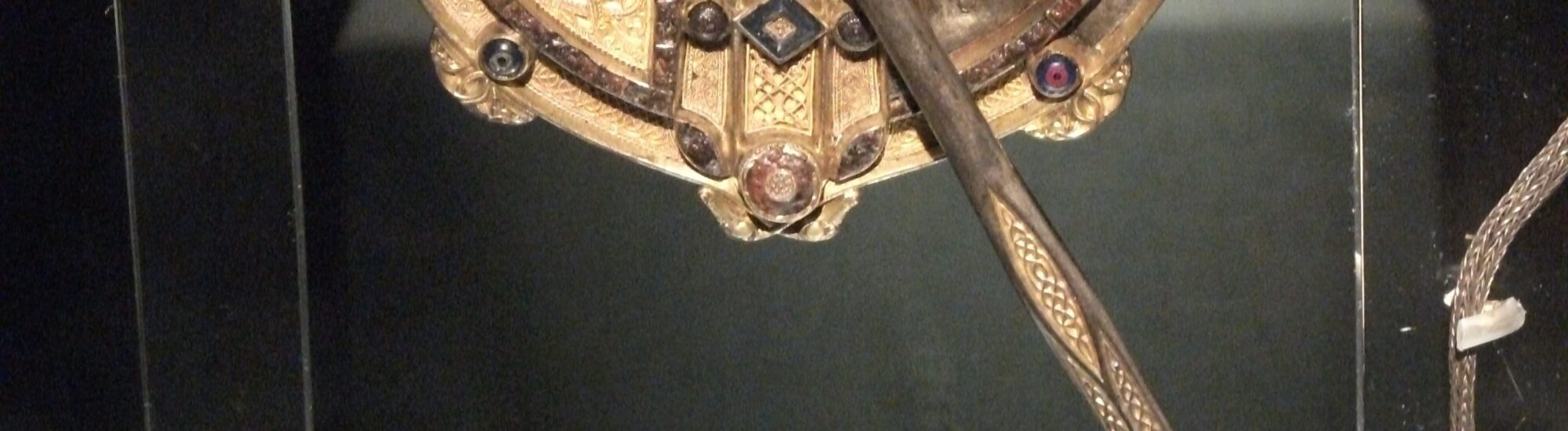
The brooch has a gilt-silver body, enhanced with gold filigree panels and decoration incorporating, among other materials, amber and glass. Its long pin and ring form a spectacular piece of jewellery, yet it is the precision of its decoration that draws the eye.
Filigree involves working very fine metal threads to create patterns. On the brooch, this craftsmanship demands close attention: at close range, the lines cross, coil and form shapes whose complexity almost escapes the eye at first glance.
The object is also decorated on its reverse. A chain of braided silver wire is attached to it by a hinged element in the shape of an animal’s head. Every part reveals careful workmanship, designed with both the jewel’s function and appearance in mind.
The main face combines interlace, spirals, geometric forms and animal motifs. Some stand out immediately; others require a little more patience. That is the pleasure of looking closely: the more you look, the more details the jewel seems to reveal.
Do not necessarily look for a scene telling a specific story. The brooch bears no inscription identifying either its owner or its maker. Its motifs primarily demonstrate a remarkable artistic language and technical mastery.
The National Museum of Ireland displays the brooch among the treasures in the The Treasury exhibition, devoted in particular to the art of medieval Ireland. It is a fine opportunity to see it alongside other precious objects, including the famous Ardagh Chalice.
The Tara Brooch is held at the National Museum of Ireland – Archaeology, on Kildare Street in central Dublin. It is among the objects displayed in the permanent The Treasury exhibition.
Be sure to choose the right address: the National Museum of Ireland has several sites, including Decorative Arts & History at Collins Barracks. To see the original brooch, head to the archaeology museum on Kildare Street.
When you arrive, ask a member of staff where to find The Treasury. Once you are in front of the brooch, take a few minutes to examine the different elements of its decoration. The motifs are so fine that a quick glance is not always enough to grasp the richness of the workmanship.
Admission to the museum is free. Opening hours and access arrangements may change, particularly on public holidays or during exceptional closures. Check the museum’s visitor information before you travel.
Galleries may occasionally close, or an object may be temporarily removed from display. If the Tara Brooch is the main reason for your visit, the museum recommends checking that it is on display before you come, on +353 1 677 7444.
Make the most of your visit by exploring the other archaeological collections. From the Ardagh Chalice to prehistoric gold objects, they take you through several centuries of Irish history and place the brooch within a much broader body of craftsmanship and tradition.