The film The Lost Children of Tuam revisits the heartbreaking story of the hundreds of children who died at the Bon Secours home in Tuam, County Galway. Based on true events, this feature film highlights the fight of Catherine Corless, the local historian who brought this case to public attention.
The Lost Children of Tuam, originally titled The Lost Children of Tuam, draws from the years of research conducted by Catherine Corless. This Tuam resident delved into local archives to understand what happened to the children cared for in the former home for unmarried mothers run by the Bon Secours Sisters.
By examining death certificates and available records, Catherine Corless discovered that nearly 800 infants and young children died at the institution between 1925 and 1961. Yet, no official graves appeared to correspond to these deaths.
The film traces this long and difficult investigation, as well as the resistance Catherine Corless faced from institutional silence and the disbelief of parts of the community.
The Bon Secours home in Tuam was established to accommodate unmarried pregnant women and their children. At that time, Irish society was deeply influenced by the Catholic Church and heavily stigmatized out-of-wedlock pregnancies.
Many young women were sent to these institutions, sometimes under family pressure. They often gave birth under very harsh conditions before being separated from their babies.
Some children were later adopted, while others remained in the home for several years. Poor sanitary conditions, poverty, disease, and lack of medical care led to an exceptionally high mortality rate.
Catherine Corless’s research prompted authorities to investigate a plot of land near the former home. Human remains belonging to very young children were found in a disused underground structure.
The site has often been described as an old septic tank, although the exact layout has been subject to extensive analysis. Nevertheless, the presence of human remains confirmed that a significant number of children had been buried without individual graves or known funeral ceremonies.
This discovery sent shockwaves through Ireland and led the Irish government to launch investigations into former mother and baby homes.
The film gives a pivotal role to Catherine Corless. Without significant resources or initial institutional support, she patiently pieced together the story of the children of Tuam.
Her work is based on death certificates, municipal archives, and testimonies from people familiar with the former home. She also sought to locate the families of the deceased children.
Thanks to her perseverance, the Tuam case gradually became a national and then international issue. Catherine Corless is now recognized as a key figure in the remembrance work related to Irish mother and baby homes.
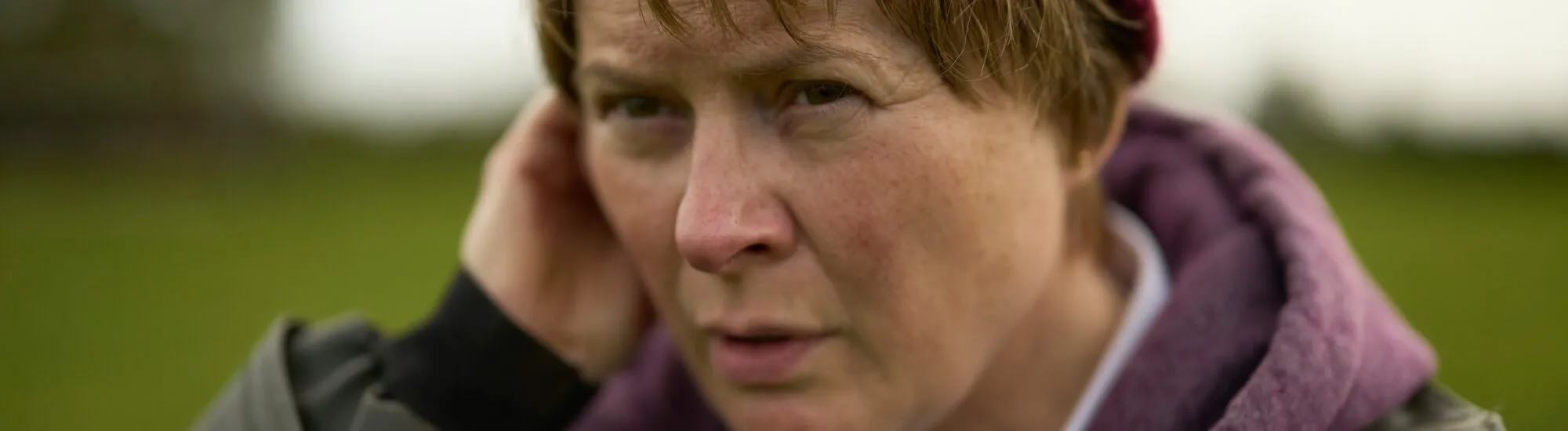
In The Lost Children of Tuam, Catherine Corless is portrayed by British actress Monica Dolan. The film focuses as much on the historical discoveries as on the personal consequences of this investigation.
The story depicts an ordinary woman facing an extraordinary reality. It showcases her determination, doubts, the reactions of those around her, and the painful testimonies of affected families.
The cast also includes Ian McElhinney and Jeanne Nicole Ní Áinle. Liam Neeson is involved in the project as a producer.
The Lost Children of Tuam does more than recount a historical investigation. The film also addresses the role of women in Irish society, the influence of religious institutions, and how some victims were denied recognition for decades.
It also reminds us that the story of mother and baby homes is not limited to Tuam. Several similar institutions existed in Ireland throughout the 20th century.
For families, the goal is also to identify the children, recover their remains, and provide them with a dignified burial. The work of exhumation and identification is therefore a crucial step in the process of truth and healing.
Tuam is located in the east of County Galway, about 35 kilometers from Galway city. Long known as a market town and an important religious center, it is now inseparable from the Bon Secours home case.
Travelers passing through this part of Ireland will find a rural, peaceful region quite different from the coastal landscapes of Connemara. Yet behind this apparent tranquility lies one of the most painful episodes in Irish social history.
The film helps to better understand the profound changes Ireland has undergone in recent decades, especially regarding religion, women’s rights, and child protection.
The Tuam case continues to raise many questions. Families want to know the identities of the children buried on the site, understand the exact circumstances of their deaths, and obtain official recognition.
The film The Lost Children of Tuam helps keep this memory alive. It pays tribute to the lost children, the mothers who lived in these institutions, and all those still fighting for answers.
Through Catherine Corless’s journey, it also shows that local, patient, and thorough work can compel an entire country to confront its past.