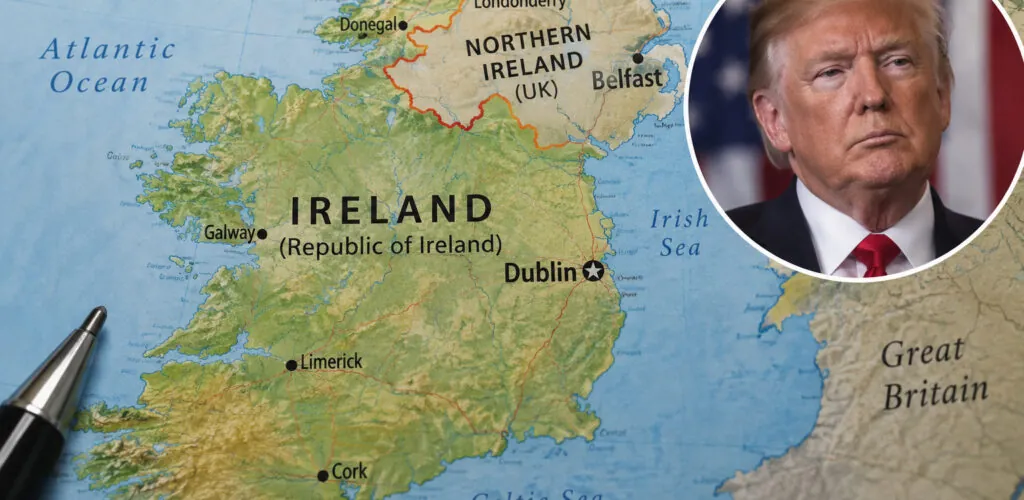
An unexpected statement that revives one of the island’s most sensitive political debates. During a visit to Ireland on Saturday 12 September 2026, Donald Trump said he would like to see the Republic of Ireland and Northern Ireland reunified. The US president went further still, saying that reunification would, in his view, eventually happen.
Donald Trump backs a united Ireland
A statement made alongside Micheál Martin in Dublin
The exchange took place at Farmleigh House in Dublin, during a meeting between Donald Trump and Taoiseach Micheál Martin. Asked by journalists about the prospect of reunifying the island, the US president took a far more explicit position than Washington has traditionally adopted on the issue.
Donald Trump said he would “like” to see a united Ireland and described the prospect as “fantastic”. He also said reunification would happen “eventually”, while immediately acknowledging that the United Kingdom would, of course, have a say.
Later in the day, he returned to the subject, describing a united Ireland as “very cool”, while acknowledging that there was no simple answer to such a complex question.
Why have Donald Trump’s remarks drawn so much attention?
US presidents have traditionally been cautious on the issue
The United States has a particularly strong historical relationship with Ireland and played an important role in the peace process that led to the 1998 Good Friday Agreement. But US administrations have generally been cautious when it comes to Northern Ireland’s constitutional future.
Donald Trump’s statement therefore marks a break with that diplomatic restraint. It also comes as the debate on Irish unity has been regularly revived since Brexit and remains one of Northern Ireland’s most sensitive political issues.
A united Ireland could not be decided by Donald Trump
The Good Friday Agreement sets out clear rules for any referendum
Despite the political significance of the US president’s remarks, Washington does not, of course, decide Northern Ireland’s status.
The Good Friday Agreement, concluded in 1998, is founded in particular on the principle of consent. Any change to Northern Ireland’s constitutional status must be decided democratically by its people. The British government provides for a referendum — often called a border poll — if the conditions set out in the agreement are met and a majority in favour of reunification appears likely.
Reunification would also require democratic approval in the Republic of Ireland. It is therefore not simply a matter of removing a border from a map: such a change would involve a major political, constitutional and institutional process on both sides of the border.
Unionists react immediately
The DUP says Northern Ireland’s future belongs to its people
Unsurprisingly, the US president’s remarks quickly prompted reactions in Northern Ireland. Gavin Robinson, leader of the Democratic Unionist Party (DUP), rejected the prospect advocated by Donald Trump and reiterated that Northern Ireland’s constitutional future must be determined by its people.
In London, the British government also said its position had not changed. British Prime Minister Andy Burnham had recently said that a referendum on Irish unity was not currently on the agenda, citing the absence, in his view, of demonstrated majority support in Northern Ireland.
Trump in Ireland for a closely watched visit
From Dublin to Doonbeg, a high-security visit
The statement came during Donald Trump’s two-day trip to Ireland. After arriving in Dublin, the US president met Irish President Catherine Connolly at Áras an Uachtaráin, before meeting Micheál Martin at Farmleigh House.
He is then due to travel to County Clare and his Doonbeg golf resort, where the Irish Open is taking place. His presence has led to exceptional security measures as well as traffic restrictions in Dublin and Clare.
Beyond golf and economic relations between the United States and Ireland, this brief remark on reunification may ultimately stand out as one of the most widely discussed political moments of his visit to the island.
A border inherited from the partition of Ireland
An issue that remains central more than a century after 1921
To understand the significance of this statement, it is necessary to go back to the partition of the island in the early 1920s. Today, the Republic of Ireland is an independent state, while Northern Ireland’s six counties are part of the United Kingdom.
This division has profoundly shaped the island’s modern history and lies at the heart of nationalist and unionist political identities in Northern Ireland. The Good Friday Agreement brought an end to most of the violence of the Troubles by establishing a political framework based, in particular, on power-sharing and democratic consent.
The question of possible reunification therefore remains legally open, but its implementation would depend above all on the choice of the populations concerned. Donald Trump’s remarks do not alter that framework. They do, however, lend striking international resonance to a debate that continues to run through Irish politics.