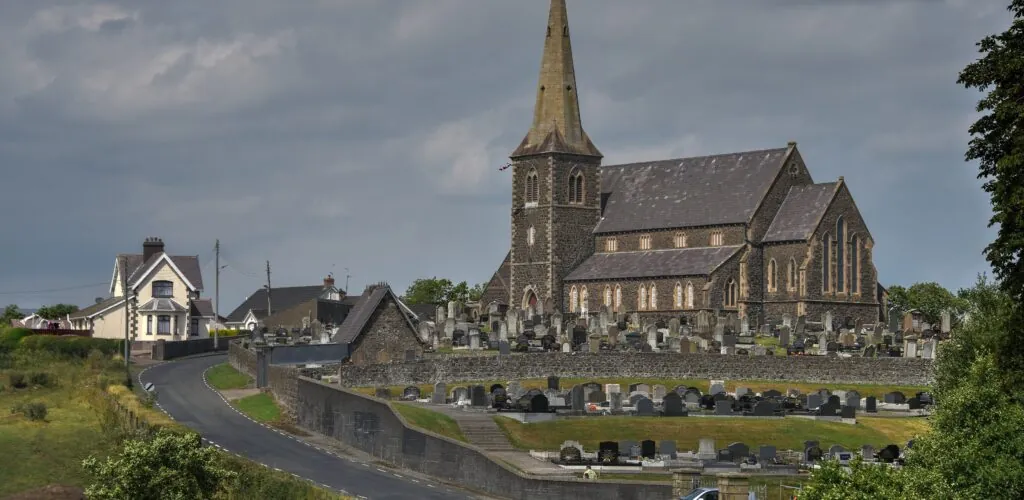
A church, a road and two ways of telling history. In Portadown, County Armagh, the dispute over Drumcree is a reminder of how heavily a route can weigh on Northern Ireland’s collective memory. For some, using Garvaghy Road is a tradition worth defending; for others, the return of an Orange parade to their neighbourhood reopens wounds that years of easing tensions have not erased.
The dispute has now reached police stations and political institutions. Michelle O’Neill and Mary Lou McDonald were interviewed by police on 21 October 2026. On 23 October, unionist MP Carla Lockhart announced that she was stepping down from an internal DUP role. Here are the key points for understanding this story, without confusing local tensions with the situation across Northern Ireland as a whole.
Drumcree: why this road matters so much
In Portadown, a parade route carries a painful history
Drumcree here refers to the church near Portadown in Northern Ireland. Garvaghy Road runs through a predominantly nationalist area, where residents have long opposed the Orange Order parade passing through. For its part, the Protestant organisation attaches great religious and cultural importance to the route.
In the 1990s, Drumcree became one of the most painful flashpoints in Northern Ireland’s community divisions. The CAIN archives at Ulster University document the clashes, roadblocks and violence that accompanied these crises. In 1998, the Parades Commission ruled that the parade should be rerouted to avoid Garvaghy Road. Opposition to that decision led to a lengthy stand-off.
That history explains why the issue extends far beyond a few minutes of marching. A ceremonial route may be experienced as a cultural affirmation by those who use it, and as a display of dominance by those living in the neighbourhood it passes through. Understanding this disagreement means holding these perceptions together, without equating every resident with a single political position.
What reignited tensions in September 2026
Limited permission, a blockade and a government ban
On 25 September, the Parades Commission authorised 35 members of the Portadown lodge to use Garvaghy Road on 27 September, without musical accompaniment. Following a series of legal proceedings, the parade remained authorised, but protesters occupied the road and prevented it from going ahead.
The stand-off continued for almost two weeks. Talks took place under the auspices of the UK Secretary of State for Northern Ireland, Chris Bryant, but failed to produce a compromise. On 9 October, he ultimately banned the procession, after considering a request from the Chief Constable of the PSNI, Northern Ireland’s police service.
One distinction is crucial: the initial authorisation and the subsequent ban were two separate decisions. In his statement to Parliament on 12 October, Bryant said he had taken a new situation into account: allowing the parade to proceed would have required a major police operation, with what was judged to be an unacceptable risk of serious injury and disorder. That decision was itself challenged in court.
Why the matter now involves political leaders
Police interviews and a disagreement within the DUP
According to The Irish Times on 21 October, Northern Ireland First Minister Michelle O’Neill and Sinn Féin president Mary Lou McDonald were interviewed in Belfast as part of the investigation into the protests that blocked Garvaghy Road. They describe their involvement as support for local residents. An interview does not prejudge either possible prosecution or guilt.
On 8 October, the PSNI announced that it had sent letters about interviews to people reasonably suspected of offences. The legal handling of individual conduct is therefore continuing separately from the debate over the parade.
Another development, reported by UTV on 23 October: Carla Lockhart stepped down from an internal DUP role amid disagreement with party leader Gavin Robinson over the possible withdrawal of Emma Little-Pengelly from the Northern Ireland Executive. The announcement concerns a party responsibility and should not be confused with a resignation from her role as an MP.
What this means for travel in Northern Ireland
Local information to check before travelling
Political tensions are real, but the events described here are concentrated around Portadown. They are not enough to conclude that there are widespread disruptions in Belfast, Derry or along the Antrim coast.
In a statement on 12 October, the PSNI Chief Constable said that no protesters or Orange Order members were present on Garvaghy Road or Drumcree Hill on 11 October. This dated observation does not guarantee that no gathering will take place later. If travelling through the area, check the latest police information and traffic conditions on the day; if a gathering is under way, follow instructions on the ground and use the diversions provided.
For visitors, the issue is also an invitation to read places carefully. A church or street name can carry a history that remains sensitive for those who live there. Photographing them discreetly, listening to local explanations and distinguishing between memory, claims and established facts can help visitors discover this part of the island with greater understanding.