

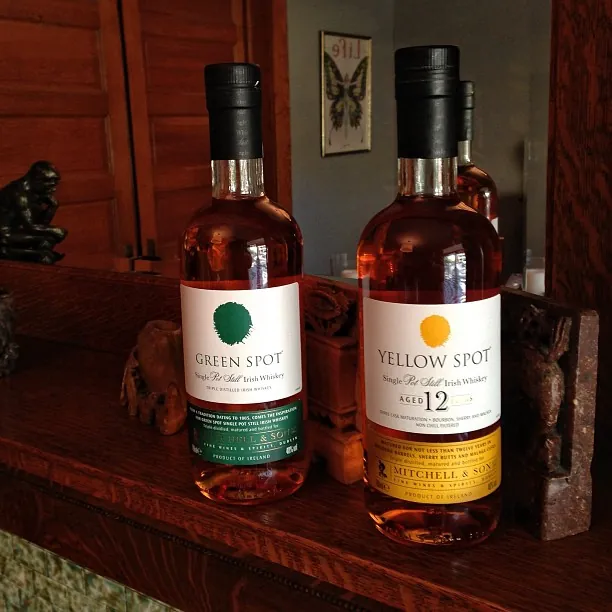
A simple dot of paint can become a name still found behind bars a century later. Green Spot preserves the memory of Dublin’s cellars, where wine merchants identified their casks with coloured marks. Its story follows that of the Mitchell family: a family that moved from confectionery and wine into whiskey, with a sure eye for a good idea.
Now produced in Midleton, County Cork, this Irish single pot still retains its connection to Mitchell & Son. The classic 40% ABV bottle introduces a style whose official notes of green apple, cereals and spice invite you to look beyond the best-known blends. A small lesson in commercial heritage, best explored with a glass in hand, should you wish.
The Mitchell business began on Grafton Street in 1805, trading in confectionery and wine. In 1887, the family moved into whiskey bonding: they had their casks filled at Jameson’s Bow Street distillery, then arranged for them to mature in their own cellars.
At the time, the merchant’s trade was of considerable importance. Casks had to be selected, stocks monitored and time allowed to pass, before deciding which whiskeys would be brought together and sold. Distillation was an essential stage; ageing and selection then shaped an identity specific to the house selling the bottles.
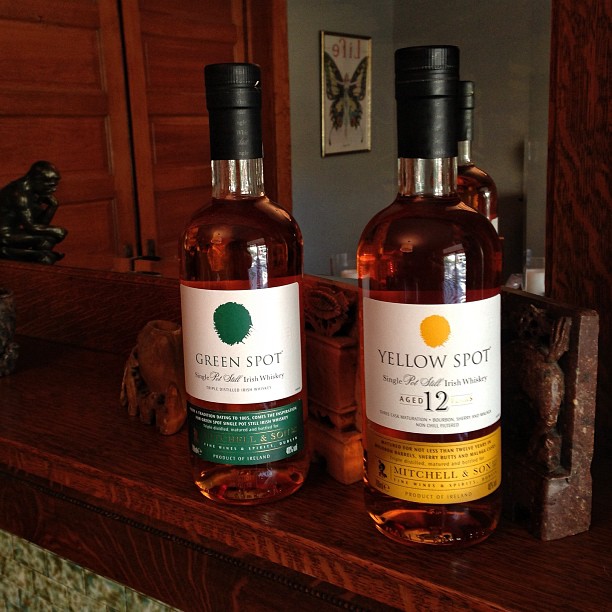
The Mitchells marked their casks with a coloured dot to identify the intended maturation period. Historically, green denoted ten years, yellow twelve, red fifteen and blue seven. These cellar markers gave the Spot Whiskeys their name. The name Green Spot does not, however, mean that the current classic bottle carries a ten-year age statement.
Green Spot is made from malted and unmalted barley, triple-distilled in copper pot stills. It belongs to the single pot still category: it comes from a single distillery and follows a production style distinct from single malt, which is made from malted barley.
It is now produced in Midleton, County Cork. For travellers, then, two places shed light on the same bottle: Dublin for the story of the Mitchells and the merchant trade, and Midleton for today’s distillation. There is no standalone Green Spot distillery to seek out on the streets of the capital.
Several casks may be used in a single pot still whiskey. The term single does not mean “a single cask” or “a single age”. This distinction explains how a house can retain a recognisable identity while working with different stocks.
Classic Green Spot carries no age statement on its label. The official website describes a blend of whiskeys aged from seven to ten years, matured in bourbon and sherry casks. The absence of an age statement does not mean there has been no maturation; it simply calls for a different reading from that of a bottle labelled “12 years”.
According to the brand’s notes, the nose combines orchard fruit, cereals, spice and toasted wood. On the palate, it suggests green apple and clove in particular. These descriptions offer a direction without turning an aroma into an ingredient: the apple mentioned does not mean that apple juice has been added to the whiskey.
Perception also depends on the glass, temperature, dilution and each individual’s sensitivity. For a first tasting, look instead for the overall balance: does fruit dominate your impression? Do the spices emerge mainly after the sip? Does the wood seem subtle or pronounced? These questions are more helpful than a long list of aromas to memorise.
Yellow Spot carries a twelve-year age statement and combines three types of cask: bourbon, sherry and Malaga wine. The use of the latter cask is part of its character. It is therefore not simply Green Spot kept for a few more years: the construction of the blend is different too.
The family also includes variations with additional names. Green Spot Château Léoville Barton, for example, is finished in Bordeaux wine casks after its initial maturation. This connection with wine neatly extends the merchanting story, but it identifies an expression distinct from classic Green Spot.
At a bar or specialist wine and spirits shop, specify the full name you are looking for. To begin with, the classic bottle offers the most direct point of reference; you can then explore another maturation knowing what you are comparing.
A specialist bar may offer Green Spot by the glass. Ask which expression is available, how much is served and the price before ordering. Tasting a small measure lets you discover its style before buying a bottle to take home.
Start with a small sip, then try a few drops of water if you would like to compare. Take your time between the two observations. If you are travelling with a bottle, check your baggage conditions and the rules that apply to your journey, and protect the glass: a lovely souvenir deserves better than a rough encounter with the baggage carousel.
The technical details and aromas presented here come from the official Green Spot profile and the presentation by Mitchell & Son. The history is documented in the Spot Whiskeys timeline. The producer’s notes are tasting guidance, and the editorial team makes no claim of personal experience.
Alcohol abuse is dangerous for your health. Drink in moderation.