
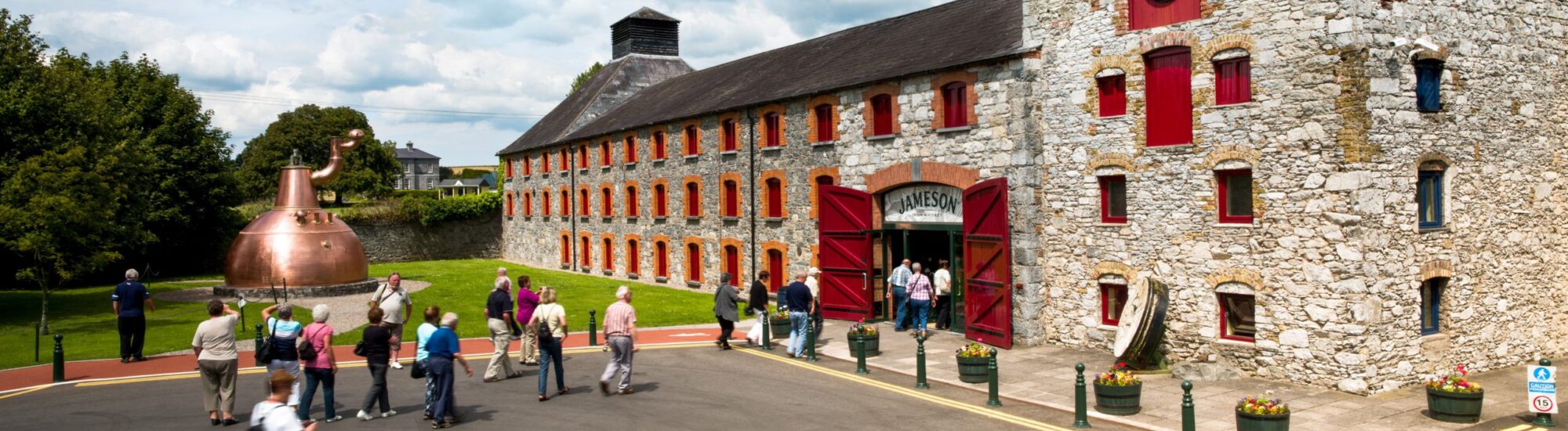
Midleton Distillery is Irish Distillers’ main production centre and one of Ireland’s largest whiskey distilleries. Located around 20 kilometres from Cork, it produces Jameson, Powers, Redbreast, Midleton Very Rare, the Spot whiskeys and Method and Madness, among others.
The site actually comprises two distinct areas. Founded in 1825, the Old Midleton Distillery includes the historic buildings now incorporated into the visitor experience. Right next door, the New Midleton Distillery is a vast production facility that opened in 1975. Some of the more in-depth experiences provide access to areas of this working distillery that are usually closed to the public.
Contrary to what this article once stated, Tullamore D.E.W. is no longer made in Midleton. Since 2014, this whiskey has once again been produced in its home town of Tullamore, County Offaly, at a distillery owned by William Grant & Sons.
Midleton Distillery
The site’s industrial history began before whiskey production. In 1796, Marcus Lynch built a major woollen mill powered by the waters of the River Dungourney. During the Napoleonic Wars, the British government bought the building and converted it into barracks and stables.
The complex subsequently changed hands several times before being acquired in December 1825 by three brothers from a Cork merchant family: James, Daniel and Jeremiah Murphy. The Murphy brothers converted the former buildings into a distillery and established James Murphy & Company.
The reform of spirits taxation introduced in 1823 had made legal distilling more attractive. The Murphys also benefited from Midleton’s location, at the heart of a grain-producing region and close to rail and sea routes that made it easier to transport raw materials and barrels.
The distillery used water from the Dungourney and a large waterwheel to power some of its equipment. An iron wheel installed in 1852 can still be seen on the tour of the historic site.
The Murphys did not envisage Midleton as a small craft operation. From its earliest years, the establishment produced on a considerable scale. By 1827, its output is said to have already exceeded 188,000 gallons of spirits, rising to around 400,000 gallons a year during the 1830s.
The distillery then employed nearly 200 people. It had extensive areas dedicated to malting, brewing, fermentation, distillation and whiskey maturation.
In the middle of the 19th century, however, the Irish whiskey industry went through several difficult periods. The temperance movement reduced alcohol consumption, while the Great Famine disrupted Ireland’s economy and society.
In response to market changes and competition, several Cork producers decided to join forces. In 1867, the North Mall, Green, Watercourse and Daly’s distilleries merged to form the Cork Distilleries Company. Midleton joined the group the following year.
The local production was marketed in particular under the name Cork Distilleries Company Old Irish Whiskey. At the beginning of the 20th century, this whiskey became better known as Paddy, after Patrick J. O’Flaherty, a particularly popular company salesman.
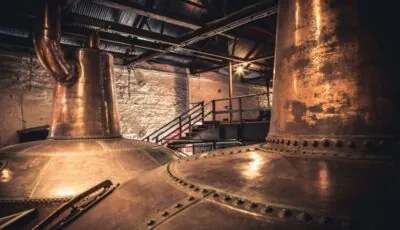
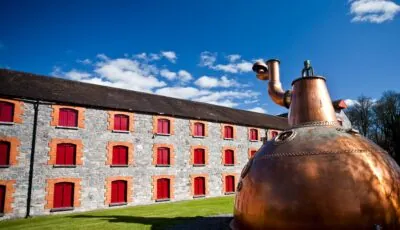
One of the most impressive objects at the old distillery is its gigantic copper pot still. Assembled on site in the 19th century, it had a capacity of around 31,600 imperial gallons, or more than 143,000 litres.
It was so large that the building had to be arranged around it. It is generally described as the largest pot still ever built. It remained in use until production ceased at the old distillery in 1975.
The still is no longer operational, but it is now one of the highlights of the visitor experience. It gives an idea of the industrial scale Midleton had achieved long before the site was modernised.
At the beginning of the 20th century, Irish whiskey faced a succession of crises. The War of Independence, the trade war with the United Kingdom, American Prohibition, the closure of several export markets and competition from Scotch all contributed to the collapse of what had once been a flourishing industry.
By the 1960s, only a small number of major distilleries remained on the island. To pool their resources and preserve their operations, John Jameson & Son, John Power & Son and the Cork Distilleries Company merged in 1966. They founded Irish Distillers Limited.
The new group had to choose a site capable of centralising much of its production. Midleton had extensive land, access to water and a setting that allowed a modern facility to be built beside the existing buildings.
The choice of Midleton led to the gradual closure of the former Jameson distillery at Bow Street and the Powers distillery at John’s Lane in Dublin. The names of these houses were retained, however, and their whiskeys continued to be made in County Cork.
The new distillery began operating in July 1975. Production then ceased in the historic buildings after 150 years of operation and resumed in the modern facilities built next door.
The New Midleton Distillery was designed to produce several styles of whiskey within the same complex. Large copper pot stills are used to make single pot still Irish whiskey, while column stills produce the grain whiskey used in blends.
This diversity is essential. Jameson, for example, is a blended Irish whiskey combining grain and pot still whiskeys. Redbreast, by contrast, belongs to the single pot still whiskey category, made at a single distillery from a mixture of malted and unmalted barley.
The distillery develops different flavour profiles by varying the grains, distillation cuts, type of distillate and maturation casks. This gives the master blenders a broad range of whiskeys to maintain the consistency of leading brands or create rarer editions.
Irish Distillers joined the Pernod Ricard group in 1988. Jameson’s global growth subsequently led to major investment in Midleton, notably in production equipment, maturation warehouses and the experimental microdistillery.
The Garden Still House contains immense stills of around 75,000 litres, among the largest operational stills in the world. Column stills operate alongside them to produce grain whiskeys.
The complex’s theoretical capacity has been estimated at several tens of millions of litres of alcohol a year. The former figure of 19 million litres is therefore outdated and no longer reflects the scale of the current facilities.
These figures refer to production capacity, not necessarily the quantity actually distilled each year. Production varies according to demand, available stocks and the group’s strategy. The whiskey must then mature in casks for at least three years before it can legally be called Irish whiskey.
Midleton Distillery in Ireland – © Arvydas Kniukšta
Midleton brings together several brands, each with its own history and distinctive style. The principal families presented on site in 2026 are:
Paddy also has an important historical connection with Midleton. However, the brand has no longer belonged to Irish Distillers since its sale to the Sazerac group. It is therefore no longer among the main brands featured in the current visitor experience.
Tullamore D.E.W. was produced in Midleton for several decades after the closure of its former distillery in County Offaly. That is now a thing of the past.
The brand was acquired by William Grant & Sons in 2010, which built a new production facility in Tullamore. Opened in 2014 and subsequently expanded, it now handles the distillation and blending of Tullamore D.E.W.
Tullamore D.E.W. should therefore no longer be included among the whiskeys currently produced by Irish Distillers in Midleton.
The Old Midleton Distillery opened to the public in 1992. Following a major modernisation of its visitor route, the site is now known as the Midleton Distillery Experience.
It is not simply a museum of display cases. The guided tour takes in several buildings on the historic estate, which covers around 15 acres. It follows the main stages of whiskey making, from grain selection to cask maturation.
The tour includes the old waterwheel, the production buildings, historic equipment and the spectacular still of more than 143,000 litres. An introductory film places Midleton in the history of Irish whiskey.
The standard tour remains chiefly focused on the old distillery. It should not be confused with a full tour of the vast modern working plant. Some premium options do, however, provide access to additional areas of production and maturation.
The classic tour is the most accessible way to discover Midleton. Over around 75 minutes, a guide presents the history of the estate, its heritage buildings and the main stages of Irish whiskey production.
The experience ends with a tasting or a drink suited to the visitor’s age and preferences. It is suitable both for those discovering the world of whiskey and for travellers primarily interested in industrial heritage.
The advertised price in 2026 starts at €28 per person. Booking is strongly recommended, especially at weekends and during the high season.
The Midleton Distillery Experience with Premium Tasting follows the historic route and adds a guided tasting of three premium whiskeys produced in Midleton.
Led by a specialist, the tasting makes it possible to compare several flavour profiles and better understand the influence of distillate type, age and casks. This option lasts around 75 minutes and costs from €40 in 2026.
The Behind the Scenes option is for visitors who want to go further. Lasting around two hours, it explores more of the estate and may include the microdistillery, cooperage, a maturation warehouse and the historic distiller’s house, depending on the programme offered.
Above all, it provides a clearer distinction between the historic buildings and facilities still used for research, maturation or production. A premium whiskey tasting completes the experience.
This tour is available from €75. As groups are smaller and fewer time slots are available, advance booking is recommended.
The Distiller’s Apprentice Tour is the most in-depth experience available in less than half a day. It includes around 2 hours 45 minutes of touring and exceptional access to several operational facilities.
Participants can notably discover the Garden Still House, the microdistillery and a working maturation warehouse. A tasting drawn directly from a cask and a selection of premium whiskeys are also included.
This option is available from €150 and operates mainly on Saturdays and Sundays. It is primarily aimed at enthusiasts who already have some knowledge of whiskey production.
Midleton offers several additional experiences, not all of which require a lengthy visit to the estate:
The experiences on offer may change during the year. It is best to choose an option according to your level of knowledge: the classic tour is sufficient for a first introduction, while the Behind the Scenes and Distiller’s Apprentice formats offer a more technical perspective.
The shop, bar and dining areas can be accessed without a ticket. You can therefore experience some of the site’s atmosphere, buy a bottle or have a drink without taking part in a guided experience.
The shop brings together the main expressions produced in Midleton, premium editions, accessories and various souvenirs. Some bottles or presentations may be exclusive to the site or available in limited quantities.
The bar offers the opportunity to taste the house whiskeys or try cocktails. Non-alcoholic alternatives are available for drivers, underage visitors and those who do not wish to drink alcohol.
Free access to these areas does not, however, allow visitors to explore the historic buildings or working distillery freely. Booking remains necessary for tours, organised tastings and workshops.
For a first visit, the Midleton Distillery Experience from €28 offers the best balance of history, site discovery and an introduction to whiskey. The premium option is more suitable for comparing several expressions from the distillery.
Knowledgeable enthusiasts will prefer the Behind the Scenes tour. The Distiller’s Apprentice Tour and Discoverer Academy are intended for those who want to understand distillation, cask work and maturation in greater detail.
It is advisable to arrive at least 15 minutes before the stated time. Tours start at fixed times and latecomers cannot always join their group.
Families can explore the historic route, but only visitors of the legal age may take part in alcoholic tastings. A non-alcoholic drink is offered to the visitors concerned.
Some workshops, premium tastings and technical tours may have a specific minimum age requirement. The conditions should be checked when booking each experience.
The two visits meet different expectations. Jameson Bow Street in Dublin occupies the brand’s former historic distillery, but no whiskey is now produced there on a large scale. Its experience focuses more on Jameson’s history, tasting and mixology.
Midleton is the true production site of Jameson and several other Irish Distillers whiskeys. Its industrial heritage, old equipment and proximity to the working distillery make it a more comprehensive visit for understanding how whiskey is made.
Travellers interested in production and technique will therefore get more from choosing Midleton. Those with limited time who are staying only in Dublin will find Bow Street easier to access.
Closures or reduced opening hours may apply at Christmas and during private events. It is recommended to check the official ticket office before travelling rather than arriving without a booking.
Tagline: At Midleton, two centuries of history and resolutely modern production meet at the heart of Ireland’s largest whiskey house.
Want to extend your visit without having to rush around? Here are a few well-located places to stay near the must-see attractions.
Essential information to help you plan your visit, including key landmarks, access information, and booking options.
51.913681, -8.167699
45 minutes
Compare tickets, guided tours, and excursions available through our partner platforms.