

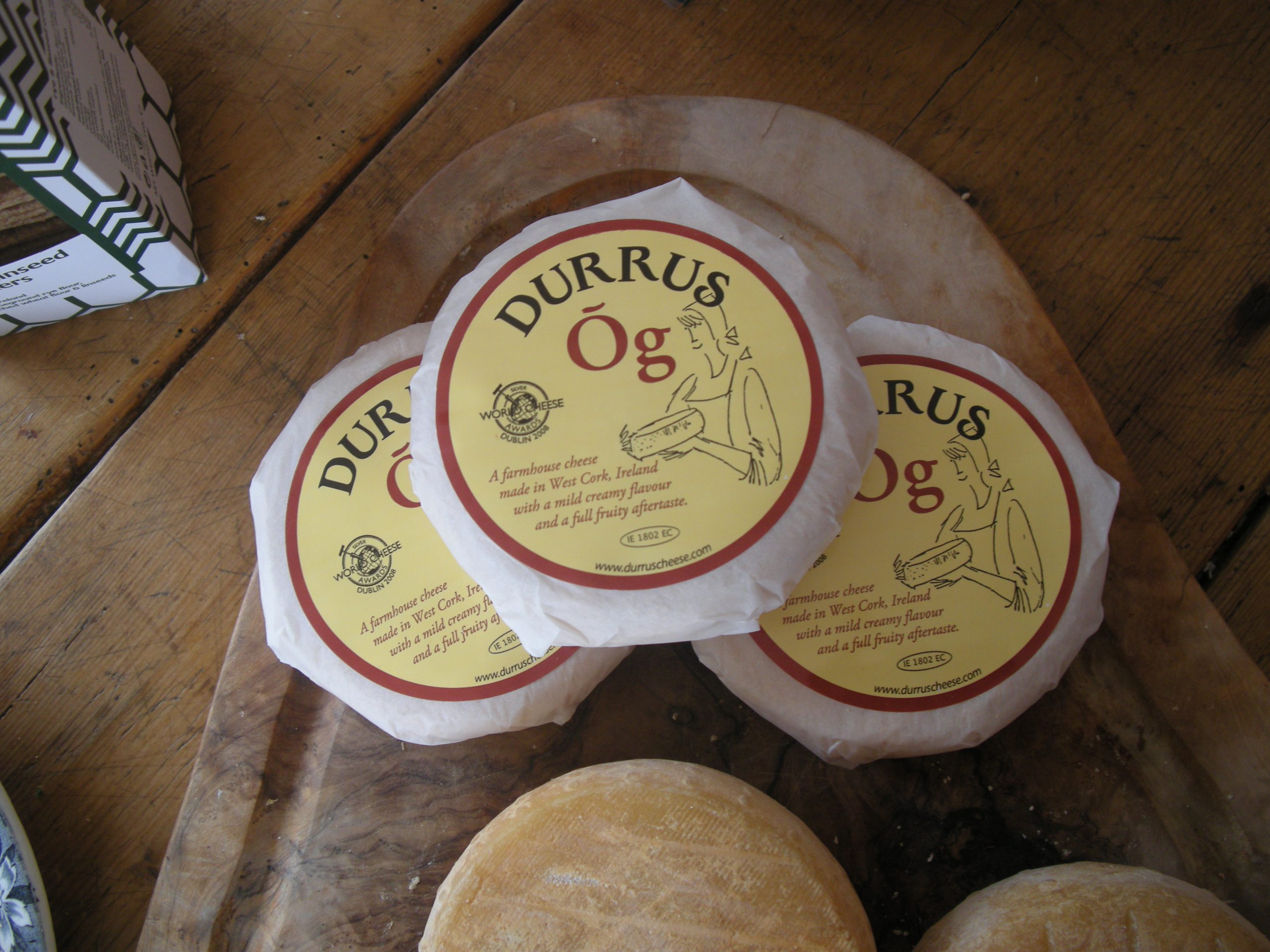
Durrus is one of Ireland’s most iconic farmhouse cheeses. Made on the Sheep’s Head peninsula in west County Cork, it is recognisable by its small round shape, pink-tinged washed rind and soft paste. Behind its assertive character lies a balanced cheese whose flavours evolve noticeably as it matures.
The story of Durrus begins with Jeffa Gill, who set up on a small farm in Coomkeen, in the hills above the village of Durrus. She began making her cheese in 1979, at a time when Irish farmhouse production was only just beginning to re-emerge. She was therefore among the pioneers who helped revive artisan cheesemaking in Ireland.
Production has grown without losing its local roots. The cheese is still made on this West Cork farm, now with the involvement of Jeffa Gill’s daughter, Sarah Hennessy, and a small team. This family continuity is an integral part of Durrus’s identity.
The Sheep’s Head peninsula is a landscape of pasture, hills and ocean winds. The milk used comes from neighbouring farms, whose herds graze in this coastal environment. The close relationship between the farmers and the cheesemaker makes it possible to work with fresh milk while maintaining production on a human scale.
Here, the term terroir takes on a very tangible meaning: the damp climate, meadow flora and rhythm of the seasons influence the milk, and in turn the character of the cheese. A young Durrus therefore does not reveal quite the same nuances as a more mature cheese.
Durrus belongs to the family of soft, washed-rind cheeses. During maturation, its surface is carefully tended to encourage the development of a natural, slightly moist and coloured rind. This process contributes to its distinctive aromas without necessarily making the cheese strong.
When young, it has a mild, creamy paste with milky, buttery and lightly tangy notes. As it matures, its texture becomes softer and its aromas gain depth: hazelnut, woodland floor, hay, mushroom and delicate animal notes may emerge. The rind is edible and plays a full part in the tasting experience.
Lovers of mild cheeses will prefer a younger Durrus, with a firmer centre and a fresh profile. A more mature version will suit those seeking a melting texture and a more lingering flavour. Its aromas are far more expressive at room temperature than straight from the fridge.
Its small size makes it an easy cheese to share and add to a cheeseboard. An even paste, a slightly supple rind and a clean but not aggressive aroma are good indicators of maturity.
On a cheeseboard, Durrus pairs well with sourdough bread, soda bread or lightly salted crackers. A crisp apple, a pear, a few walnuts or a lightly tangy chutney complement its richness without overwhelming its nuances. For drinks, a dry Irish cider makes a particularly natural regional pairing.
In cooking, it melts elegantly. It can be added to a potato gratin, slipped into a toasted sandwich or placed over roasted vegetables. It also adds character to a savoury tart, provided it is not surrounded by too many strongly flavoured ingredients.
Durrus is available from many cheesemongers, delicatessens and at some farmers’ markets, especially in the south-west of the country. It also appears on the cheeseboards of restaurants committed to Irish produce. Asking for it by name often opens up a conversation about the extraordinary vitality of West Cork’s cheese scene.
More than a local speciality, Durrus tells the story of an important chapter in contemporary Irish gastronomy: that of artisans who gave the country back a living, original cheesemaking tradition, deeply connected to its region.
Durrus emerged at a pivotal moment. In the late 1970s, Ireland’s cheese landscape was largely based on industrial production, while small-scale artisan cheesemaking remained rare. Jeffa Gill belonged to a generation of producers who began once again to process local milk on the farm and develop cheeses with an identity of their own.
This movement gradually changed perceptions of Irish cheese. The country is no longer limited to cheddar: its soft cheeses, blue cheeses and washed-rind cheeses are now recognised far beyond the island. Durrus holds a special place in this history, both for its longevity and the consistency of its production.
The process remains rooted in precise techniques. After the milk has coagulated, the curd is cut, stirred and then moulded. The small cheeses are then turned and tended throughout maturation. Washing the surface encourages a specific flora which gradually gives the rind its orange hue and the cheese its aromatic range.
This method requires constant attention: the temperature, humidity and maturity of each cheese all influence the result. Its artisan nature does not mean inconsistency, but rather continual adaptation to a living raw material. Slight seasonal variations may remain, and are part of the product’s appeal.
A young Durrus generally has a fairly firm ivory-coloured paste and a still-subtle rind. As it matures, the paste softens beneath the rind and its aroma becomes more expressive. A slightly moist surface is normal for this family of cheeses; however, it should show neither pronounced drying nor a dominant ammonia smell.
At a cheesemonger’s, it is helpful to specify when you plan to eat it and the intensity you are looking for. The professional can recommend a cheese ready to serve or one that can continue developing for a few days. At an Irish market, this conversation is also an opportunity to discover the differences between the formats on offer.
Durrus should be kept chilled, wrapped in cheese paper or a material that allows it to breathe. A box placed in the least cold part of the fridge limits the spread of its aromas while preventing it from drying out. Prolonged airtight wrapping can trap too much moisture and affect the rind.
Take it out around an hour before serving, depending on the room temperature. Serve it in wedges so that everyone can enjoy both the centre and the creamier layer beneath the rind. There is no need to surround it with numerous condiments: its evolution on the palate is more than enough to hold the attention.