For more than three decades, several bone fragments discovered in County Kerry helped fuel one of the leading theories about the arrival of farming in Ireland. Archaeologists believed they had found the remains of a domestic cow dating back several millennia, quickly nicknamed the ‘Kerry Cow’. But new analyses have shattered that certainty: the bones did not belong to a cow, but to a bear and a wild boar.
The discovery is significant enough to require researchers to rethink part of the story of prehistoric Ireland.
The famous ‘Kerry Cow’ was not a cow after all
A discovery made more than 30 years ago has been re-examined
The story begins at Ferriter’s Cove, or Cuan an Chaoil, a small bay on the Dingle Peninsula in County Kerry.
Between 1983 and 1995, archaeological excavations at the site uncovered numerous remains attesting to the presence of hunter-gatherer communities. Among them were several particularly intriguing bone fragments.
Some were identified at the time as coming from domestic cattle.
The detail may seem insignificant. For archaeologists, however, it was hugely important.
The remains date from the end of the Mesolithic, a period before farming became firmly established in Ireland. Their presence therefore suggested that domestic animals had reached the island far earlier than most other archaeological discoveries indicated.
Over the years, the bones became well known in the small world of Irish archaeology. They were even nicknamed the ‘Kerry Cow’.
A cow that posed a problem for archaeologists
It appeared to prove very early contact with Europe’s first farmers
The existence of this mysterious cow was far from a mere zoological detail.
For millennia, the people living in Ireland had largely survived through hunting, fishing and gathering wild resources. Farming and animal husbandry only became widespread later, with the arrival of the Neolithic period.
Yet the presence of a domestic cow at Ferriter’s Cove suggested a far more complex scenario.
Irish hunter-gatherers may have been in contact with farming communities from continental Europe before 4000 BC. Livestock could then have reached Ireland before farming itself had truly taken hold there.
For more than 30 years, the ‘Kerry Cow’ was regularly cited in academic discussions about the transition from the Mesolithic to the Neolithic in Ireland and Britain.
Except that the cow probably never existed.
Scientists analyse the bones again
A modern technique identifies the animal through proteins preserved in the bones
A research team led by University College Dublin decided to revisit the archaeological material from Ferriter’s Cove.
The original fragments, now held at University College Cork, were sent to a CNRS laboratory in Lille, France.
This time, the scientists did not simply examine the shape of the fragments.
They used a method called ZooMS (Zooarchaeology by Mass Spectrometry). Among other things, this technique can identify the animal origin of a bone fragment through proteins preserved in its collagen.
It is especially useful when bones are too fragmented to be assigned with certainty to a species on the basis of their anatomy alone.
And the results came as quite a surprise to the researchers.
The fragments analysed do not belong to domestic cattle.
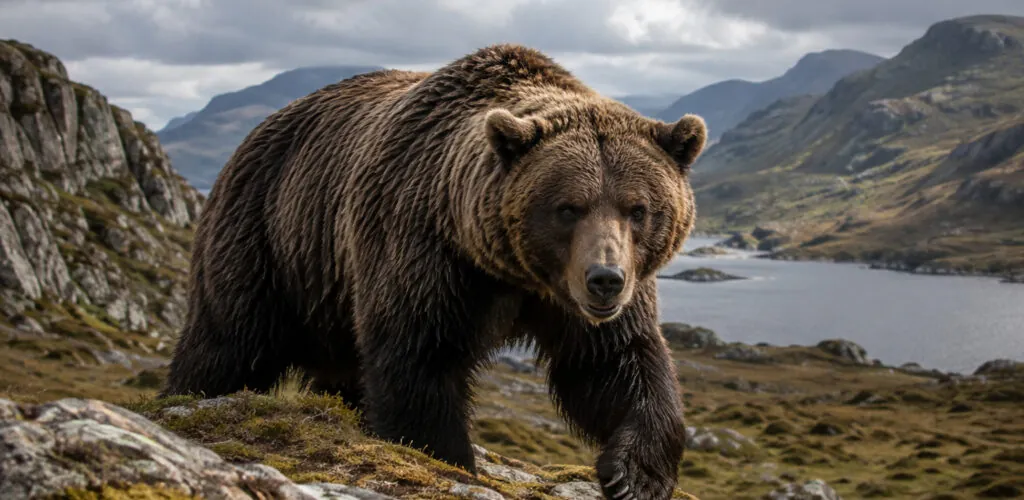
They actually came from two wild animals: a bear and a wild boar.
A bear really did live in prehistoric Ireland
Researchers are now seeking to identify its species precisely
The presence of a bear in prehistoric Ireland is not, in itself, entirely unexpected. Bears lived on the island before disappearing several millennia ago.
But the fragments from Ferriter’s Cove could provide new information about these ancient populations.
Researchers are now continuing their analyses to determine exactly which type of bear the bones belonged to.
Two possibilities are being explored in particular: the brown bear and, much more surprisingly, a bear with close affinities to the polar bear.
Caution is still needed, however: the scientists have not yet resolved the question. Further analyses are specifically intended to establish the animal’s identity.
The discovery changes part of Ireland’s history
One of the main pieces of evidence for livestock before 4000 BC has just disappeared
Ultimately, the real upheaval caused by this study does not concern the bear.
It concerns the cow that was not a cow.
By removing the Ferriter’s Cove fragments from the record of the earliest domestic animals, the researchers have eliminated one of the major archaeological arguments for the early presence of cattle in Ireland.
According to the research team, there is now no archaeological evidence to support the claim that domestic cattle — and, by extension, farming communities — had reached or influenced Ireland before around 4000 BC.
That does not mean Irish hunter-gatherers necessarily lived in complete isolation from the rest of Europe.
It does, however, mean that one of the best-known pieces of evidence used to support the hypothesis of very early contact with European farmers has disappeared.
And all because of a few pieces of bone misidentified more than 30 years ago.
Ferriter’s Cove, a small corner of Kerry that became important to archaeology
The Dingle Peninsula preserves traces of Ireland’s last hunter-gatherers
For travellers, Ferriter’s Cove could easily go unnoticed.
This small wild bay lies at the western end of the Dingle Peninsula, amid a striking landscape of cliffs, pastureland and the Atlantic. Yet beneath its apparent tranquillity lies one of the sites that helps us better understand the people living in Ireland several thousand years before the Celts.
Excavations at Ferriter’s Cove have uncovered stone tools, animal remains and various traces of human occupation.
Above all, the new study is a reminder of how much archaeology can evolve.
A bone identified visually several decades ago can now be re-examined using chemistry and molecular biology. And sometimes, a few proteins preserved for more than six millennia are enough to call into question a theory taught and debated for 30 years.
In Kerry, Ireland’s most famous prehistoric cow has thus disappeared from history.
In its place were a bear and a wild boar.
Sources: study led by University College Dublin with researchers from University College Cork, and biomolecular analyses carried out at the CNRS in Lille; results announced on 18 August 2026 and presented in PAST, the publication of the Prehistoric Society.