
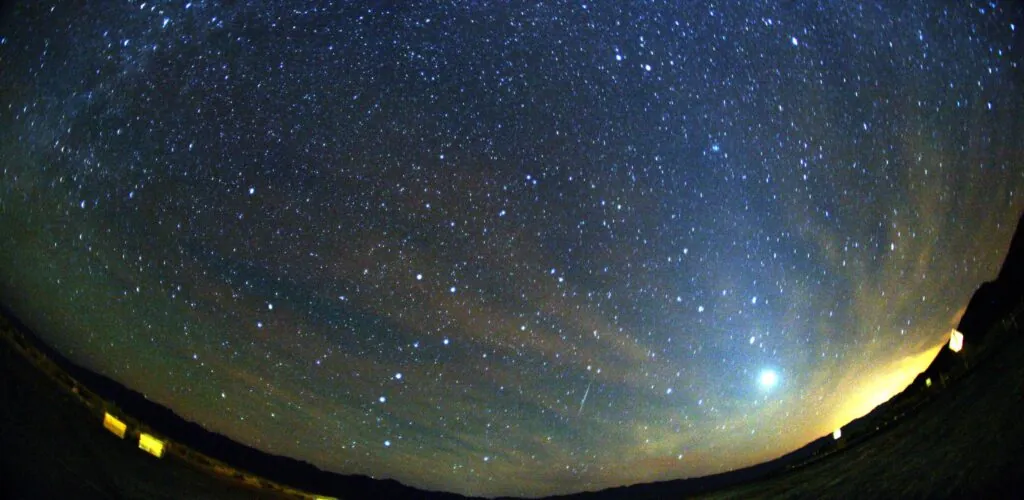
There is no need to wait for Halley’s Comet to return to encounter its legacy. Every autumn, Earth passes through a trail of debris left in its wake. Some of it burns up in our atmosphere: the Orionids. In Ireland, the 2026 event comes with one very earthly condition: finding a break in the clouds, then allowing your eyes to adjust to the night.
The Orionids return around 21 October 2026
The night of 21–22 October to remember
The Royal Observatory Greenwich places the peak on the night of Wednesday 21 to Thursday 22 October 2026. The shower remains active from 2 October to 7 November: this date is a useful marker, rather than the only moment when everything happens. A nearby evening may also offer good viewing if the sky clears.
The Natural History Museum in London, however, warns that 2026 conditions will be affected by moonlight. The peak falls just a few days before the full Moon, so fainter meteors may be lost in the brightened sky.
A post-midnight date, with no promise of fireworks
Favour the hours after midnight and before dawn, checking the Moon’s setting time and cloud cover for your location. Greenwich’s estimate of around fifteen meteors an hour remains an indication of what may be seen in good conditions, never a guarantee. Clouds, light and the horizon all reduce what is actually visible.
A luminous link with Halley’s Comet
What a shooting star tells us
NASA explains that these particles come from Comet 1P/Halley. As our planet passes through its debris trail, it encounters them: they enter the atmosphere and create the streaks of light we call shooting stars. They are not falling stars, nor is Halley itself returning this week.
The Orionids appear to radiate from the same region of the sky, in the constellation of Orion: this is their radiant. But they can appear elsewhere across the sky. There is no need to stare at one fixed point; the display calls instead for an open gaze and time.
Where to watch the Orionids in Ireland
Mayo, an invitation to rediscover the night
Wild Nephin National Park is home to Mayo Dark Sky Park, recognised for the quality of its darkness. The National Parks service lists three viewing locations: Ballycroy Visitor Centre, Claggan Mountain Coastal Trail and Brogan Carroll Bothy. These are useful reference points when planning your outing; check access, guidance and any restrictions before setting off.
There is no need to cross the island, however. Near your accommodation, first look for an authorised, open spot away from artificial lighting. A dark sky cannot make up for cloud cover: a modest location beneath a clear spell is better than a long journey to a site that is completely overcast.
An outing to prepare before nightfall
Choose your location in daylight and stick to permitted access routes. In the mountains, by the water or near cliffs, darkness changes how the terrain is read; for a first viewing, choose a spot that is easy to reach. Check Met Éireann forecasts and warnings shortly before heading out, without treating this article as a weather forecast.
How to enjoy the evening without a telescope
Time, warm clothing and a wide expanse of sky
NASA recommends getting away from streetlights, making yourself comfortable and allowing your eyes around thirty minutes to adjust. A blanket and reclining chair make the wait more pleasant. Avoid bright screens: checking them constantly prevents you from making the most of the darkness.
Watching with the naked eye works particularly well: binoculars and telescopes restrict the portion of sky you can monitor. Be patient. A quiet minute, then a brief streak, sometimes nothing for a long time: that unpredictability is part of the experience. Beneath Irish skies, the best promise remains that of a night seen differently.
Information checked on 18 October 2026. Sources: Royal Observatory Greenwich, article dated 29 September 2026; NASA; Natural History Museum; National Parks of Ireland. Local conditions should still be checked before any observation.
Featured image: photograph of an Orionid meteor in October 2007, with no established Irish location. Brocken Inaglory, Wikimedia Commons, CC BY-SA 3.0. Image resized and compressed; it does not depict the 2026 event.