
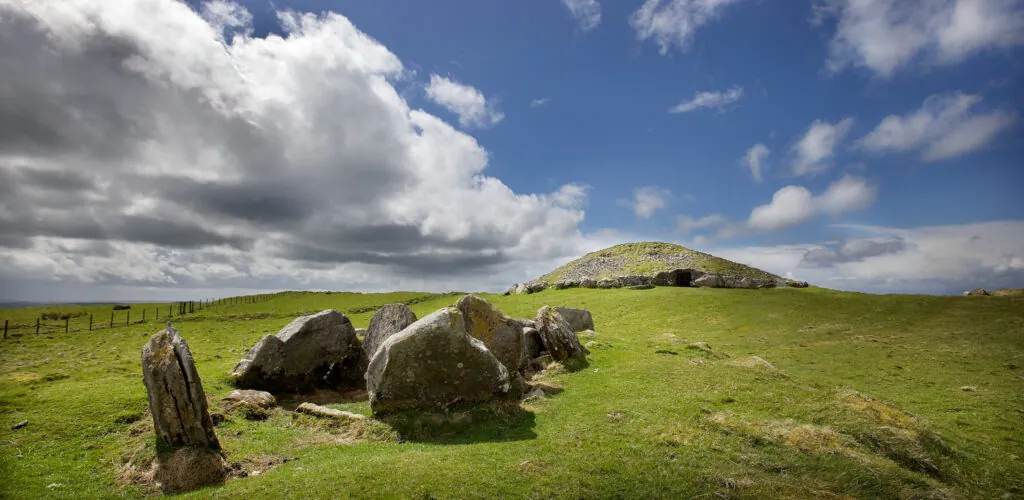
Stones carved nearly 5,000 years ago have been struck and covered in graffiti: one of Ireland’s major prehistoric burial complexes has suffered further damage. On 21 September 2026, authorities reported a serious act of vandalism at the megalithic cemetery of Loughcrew, near Oldcastle in County Meath. The news, reported by several Irish media outlets on 22 September, concerns stones inside one of the passage tombs, some of which are decorated with megalithic art.
The Office of Public Works (OPW), the National Monuments Service and the Irish government department responsible for heritage inspected the site. The case is now under investigation by An Garda Síochána, the Irish police force. At this stage, the authorities have not publicly specified the exact number of stones affected, the identity of those responsible or the prospects for restoration.
What happened at Loughcrew?
According to the heritage services’ statement reported by the Irish press, stones in a passage tomb were damaged by blows and graffiti. Some of the stones concerned bear megalithic decoration, which is precisely what makes the incident so worrying. On a prehistoric monument, a recent inscription is not simply a mark that can be erased without consequence: it may alter the original surface and the traces left by Neolithic builders.
The authorities have described the incident as a serious attack on heritage, falling under Irish national monuments legislation. The OPW and the National Monuments Service carried out an inspection, while the Garda investigation continues. No verified information currently makes it possible to attribute the damage to an individual or group, or to state that all the affected carvings have been irretrievably lost.
Why is Loughcrew an exceptional site?
A few kilometres from Oldcastle, the Loughcrew Cairns comprise a group of passage tombs built around 3000 BCE. The site is also known as the Hills of the Witch, a name referring to the stories surrounding its hills and monuments.
The tombs are spread across several hilltops. Their chambers and stones preserve abstract motifs — circles, radiating lines and other geometric forms — which bear witness to the funerary practices and artistic expression of Neolithic communities. Loughcrew is one of Ireland’s four major passage tomb complexes, alongside Brú na Bóinne, Carrowmore and Carrowkeel.
A tomb linked to the equinox sun
Cairn T, one of the site’s best-known monuments, is aligned with the rising sun at the spring and autumn equinoxes. When conditions allow, light enters its passage and illuminates engraved motifs at the back of the chamber. This feature links Loughcrew to astronomy, the skills of its builders and the landscapes of County Meath. We recently explained this phenomenon in our article on the equinox sun at Loughcrew.
The damage reported in September 2026 concerns a passage tomb within the cemetery; the statements consulted do not make it possible to identify the precise monument with certainty. It would therefore be premature to state that Cairn T itself was vandalised.
A precedent in 2021: the site had already been targeted
Unfortunately, this is not the first time Loughcrew has made the news for the wrong reasons. In April 2021, graffiti had already been carved into ancient stones, prompting outrage among specialists and authorities. Monitoring measures were announced at the time. Read our article on the 2021 damage.
The September 2026 incident is a new case: images, statements or decisions from five years ago should not be confused with the current findings. The available information also does not allow us to conclude that the measures adopted at the time were still in place when the new incident occurred.
Can Loughcrew still be visited?
At this stage, the announcements concerning the vandalism do not state that a general closure of the site has been decided as a result. There is, however, a restriction unrelated to this incident: access to the interior of Cairn T is already impossible because of conservation works, while the outdoor areas remain accessible according to information published by Heritage Ireland and Meath County Council.
If you are planning a visit, check the latest information on the official Heritage Ireland page. The climb is steep, the access road is narrow, and it is forbidden to climb on the monuments or mark the stones. To plan your visit, also consult our practical guide to the Loughcrew Cairns.
Preserving traces that no one can replace
Loughcrew’s monuments have endured for several millennia. Their preservation depends as much on the work of archaeologists and heritage teams as on visitors’ behaviour. The OPW and the National Monuments Service remind visitors not to scratch or write anything on the stones: some ancient motifs are so faint that they are difficult to make out with the naked eye.
It remains to establish the precise extent of the damage from September 2026 and to determine what conservation measures may be possible. The police investigation is ongoing; we will update this article if the authorities publish further information.