In a few days’ time, at dawn, a ray of sunlight should once again pass through the narrow passage of a Neolithic tomb perched in County Meath. If the Irish sky cooperates, the light will reach the back of Loughcrew’s Cairn T and reveal the patterns carved into its stones. It is a silent spectacle conceived by builders more than 5,000 years ago, long before the pyramids of Giza.
At Loughcrew, the countdown to the equinox has begun
A light phenomenon expected around 23 September 2026
The autumn equinox will occur in Ireland on the night of Tuesday 22 to Wednesday 23 September 2026. A few hours later, at daybreak, the Sun will rise almost exactly in the east. It is this particular position that allows its first rays to stream into the passage of Cairn T, one of the principal monuments at the Loughcrew Cairns.
The phenomenon is not confined to a single precisely timed second. The alignment may be visible over several mornings around the equinox, with its path and intensity changing slightly from one day to the next. It also depends on the weather: thick cloud cover is enough to obscure an event the monument has nevertheless been preparing for five millennia.
When the sun illuminates a 5,000-year-old carved stone
The beam passes through the passage before reaching the chamber
At dawn, the light enters through the east-facing entrance, travels along the stone passage and reaches the cruciform chamber. There, it illuminates the rear stone, which is covered in Neolithic motifs. Circles, radiating shapes, lines and geometric designs gradually emerge from the darkness as the beam moves across the surface.
The effect is brief, delicate and achieved by no mechanism other than the Sun’s apparent course. Yet it points to a precise understanding of the landscape and the sky. The builders must have observed the changing position of sunrise through the seasons for a long time before selecting the passage’s orientation. Nothing allows us to know with certainty the exact meaning of this staging of light. It may have served as a seasonal marker, accompanied funerary rites or formed part of community gatherings. Several purposes may well have overlapped.
A monument older than Newgrange
Loughcrew forms part of one of the Neolithic era’s great funerary complexes
The Loughcrew complex dates from around 3000 BC and is thought to be approximately 5,200 years old. It extends across several hilltops in north-west County Meath, including Carnbane East, Carnbane West, Carrickbrack and Patrickstown. Archaeologists have recorded dozens of cairns here, although not all are as well preserved or as readily identifiable.
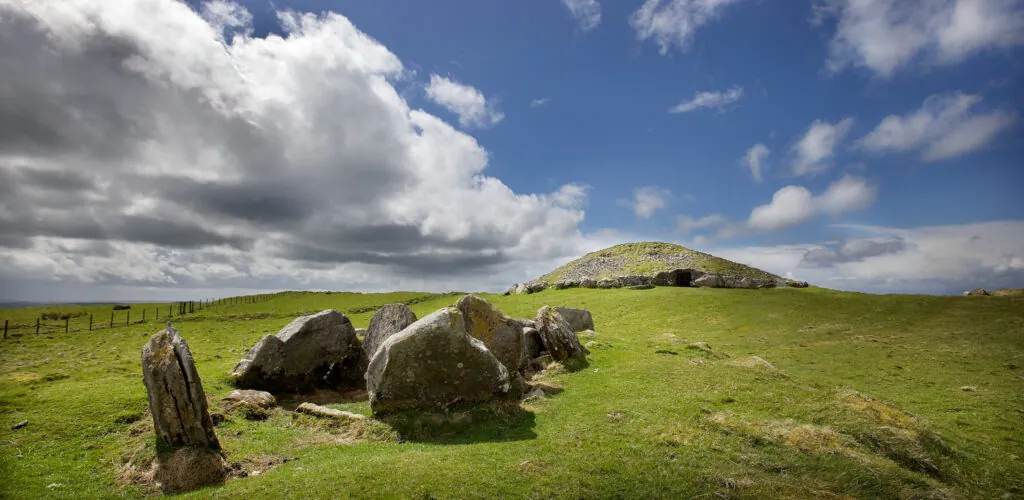
Cairn T overlooks the complex from the summit of Carnbane East, at an elevation of around 276 metres. Beneath its pile of stones lies a complex structure: a passage leads to a chamber with three side recesses, roofed using corbelling. Several orthostats bear abstract engravings characteristic of Irish megalithic art.
Loughcrew is sometimes overshadowed by Newgrange, whose alignment with the winter solstice is known around the world. Yet the two sites do not tell quite the same story. At Newgrange, solstice light passes through an opening specially constructed above the entrance. At Loughcrew, the orientation of Cairn T’s passage is associated with sunrise at the spring and autumn equinoxes.
Did Neolithic builders understand astronomy?
An achievement of observation rather than an observatory in the modern sense
Speaking of ‘astronomy’ can suggest that Neolithic communities possessed calculations comparable to our own. Their knowledge was more likely based on patient, repeated observation. From the hills of Loughcrew, the eastern horizon is largely unobstructed. From one week to the next, the point at which the Sun appears shifts. This regular rhythm could have been remembered, passed on and incorporated into construction.
Cairn T’s alignment shows, in any case, that the monument was not sited at random. Its orientation connects the interior space, the surrounding terrain and an important moment in the annual cycle. The Sun does more than illuminate the tomb: it seems to activate it, revealing for a few moments signs that remain invisible the rest of the time.
A relatively recent modern discovery
The alignment was brought to light again in the 20th century
The cairns had long been known, and their present naming system dates back to Eugene Conwell’s work in the 19th century. Cairn T’s light alignment, however, was documented in the contemporary era in the early 1980s, notably through the observations of Martin Brennan. Since then, equinox sunrise has drawn photographers, archaeology enthusiasts and curious visitors to the heights of Loughcrew.
This rediscovery transformed perceptions of the monument. Cairn T is no longer regarded simply as an ornamented monumental tomb; it is also understood as an architectural structure closely connected to the seasonal movement of light.
Can you witness the phenomenon from inside in 2026?
Cairn T’s chamber remains closed for conservation
This is the essential point to note before planning a visit: access to the interior of Cairn T is currently impossible because of conservation work. The light phenomenon can still occur in the chamber, but visitors cannot enter to observe it directly. Heritage Ireland states that the other monuments on the hill are not affected by this closure.
Visitors can reach the outdoor areas and watch day break from the summit, subject to access and safety conditions. The Office of Public Works has not, to date, announced any exceptional opening of the chamber for the autumn equinox in 2026. It is therefore essential not to confuse watching the sunrise at the site with access to the interior of the tomb.
What to know before climbing to Loughcrew
A short but steep, exposed climb
The site is at Corstown, around three kilometres east of Oldcastle. The climb to Cairn T is steep, and the ground can become slippery after rain. Footwear with good grip is essential, particularly before sunrise. The approach road is narrow and also requires care.
At this time of year, bring warm clothing, a waterproof jacket and a torch for the early-morning walk, while never shining harsh light directly at the monuments or their engravings. Dogs must be kept on leads. The summit is not wheelchair accessible because of the slope and nature of the terrain.
The stones are protected under the National Monuments Acts. It is forbidden to mark or scratch them, or to try to make the motifs stand out. Some engravings are extremely faint, and any intervention, however harmless it may seem, can cause irreversible damage.
Why this moment continues to fascinate
A message whose language we have lost
No one can say with certainty what Loughcrew’s builders wished to express. That is precisely what makes this encounter so powerful. As light glides across the carved stone, an architectural gesture more than five millennia old still works as intended, despite erosion, collapses and the disappearance of the society that conceived it.
The Sun will rise regardless of the clouds or the visitors. In the darkness of Cairn T, its beam will once again seek out the rear stone. For a few minutes, Loughcrew will remind us that Ireland’s first great monuments were not merely built into the landscape: they were conceived with it.