
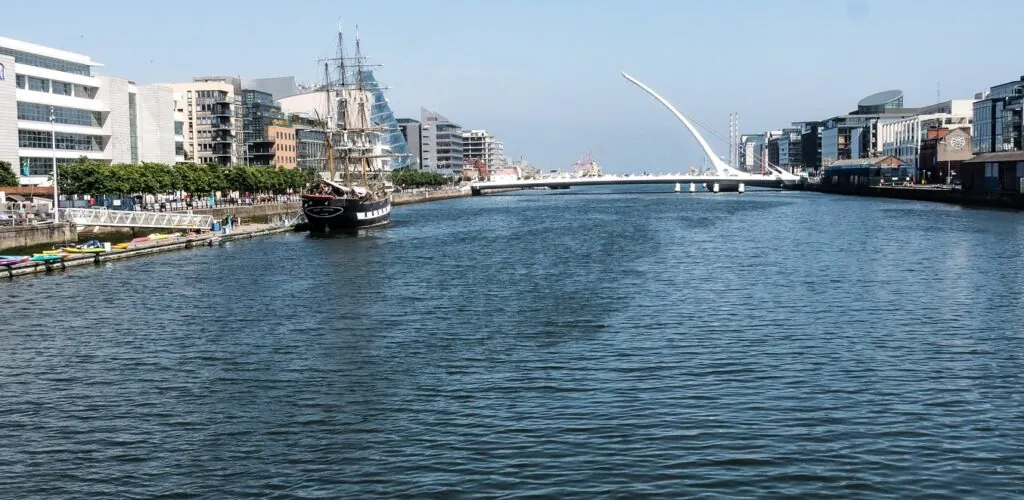
The artificial intelligence revolution is taking up residence along Dublin’s quays. OpenAI, the American company behind ChatGPT, has just announced a major expansion of its activities in Ireland. A new European headquarters, 250 additional jobs and nearly 8,200 m² of office space: the company led by Sam Altman intends to make the Irish capital one of the main centres of its development in Europe.
OpenAI significantly expands its European headquarters in Dublin
A new Irish chapter for the creator of ChatGPT
OpenAI announced on 27 July 2026 that it would create 250 jobs in Dublin over the next two years. The company already employs more than 100 people in Ireland. This new wave of recruitment should therefore bring its local workforce to more than 350 employees.
To accommodate this expanded team, OpenAI has leased the Tropical Fruit Warehouse, a large property complex located in Dublin’s Docklands. The building will become the company’s new headquarters for the European Union at the end of 2026.
The new offices will cover 88,000 square feet, or approximately 8,175 m². They will bring together the Irish teams, welcome European businesses and developers, and showcase technologies developed by OpenAI.
The announcement confirms the strategic importance Dublin has taken in the group’s international organisation. Ireland will no longer be merely a branch responsible for supporting European activities: it will become one of OpenAI’s main operational centres outside the United States.
OpenAI has already been present in Ireland since 2023
A discreet arrival that has become a strategic presence
Contrary to what this new announcement might suggest, OpenAI is not discovering Ireland. The company opened its first office there in September 2023, after San Francisco and London.
At the time, this presence was primarily intended to support its European operations in trust and safety, security engineering, business development and legal affairs.
Three years later, the change in scale is spectacular. The Irish team now numbers more than one hundred people, and Dublin has officially acquired the status of OpenAI’s headquarters for the European Union.
The company is led locally by Emma Redmond, head of OpenAI Ireland and responsible for legal, privacy and data protection matters. This organisation illustrates Dublin’s particular role: the capital must both support ChatGPT’s commercial development and enable the company to meet European regulatory requirements.
What jobs will OpenAI create in Dublin?
Recruitment extending well beyond IT roles
The 250 announced positions will not be reserved exclusively for engineers and artificial intelligence model specialists. OpenAI plans to recruit in many areas needed to develop its European activities.
The jobs will notably cover engineering, sales and service go-to-market, user operations, human resources, finance, law, privacy, internal services and management of the future headquarters.
This diversity is important. It shows that Dublin will not become merely a sales office responsible for selling ChatGPT subscriptions. Some teams will contribute to the technical operation of the services, user support and the handling of legal or regulatory issues encountered in the European Union.
OpenAI has not provided a salary grid or a detailed schedule for each recruitment drive. Positions are expected to be published gradually on the company’s careers portal over the next two years.
The Tropical Fruit Warehouse will house OpenAI
A European headquarters in Dublin’s Docklands
To symbolise this new stage, OpenAI has chosen a building with a hard-to-forget name: the Tropical Fruit Warehouse. Located in the Docklands, along Dublin’s quays, this former warehouse converted into contemporary offices belongs to IPUT Real Estate.
The building combines a historic brick structure with modern workspaces. OpenAI is due to move in at the end of autumn 2026, according to information shared when the announcement was made.
The Docklands area, sometimes nicknamed the “Silicon Docks”, is already home to numerous international digital companies. Google, Meta, Microsoft and other American groups have established significant operations in this part of the capital.
The arrival of OpenAI’s new headquarters further strengthens this specialisation. After welcoming giants of the web, social media and software, Dublin is now seeking to establish itself as one of Europe’s main centres for artificial intelligence.
Why is OpenAI investing so heavily in Ireland?
Talent, European regulation and a technology ecosystem
Dublin’s choice reflects several considerations. First, Ireland has a large international and English-speaking workforce trained in technology, law, finance and user services.
The longstanding presence of many multinationals has also created a broad ecosystem of expertise. Professionals who have worked for digital platforms, software publishers or cybersecurity companies can be recruited without leaving Dublin.
The capital is also a gateway to the European single market. For a company such as OpenAI, facing complex rules concerning personal data, platform security and the regulation of artificial intelligence, this presence has a major regulatory dimension.
Ireland also offers an environment that is highly favourable to foreign investment. Multinationals, mainly active in technology and pharmaceuticals, account for approximately 11% of the country’s jobs. Irish taxation remains a factor in its appeal, even though the authorities now place greater emphasis on available skills, universities and research capabilities.
Dublin at the heart of OpenAI’s European strategy
A headquarters designed to support users, businesses and developers
The Irish expansion comes as the use of ChatGPT continues to grow in Europe. According to data shared during the announcement, more than one million people now use the service in Ireland.
The future European headquarters will be tasked with meeting this growing demand. It should enable OpenAI to work more closely with businesses integrating its models into their services, developers using its application programming interfaces and organisations wishing to train their employees in artificial intelligence.
Irish companies are already using OpenAI technologies to automate certain tasks, programme, improve customer service or develop new products. The announcement specifically cites Lenehans Hardware, a historic hardware retailer, and Tines, an Irish company specialising in automation and cybersecurity.
This contrast neatly sums up the stated ambition: to bring artificial intelligence into both young technology companies and much more traditional commercial activities.
OpenAI for Ireland aims to train Irish businesses
Artificial intelligence workshops for SMEs
The establishment of the new headquarters will also support the OpenAI for Ireland programme, launched in November 2025 with the Irish government, Dogpatch Labs and the organisation Patch.
This initiative seeks to facilitate the adoption of artificial intelligence by small and medium-sized businesses, young entrepreneurs and start-up founders. A programme called SME Booster is notably intended to provide practical training, workshops and mentoring sessions for Irish SMEs.
OpenAI is also working with Dogpatch Labs, one of Dublin’s leading start-up hubs. The aim is to help young companies integrate artificial intelligence tools into their products and working methods.
A three-year partnership has also been concluded with Patch, a programme for creators and entrepreneurs aged 16 to 21. OpenAI thus intends to contribute to training a new generation of Irish developers and founders.
Ireland wants to become a European artificial intelligence hub
OpenAI joins an already highly active technology race
The announcement comes amid strong competition between artificial intelligence companies. Anthropic, the company behind the Claude assistant, has also chosen Dublin for its European headquarters. In March 2026, it announced the creation of 200 additional jobs in Ireland by 2027.
Other groups are investing in the country at the same time. MongoDB announced in April 2026 a €74 million package to develop its Irish engineering and artificial intelligence activities. Intel, for its part, plans to invest €5 billion in its Leixlip site to meet demand for computer components linked to AI and high-performance computing.
The Irish government now considers artificial intelligence a priority lever for renewing technology investment. This direction comes at a delicate time: several major platforms, including Meta and TikTok, have recently announced staff reductions in their Irish operations.
OpenAI’s job creation therefore brings encouraging news, without erasing the sector’s broader transformations. Artificial intelligence is creating highly skilled jobs, but it is also changing certain administrative, commercial and technical roles previously held in large digital companies.
What OpenAI’s announcement does not include
A European headquarters, but not a ChatGPT factory
The future Dublin site will be an office complex, not a data centre. OpenAI has announced neither the construction of giant servers in Ireland nor infrastructure intended to directly train its artificial intelligence models.
The distinction is important in a country where data centres are regularly debated because of their electricity consumption and impact on the energy grid. The Tropical Fruit Warehouse will mainly accommodate employees, clients, developers and partners.
OpenAI has also not disclosed the total financial amount of this investment. The confirmed information concerns the lease of 88,000 square feet of office space, the creation of 250 positions and a move planned for the end of 2026.
A new chapter for Dublin’s Silicon Docks
The Irish capital prepares for the post-Big Tech era
For two decades, Dublin built its digital reputation on the presence of American web giants. Google, Meta, Microsoft, LinkedIn and many other companies developed their European operations there.
With OpenAI and Anthropic, a new generation of players is now setting up along the quays. They no longer work only on search engines, social networks or software: they develop models capable of producing text, images and code, and of supporting a multitude of professional tasks.
The opening of OpenAI’s new European headquarters therefore does not mark its arrival in Ireland, but its true change in scale. Moving from a small presence opened in 2023 to a team expected to exceed 350 people, the company is making Dublin a central base for its activities in the European Union.
In the former warehouses of the Docklands, crates of goods have given way to screens and artificial intelligence models. Quite a Dublin transformation: keeping the walls while completely changing what happens inside.