Solar eclipse of 12 August 2026 in Ireland: where and when to see it?
An exceptional astronomical phenomenon visible across Ireland
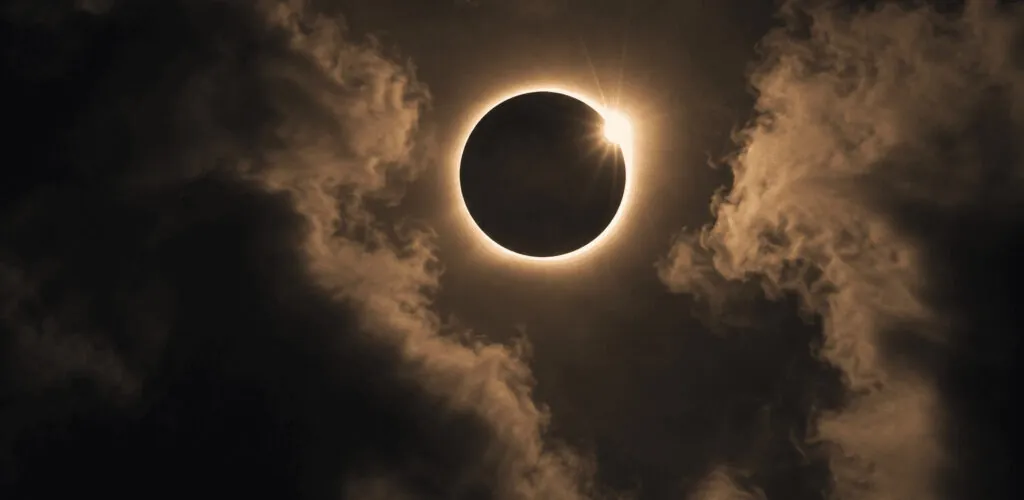
The Irish sky is set to offer a rare spectacle. On Wednesday 12 August 2026, a spectacular solar eclipse will be visible throughout Ireland. Although the island will not lie within the path of totality, the phenomenon will be particularly striking: depending on the region, around 94% to more than 96% of the Sun’s disc will be obscured by the Moon.
The eclipse will begin shortly after 6 pm and reach its maximum at around 7.10 pm. For a few minutes, only a thin sliver of the Sun will remain visible in the Irish sky.
The south-west of the country will be particularly well placed. In some parts of Kerry, the obscuration could reach around 96% to 97%. Cork, Limerick and Galway will also enjoy a particularly deep eclipse.
UPDATE — Wednesday 12 August 2026
Solar eclipse in Ireland: where will skies be clearest this evening?
Good news for Dublin, eastern and south-eastern Ireland
With only a few hours to go before the solar eclipse, the latest weather forecasts now make it possible to identify the regions expected to have the best viewing conditions on Wednesday evening.
And the news is fairly encouraging: after a sometimes cloudy start to the day, sunny spells should become increasingly frequent through the afternoon.
According to Met Éireann’s latest forecasts, the longest periods of sunshine are expected in eastern and south-eastern Ireland. By contrast, the west and south-west coasts are expected to remain cloudier.
Eclipse weather map: the best-placed regions
Estimated viewing conditions for the maximum at around 7.10 pm
Very good chances
Sunny spells expected in the evening
Most favourable area
More prolonged sunny spells
More uncertain
More cloud cover
Higher risk of cloud
A sunny break is essential
Important: this map summarises the forecasts available on Wednesday morning. Cloud cover can change quickly: check local conditions before choosing your viewing spot.
Dublin could ultimately be one of the best places
Sunny spells are expected at the time of maximum eclipse
The situation is particularly promising in Dublin. The hourly forecasts available on Wednesday morning indicate a gradual improvement in the late afternoon, with fairly sunny weather around 6 pm and even more favourable conditions by 7 pm.
As the eclipse is expected to reach its maximum in Dublin at around 7.10 pm, the timing could be excellent.
Around 94% of the Sun’s disc will then be obscured. The obscuration will be slightly less extensive than in Kerry, but the weather could more than make up for the difference.
Wexford and Waterford among the best options
The south-east should enjoy the longest sunny spells
South-eastern Ireland currently looks like one of the most promising areas from which to view the phenomenon.
Met Éireann forecasts that the day’s longest spells of sunshine will develop in the east and south-east.
The counties of Wexford and Waterford could therefore offer an excellent balance between a very deep eclipse and relatively limited cloud cover.
Kerry: a spectacular eclipse but less favourable weather
The south-west remains best placed astronomically
The situation is almost the reverse in Kerry.
South-western Ireland remains the region where the eclipse will be most spectacular. Around Valentia Island and the Iveragh Peninsula, close to 97% to 98% of the Sun could be obscured.
But the weather forecast is less favourable: Met Éireann expects predominantly cloudy conditions to persist near the western and south-western coasts.
A sunny break around 7 pm would, of course, be enough to enjoy an exceptional spectacle. But for travellers able to choose their viewing location, Kerry should not necessarily be prioritised solely to gain a few percentage points of obscuration.
Where should you go to maximise your chances?
Above all, choose an unobstructed western horizon
With only a few hours to go before the eclipse, our first choice would therefore be south-eastern and eastern Ireland.
Wexford, Waterford and the east coast currently have the most encouraging forecasts. Dublin is also an excellent option, particularly as the hourly forecast indicates sunny spells at the time of maximum eclipse.
Wherever you choose, look above all for somewhere with a clear, unobstructed horizon to the west. The Sun will already be relatively low in the sky when the eclipse reaches its maximum.
Avoid places surrounded by buildings, trees or hills that could block the horizon.
Intro: Good news for this evening’s eclipse: sunny spells should spread into eastern and south-eastern Ireland. Dublin, Wexford and Waterford currently appear to be the best places to enjoy the spectacle.
Meta description: Where can you see the solar eclipse in Ireland on 12 August 2026? Discover the weather forecast, our map of the best regions and the areas where skies should be clearest.
What time can you see the solar eclipse in Ireland?
The maximum is expected at around 7.10 pm
The eclipse will take place in the early evening, allowing many travellers to enjoy it. Times will vary slightly depending on location.
| City | Start | Maximum | End | Sun obscured |
|---|---|---|---|---|
| Dublin | 6.12 pm | 7.10 pm | 8.05 pm | Around 94% |
| Galway | 6.12 pm | 7.10 pm | 8.06 pm | Around 96% |
| Limerick | 6.13 pm | 7.11 pm | 8.07 pm | Around 96% |
| Waterford | 6.14 pm | 7.12 pm | 8.07 pm | Around 95% |
| Cork | 6.15 pm | 7.13 pm | 8.08 pm | Around 96.4% |
Where can you see the solar eclipse in Ireland?
Kerry and the south-west will be particularly well placed
To make the most of the phenomenon, south-western Ireland appears to be one of the most interesting regions. Some areas of County Kerry are expected to approach 97% obscuration.
The Atlantic coast also offers a considerable advantage: its many open spaces make it easy to find a wide, unobstructed horizon.
The Ring of Kerry, the Dingle Peninsula and parts of the West Cork coast could therefore offer spectacular conditions, provided Irish clouds do not turn up for the occasion.
Galway and the Clare coast will also be very well positioned. In Galway, close to 96% of the Sun will be obscured.
However, there will be no need to cross Ireland to see the eclipse. In Dublin, close to 94% of the Sun’s disc will be obscured: the spectacle will still be remarkable.
What weather is forecast for the eclipse?
Cloud cover will be the real deciding factor
It is the great unknown. A solar eclipse with more than 96% obscuration obviously loses much of its appeal when a thick Irish cloud decides to sit directly in front of the Sun.
Two days before the event, forecasts are beginning to become accurate enough to identify the regions that could be most favourable. Cloud cover may nevertheless remain highly variable from one part of the island to another.
It will therefore be wise to check local forecasts on Wednesday morning before making a final decision on your viewing location.
Why will the eclipse not be total in Ireland?
The path of totality will pass further south
The eclipse of 12 August 2026 will indeed be a total solar eclipse on a global scale. The path in which the Moon will completely cover the Sun will cross Greenland, Iceland and northern Spain, among other places.
Ireland will remain just outside this zone.
From Irish territory, it will therefore be a partial solar eclipse, although the level of obscuration will be high enough to make the phenomenon spectacular.
It is important to make this distinction: even when more than 95% of the Sun is obscured, the eclipse never becomes total. A small portion of the Sun’s surface will remain visible from Ireland at all times.
Will the sky become completely dark?
A marked drop in light, but not true night
No. Even with 94% to 97% of the Sun obscured, Ireland will not be plunged into complete darkness.
However, ambient light should decrease very noticeably around the maximum. The atmosphere may take on an unusual appearance, and the perceived temperature may also fall slightly.
The phenomenon will be all the more impressive as the Sun will already be relatively low in the sky in the early evening.
Protect your eyes during the eclipse
Special glasses are essential
Never look directly at the Sun without suitable protection.
This rule still applies even when 90%, 95% or 97% of the Sun’s disc is hidden. The small part that remains visible is still intense enough to cause serious eye damage.
Glasses specifically designed for viewing eclipses must be worn throughout the phenomenon. They must comply with the international ISO 12312-2 standard.
Ordinary sunglasses, even very dark ones, do not provide sufficient protection.
Nor should you look directly at the eclipse through binoculars, a telephoto lens or a telescope without a suitable solar filter.
Can you photograph the eclipse with your smartphone?
A few precautions are necessary
A smartphone can be used to capture the atmosphere, but you should never look directly at the Sun through an optical device without suitable protection.
To take genuinely detailed photographs of the eclipse with a camera or telephoto lens, an appropriate solar filter is required.
For travellers, photographing the landscapes, changing light and overall atmosphere may also produce more interesting images than simply using digital zoom on the Sun.
Another astronomical spectacle a few hours later
The Perseids will also reach their peak
The evening of 12 August will be doubly exceptional for astronomy enthusiasts.
A few hours after the eclipse, the famous Perseid meteor shower will reach its peak on the night of 12 to 13 August.
Travellers will therefore be able to watch the eclipse in the early evening and then, if the sky remains clear, wait until nightfall to see the meteors.
For the Perseids, this time you should get as far as possible from the lights of Dublin, Cork, Galway and other major cities in order to enjoy a dark sky.
A day that could begin like any other summer day in Ireland, see the Sun almost disappear at around 7.10 pm, and end beneath a shower of shooting stars.