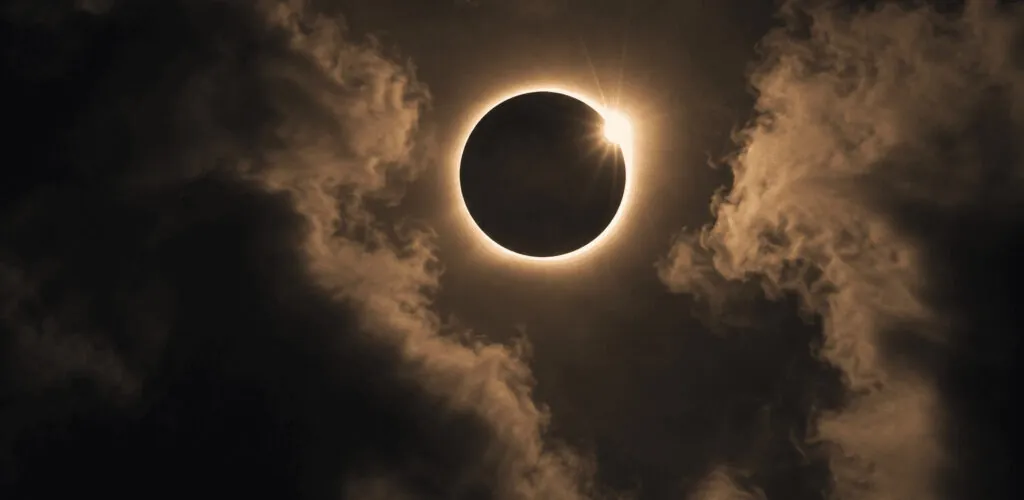
The Irish sky is set to host one of the major astronomical events of 2026. On Wednesday 12 August, a significant partial solar eclipse will be visible across Ireland, provided the clouds clear.
For almost two hours, the Moon will pass between the Earth and the Sun, gradually obscuring most of the solar disc. The eclipse will be total in some parts of Europe, including Iceland and Spain, but Ireland will lie outside the path of totality. Even so, the phenomenon will be spectacular, with more than 90% of the Sun obscured across much of the country.
When can you see the solar eclipse in Ireland?
Maximum eclipse expected at around 7.10pm
The eclipse will begin shortly after 6pm and end at around 8pm. Timings will vary slightly depending on the viewing location.
In Dublin, the event will begin at around 6.12pm. The eclipse will reach its maximum at approximately 7.10pm, before the Sun fully reappears at around 8.05pm. In Derry and several parts of Northern Ireland, the maximum will occur a few minutes earlier.
These timings are indicative: it is advisable to arrive at your viewing location before 6pm in order to see every stage of the event.
An almost total eclipse, but never total in Ireland
The Moon will obscure most of the Sun
From Ireland, this eclipse will remain partial. Even at its peak, a thin solar crescent will remain visible. The country will therefore experience neither complete darkness nor a true phase of totality, unlike areas located along the eclipse’s central path.
However, daylight may noticeably fade and the landscape may take on an unusual hue. According to Maynooth University, it will then be necessary to wait until 2090 to see an eclipse of comparable magnitude from Ireland.
Where can you see the eclipse in Ireland?
Choose a clear western horizon
The eclipse will be visible across the whole island, from Cork to Belfast via Galway, Dublin and Donegal. To make the most of the spectacle, it is best to choose a location with an unobstructed view to the west, as the Sun will already be relatively low in the sky by early evening.
Beaches, coastal headlands and rural areas away from buildings will generally offer the best conditions. The weather will nevertheless be crucial: check forecasts from Met Éireann or the Met Office a few days before the event.
Public events have also been announced. Maynooth University will notably host an evening of observation with suitable viewing glasses, solar telescopes, astronomy demonstrations and family activities.
How can you watch the eclipse safely?
Special glasses are essential throughout the observation
Never look directly at the Sun without suitable protection, even when it is almost entirely obscured. Eclipse glasses complying with the international ISO 12312-2 standard are essential. Ordinary sunglasses, even very dark ones, do not protect your eyes.
Binoculars, cameras and telescopes must also be fitted with a solar filter specifically designed to be placed in front of the lens. Looking through an optical instrument while wearing only eclipse glasses can cause serious eye damage.
Another option is to observe the phenomenon indirectly using a pinhole projector. Simple to make, this device projects an image of the Sun onto a surface without requiring you to look directly at it.
If the weather is favourable, the evening of 12 August 2026 could offer Ireland one of its most memorable natural spectacles of the decade.