Viator

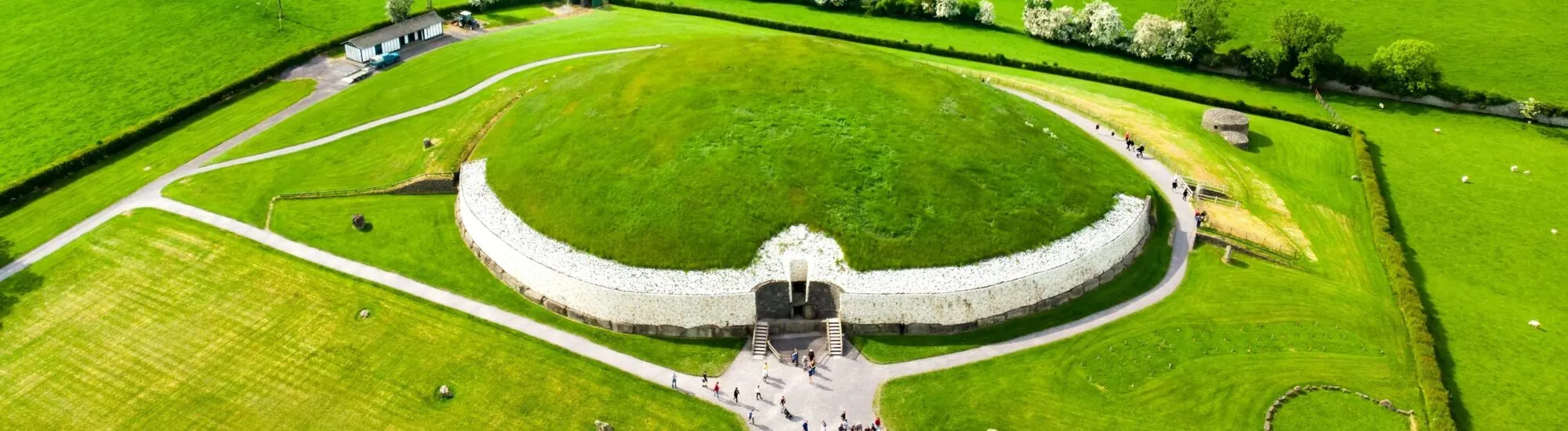
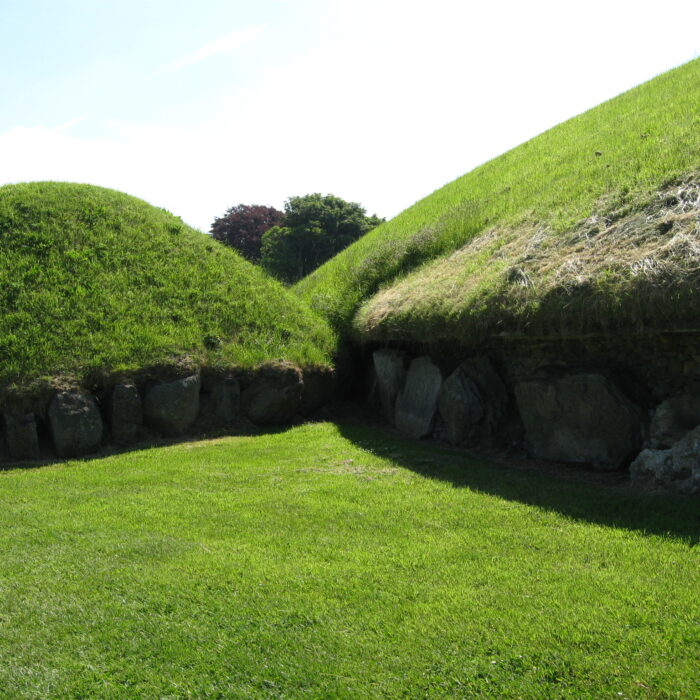
In a verdant bend of the Boyne, an immense white mound stands out against the landscape of County Meath. Beneath this almost unreal silhouette lies Newgrange, a passage tomb built around 3200 BCE by Neolithic farming communities.
The monument is older than the Great Pyramids of Giza and the stone circle at Stonehenge. Its architecture, carvings and alignment with sunrise at the winter solstice make it one of Europe’s most fascinating prehistoric sites.
Newgrange forms part of the vast archaeological landscape of Brú na Bóinne, a UNESCO World Heritage Site since 1993. From Dublin, allow around 45 minutes to an hour by car to reach the official visitor centre.
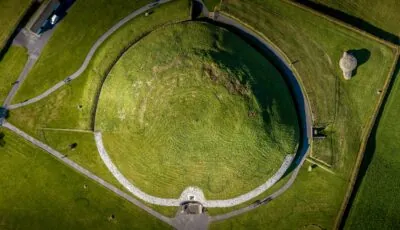
Aerial view of Newgrange – © Irish Drone Photography
Newgrange was built around 3200 BCE, roughly six centuries before the Great Pyramid of Khufu and several centuries before Stonehenge’s main construction phases.
The monument is generally described as a passage tomb. A long stone-lined passage leads to a central chamber, where cremated human remains and various objects were found. Yet this funerary role probably does not fully explain its purpose.
Newgrange was also likely a ceremonial place, associated with ancestors, the cycle of the seasons and the beliefs of Neolithic communities. Its construction required considerable collective organisation, as well as precise knowledge of materials, dry-stone building and the sun’s annual course.
The name Newgrange is far more recent than the monument itself. It is thought to derive from farmland, or a ‘new grange’, once belonging to Mellifont Cistercian Abbey. The original name given to the site by its builders is unknown.
Newgrange is not an isolated monument. It belongs to Brú na Bóinne, one of Europe’s richest archaeological landscapes. Within the great bend of the Boyne lie the passage tombs of Newgrange, Knowth and Dowth, along with dozens of other prehistoric monuments.
The UNESCO World Heritage Site covers around 780 hectares and includes more than 90 sites identified to date. Tombs, mounds, standing stones and enclosures bear witness to the valley’s long history of occupation, extending far beyond the Neolithic period alone.
Newgrange is now the best known of these monuments, thanks to access to its inner chamber and its spectacular alignment with the winter solstice sun. Knowth, however, preserves an even greater quantity of megalithic art, while Dowth offers a wilder way to explore the archaeological landscape.
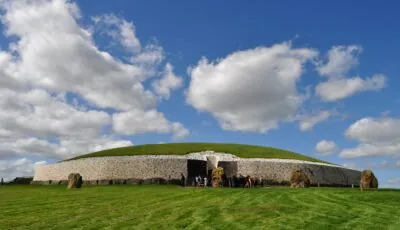
Newgrange – © LucileB
After prehistory, Newgrange probably continued to feature in local stories and traditions. Its entrance was eventually blocked, however, and the monument gradually came to resemble a large artificial hill.
In 1699, the landowner Charles Campbell asked workers to remove stones from the mound. They cleared the entrance and discovered the passage leading to the chamber. The Welsh antiquarian Edward Lhuyd subsequently visited the site and wrote one of its first scholarly descriptions.
It would therefore be inaccurate to describe Edward Lhuyd as Newgrange’s sole ‘discoverer’. Rather, he was among the first scholars to observe, document and publicise the monument after its accidental reopening.
The principal modern excavations were carried out by archaeologist Michael J. O’Kelly between 1962 and 1975. This work provided a clearer understanding of the mound’s structure, its various stones, its megalithic art and its astronomical alignment.
Major restoration work was carried out alongside the excavations. The present façade, made up of white quartz and dark stones, is partly the result of this reconstruction. Its appearance remains debated by some specialists, particularly regarding how the quartz blocks were originally arranged.
The monument seen today has therefore not remained wholly unchanged since the Neolithic period. Its passage, chamber, much of its outer stonework and its carvings are authentic, but several exterior elements have been rebuilt or restored to stabilise and clarify the whole structure.
Newgrange – Brian Morrison – © Tourism Ireland
Newgrange measures around 85 metres in diameter and rises to almost 13 metres high. Its kidney-shaped mound covers an area of more than one hectare.
The base of the monument is encircled by 97 large stones known as kerbstones. Several bear carved motifs: spirals, arcs, lozenges, parallel lines and circular forms. The stone in front of the entrance is the best known, with its large composition of triple spirals.
These designs are not a known form of writing. Their precise meaning remains beyond reach, although they appear to be connected to the symbolic systems, beliefs and ritual practices of Neolithic peoples.
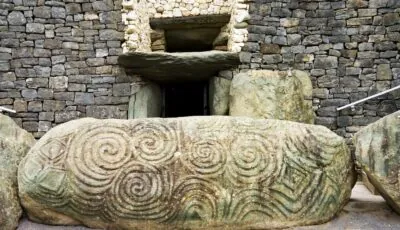
Entrance to Newgrange – © UnaPhoto
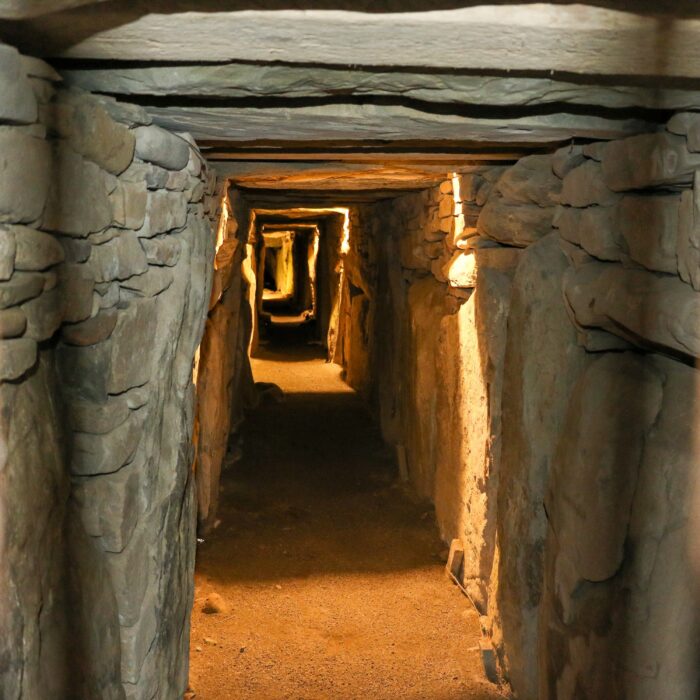
From the entrance, a narrow passage of around 19 metres runs through the mound. Its walls are formed by large upright stones, some decorated with megalithic carvings.
The passage opens into a cruciform chamber with three recesses. Stone basins were placed there, probably to hold human remains or ritual deposits.
Above the chamber, the builders laid slabs on top of one another, gradually projecting them inwards. This corbelling technique created a high vault without mortar. More than five millennia after its construction, the structure remains stable and still protects the interior from most water ingress.
The space is low, narrow and dark. Visiting the chamber may be difficult for people with claustrophobia or mobility issues. Photography is prohibited inside.
The builders of Newgrange selected materials from different parts of eastern Ireland. The white quartz was notably brought from County Wicklow, while some rounded stones may have been gathered from the coast or riverbeds.
These materials were moved without wheels, mechanical equipment or modern roads. The blocks may have been hauled on rollers or sledges, or transported using waterways. The precise methods used remain partly hypothetical, however.
The scale of the project points to a society capable of mobilising a large workforce, planning the work and passing technical knowledge down through several generations.
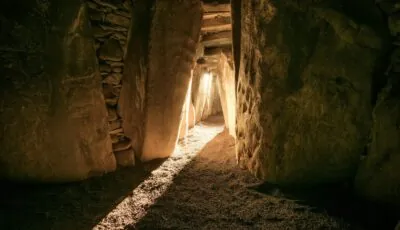
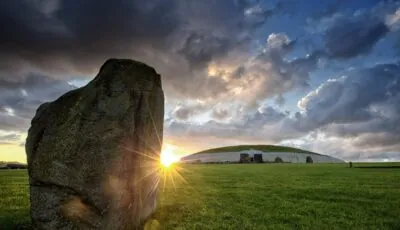
Newgrange at the winter solstice – Brian Morrison – © Tourism Ireland
Above the entrance is a rectangular opening known as the roof box. Around the winter solstice, the rays of the rising sun pass through this opening, travel along the long passage and reach the central chamber.
When the sky is clear, the light slowly moves across the floor before illuminating the interior for around 17 minutes. The phenomenon is at its most intense around 21 December, but the alignment can be observed on several mornings either side, generally from 19 to 23 December.
The precision of this orientation can scarcely be considered accidental. The builders had observed the movement of the sunrise point throughout the seasons and incorporated this knowledge into the monument’s architecture.
The return of light after the year’s longest night may have symbolised the renewal of time, the continuity of the community or a passage between the world of the living and that of the ancestors. In the absence of Neolithic texts, however, its exact religious significance remains unknown.
Each year, the Office of Public Works runs a free lottery enabling a limited number of people to enter the chamber on solstice mornings.
Registration for the Newgrange 2026 solstice lottery takes place on the official Heritage Ireland website. Being selected does not guarantee that the chamber will be illuminated: the phenomenon depends entirely on cloud cover.
Visitors who are not selected can generally gather outside the monument on the relevant mornings. Access is then organised from the Brú na Bóinne visitor centre, with dedicated times and shuttle buses. Regular tourist visits are suspended during this period.
There is no direct road access to Newgrange for visitors. All visitors must report to the Brú na Bóinne visitor centre, located south of the Boyne near the village of Donore.
After exploring the exhibition, the route crosses the river via a pedestrian footbridge. Shuttle buses then take groups to Newgrange and, depending on the option chosen, to Knowth.
The monument can only be visited with an official guide. Online booking is essential, as the number of people allowed into the chamber is very limited. All participants, including children under 12 and infants, must have a ticket.
The main option available between March and early November is the Brú na Bóinne Tour + Newgrange Chamber. It includes the visitor centre exhibition, a guided visit to Knowth and entry to the Newgrange chamber. The full visit lasts around three hours.
A shorter option combines the exhibition and Newgrange only. It is available in limited numbers during the main season and generally becomes the standard option when Knowth closes for winter.
A separate visit to Knowth is also available at certain times. The interior of its burial chambers is not open to the public, however.
Tickets go on sale at midnight Irish time, according to several booking windows:
They are available from the online ticket office: www.brunaboinne.admit-one.eu.
As the exact arrangements may vary slightly depending on the programme, check the official calendar before your trip. In summer, the best time slots are often sold out as soon as they go on sale.
Cancelled tickets may occasionally reappear online, particularly in the morning or mid-afternoon. However, you should not rely on this possibility when planning an important visit.
Allow around three hours for the main visit, which includes Knowth, Newgrange and the exhibition. The option devoted solely to Newgrange generally takes nearly two hours.
It is recommended to arrive at least 15 minutes before the time shown on your ticket. The time needed to reach the shuttle bus, cross the Boyne and form the group is an integral part of the visit.
The monuments are exposed to the wind and offer virtually no shelter. Bring waterproof clothing and comfortable shoes, even if the weather seems mild when you leave Dublin.
The visit is suitable for families, but the inner passage is dark, narrow and low. Some young children may find it intimidating. Pushchairs cannot be taken into the chamber.
Under-18s must be accompanied by an adult. Children under 12 go free, but must be included in the booking.
The visitor centre has a lift, accessible toilets and facilities for wheelchair users. Universal access remains limited at the monuments themselves, however.
Newgrange’s passage and chamber may not be suitable for people with reduced mobility or claustrophobia. Visitors are asked to contact the centre before booking to check the available assistance options.
Dogs are not allowed on the tours, except assistance dogs.
From Dublin, allow around 45 minutes to an hour by car via the M1, depending on traffic. Parking at the visitor centre is free.
The TFI Local Link 188 serves Brú na Bóinne from several towns and villages, including Drogheda, Donore, Duleek, Navan and Athboy. For a car-free day trip from Dublin, organised tours are generally the simplest option.
Do not enter ‘Newgrange’ as the final destination in your GPS: you may reach a road near the monument without being able to enter. Use the Eircode A92 EH5C for the official visitor centre.
The visitor centre includes an interactive exhibition, café, shop, toilets, picnic area, Wi-Fi connection and bicycle parking. Audio guides and multilingual materials can supplement the guides’ explanations.
At Newgrange, the architecture does more than endure across the millennia: each winter, it still waits for the sun to find its way back to its stone chamber.
Essential information to help you plan your visit, including key landmarks, access information, and booking options.
suivre la D3 à 8km à l'Est de Slane, Brú na Bóinne, Brú na Bóinne (County Meath) - Republic of Ireland
53.694845, -6.475322
1h30
The site is closed from 24 to 27 December inclusive, as well as on 1 January. From 19 to 23 December, special solstice opening times apply and regular visits are suspended.
Check the opening hours and admission requirements before you leave, especially during peak season or on Irish public holidays.
For the main option, including the exhibition, Knowth and access to the Newgrange chamber, the prices listed for 2026 are as follows:
The short Newgrange visit with the exhibition generally costs €10 per adult, €8 at the senior rate, €5 for students and young people aged 12 to 17, and €25 for a family.
Access to the exhibition alone costs €5 per adult, €4 for seniors, €3 for students and young people aged 12 to 17, and €13 for a family.
Compare tickets, guided tours, and excursions available through our partner platforms.