
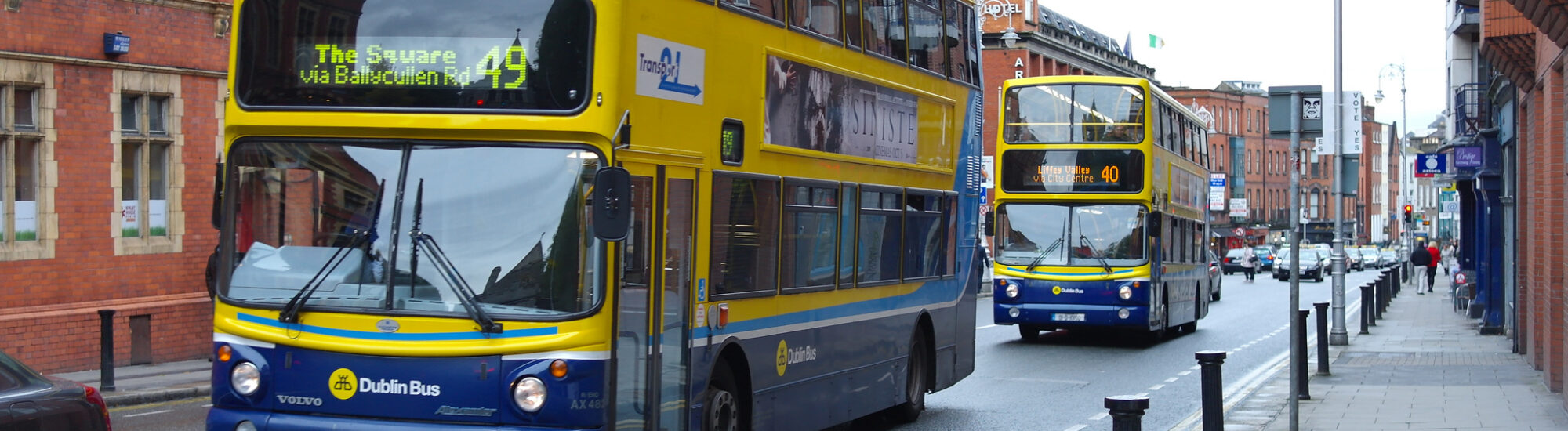
On Dublin’s streets, the yellow and blue buses are part of the cityscape. They pass Georgian façades, cross the Liffey and head out to residential neighbourhoods stretching far beyond the historic centre. For visitors, Dublin Bus is one of the simplest and most affordable ways to explore the Irish capital.
The network serves central Dublin, its suburbs and several towns across the wider urban area. It provides access to Phoenix Park, Glasnevin, Howth, Dún Laoghaire and Dublin Airport, among other destinations. It can take a little time to get used to, however: stops are not always named after nearby landmarks, and not all Dublin buses are operated by the same company.
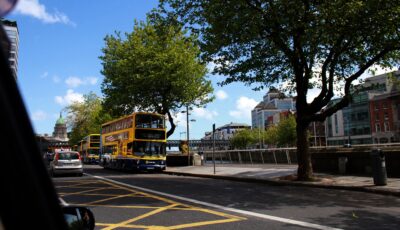
Founded in 1987, Dublin Bus, known as Bus Átha Cliath in Irish, provides a large share of the capital’s urban transport. Its routes link the city centre with neighbourhoods and suburbs on both sides of Dublin Bay.
The network is now part of Transport for Ireland, usually shortened to TFI. This organisation coordinates buses, the Luas, the DART and commuter rail services. Some urban routes are operated by Dublin Bus, while others are run by Go-Ahead Ireland. For travellers, the distinction makes little difference: the main TFI fares and the Leap Card are accepted by both operators.
The network is gradually changing as part of the BusConnects programme. New lettered routes, such as C, E, G and N, are progressively replacing some older services. It is therefore best to check your route on the day of travel rather than relying on an old printed map.
Each stop has a unique number, which is particularly useful in the TFI Live app. It lets you view upcoming services without entering a full address.
Signs at bus stops show which routes serve them, but do not always include a detailed route map. Before boarding, check both the bus number and the destination displayed on the front of the vehicle. The same route naturally runs in two opposite directions.
In Dublin, buses do not automatically stop at every stop. As the bus approaches, it is advisable to raise your hand slightly to signal to the driver that you wish to board.
To get off, simply press one of the “Stop” buttons on board in good time. A sound will be heard and a stop-requested message will usually appear on the information screen.
Most of the network consists of regular urban routes. They make many stops and link the centre with the various neighbourhoods across the urban area. Some run only during the day, while others operate all night.
The old Airlink, Nitelink and Xpresso names still appear frequently in travel guides. However, the way these services operate has changed considerably.
Regular routes serve most sites in Dublin and its inner suburbs. They are particularly handy for reaching places away from the centre, such as Phoenix Park, Glasnevin Cemetery, the National Botanic Gardens and some coastal neighbourhoods.
In the very centre, distances are often easier to cover on foot. Buses really become useful once the journey extends beyond a few kilometres, or when Irish rain decides to join the itinerary.
Traffic can cause delays, particularly at peak times. Dedicated bus lanes improve traffic flow on several main routes, but published timetables are estimates rather than absolute guarantees.
Dublin now has several routes operating 24 hours a day, 7 days a week. According to Transport for Ireland, fifteen permanent night services are available across the urban area.
These routes retain their usual number overnight. They run less frequently than during the day, but allow passengers to get home without waiting for the morning network to begin. They include route 41, which links the city centre with Swords via Dublin Airport.
All-night routes use standard fares. They should not be confused with Nitelink services, which operate differently.
Nitelink services supplement the routes available 24 hours a day. They operate on Friday and Saturday nights, mainly departing from Westmoreland Street and D’Olier Street.
These services are primarily designed to take passengers back to outlying neighbourhoods after pubs, performance venues and clubs in the centre have closed. They follow specific routes and charge a fare separate from the TFI 90-minute fare.
Contrary to what some older guides still state, Nitelink services no longer run on Thursday nights. It is essential to check the last departure time for your route before going out.
Xpresso was once the name given to Dublin Bus’s fast routes. These services made fewer stops to reduce journey times between the suburbs and the city centre.
The current network retains express routes, generally identified by the letter X followed by a number. They operate mainly at peak times and are chiefly aimed at commuters.
Express routes are not necessarily the most useful option for a first visit to Dublin. Their timetables are more limited and their fares differ from those of regular urban routes.
The former Airlink 747 and 748 routes no longer operate. Information describing these shuttles as Dublin Bus’s official service between the airport and the city centre is therefore out of date.
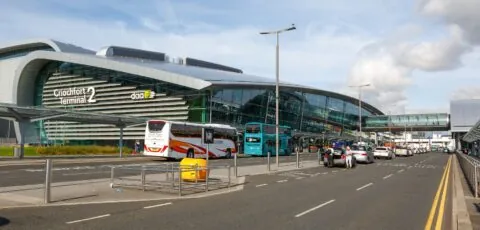
Dublin Bus still serves the airport through urban routes 16 and 41. Route 16 connects the airport with south Dublin via the city centre. It serves O’Connell Street, among other stops, and continues towards Ballinteer.
Route 41 links Lower Abbey Street with Swords Manor via the airport. Its advantage is that it operates 24 hours a day. Both routes accept the TFI Leap Card and charge the network’s standard urban fares.
Buses 16 and 41 make more stops than private shuttles. The journey is therefore longer, but significantly cheaper. Dublin Express and Aircoach offer more direct connections with large luggage compartments. These commercial operators are not part of Dublin Bus and set their own fares.
The most convenient payment method is the TFI Leap Card, a top-up card valid across much of Dublin’s public transport network. When boarding the bus, passengers simply hold their card to the validator.
For a regular journey, you can use the reader on the right as you board. The TFI 90-minute fare will then be applied. To request a short fare or pay for several passengers with the same card, speak to the driver before tapping on.
Cash payment is still possible, but coins only. Tell the driver your destination, then place the required amount in the machine. Exact fare is strongly recommended: drivers do not give change, and the old receipts that allowed passengers to claim a refund later are no longer the practical solution once described in guidebooks.
Contactless bank cards should not be regarded as a universally accepted payment method on board. The Leap Card remains the most reliable option for using Dublin’s transport regularly.
With a Leap Card, the TFI 90-minute fare allows you to use several forms of public transport for 90 minutes from the first tap.
You can therefore take a Dublin Bus, then a Luas or DART service, without paying for another full ticket, provided that you tap for the second journey before the 90 minutes have elapsed. The card must be presented every time you board a bus, and tapped at the entrance and exit of railway stations or stops when required.
This fare applies to urban routes operated by Dublin Bus and Go-Ahead Ireland, the Luas, and most DART and commuter rail services within Zone 1. Express routes, Nitelink services and certain commercial services are not included.
The standard Leap Card works with top-up credit. It is particularly suitable for travellers making only a few journeys. Its capping system automatically limits the amount charged over the course of a day or week on eligible services.
The Leap Visitor Card is intended for tourist stays. It provides unlimited travel for 24 hours, 72 hours or 7 days on Dublin Bus and Go-Ahead Ireland urban routes, the Luas, the DART and included commuter rail services.
Its validity period begins when it is first used, not when it is purchased. It does not cover hop-on hop-off sightseeing buses, private Aircoach or Dublin Express shuttles, or Bus Éireann services.
The Dublin Bus network is not automatically free for all passengers over 65. Free travel is available to holders of a valid Irish Free Travel Pass, issued under the rules of the Department of Social Protection.
Foreign visitors aged over 65 must therefore normally buy a ticket. Age alone does not entitle passengers to free travel on Dublin Bus.
The official TFI Live app allows you to plan a journey, view nearby stops and see upcoming services in real time. It covers Dublin Bus, Go-Ahead Ireland, the Luas and rail services.
The number shown on each bus stop pole is the most accurate way to find information for your exact location. It also helps avoid confusing two stops on the same street that serve opposite directions.
Timetables and routes may change due to roadworks, demonstrations, matches or major events. Up-to-date information is available on the official websites of Dublin Bus and Transport for Ireland.
The following fares apply to Dublin urban services in 2026. They may vary for Express routes, Nitelink services and commercial services.
| Journey type | Adult | Young person or student | Child |
|---|---|---|---|
| Short journey with Leap Card | €1.50 | €0.75 | €0.65 |
| TFI 90-minute fare | €2 | €1 | €0.65 |
| Express route with Leap Card | €2.40 | €1.20 | Depending on the ticket used |
| Nitelink with Leap Card | €2.40 | €1.20 | Depending on the ticket used |
Cash payment on a regular route: around €2 for a short journey and €2.60 for a long journey. Payment can only be made with coins, and the driver does not give change.
Nitelink paid in cash: €3.10 for an adult. Express routes and Nitelink services are not included in the TFI 90-minute fare.
| Traveller | Daily cap | Weekly cap |
|---|---|---|
| Adult | €6 | €24 |
| Young adult or student | €3 | €12 |
| Child | €1.95 | €7.80 |
Once the cap has been reached, no further credit is deducted for eligible travel until the end of the relevant period. The weekly cap is calculated from Monday to Sunday.
| Validity period | Indicative fare |
|---|---|
| 24 hours | €8 |
| 72 hours | €16 |
| 7 days | €32 |
The Leap Visitor Card covers Dublin Bus and Go-Ahead Ireland urban routes, the Luas, the DART and commuter rail services included in the Dublin network. It is not valid on private Aircoach and Dublin Express shuttles or hop-on hop-off sightseeing buses.
Children under 5 travel free on TFI services. Children aged 5 to 8 can travel free with a valid TFI Leap Child 5–8 card.
Fares may change. Check the official TFI fares in Dublin page.
Dublin Bus does not operate a single timetable for its entire network. First and last departures depend on the route, the day of the week and the direction of travel.
Most regular routes run approximately from early morning until 11.30 pm or midnight. Services generally run more frequently at peak times and less often on Sundays and public holidays.
Services available at night:
Night-time timetables, frequencies and final departures vary by route. It is recommended that you check your route in the TFI Live app or on the official Dublin Bus timetables page.