
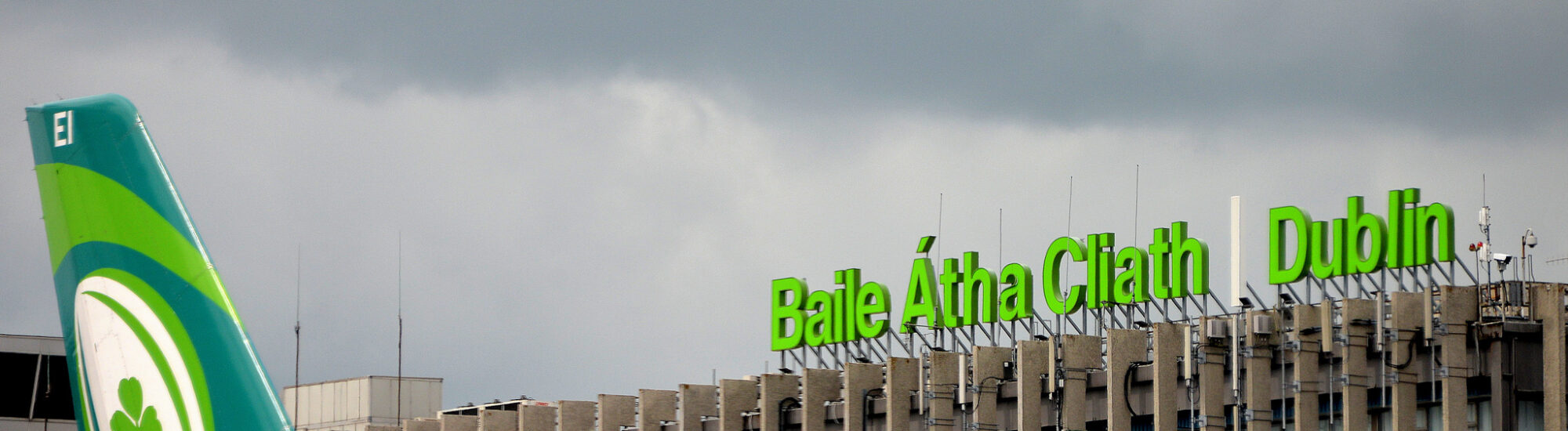
Located around 10 kilometres north of Dublin city centre, Dublin Airport is the main air gateway to the Republic of Ireland. More than 36.4 million travellers passed through it in 2025, a record that confirms its central role for both Irish travellers and international visitors.
Known in English as Dublin Airport, it has the international code DUB. Its two terminals serve more than 150 destinations, mainly in Europe, North America and the Middle East.
Despite its importance, the airport still has no railway station, tram stop or metro station. Transfers to Dublin city centre are therefore by bus, coach, taxi, private-hire vehicle or hire car.
The airport is located in Collinstown, County Fingal, close to the M1 motorway linking Dublin and Belfast and the M50 orbital motorway. This location makes it easy to reach the capital and to continue by road to the rest of Ireland.
Dublin Airport officially opened on 19 January 1940. Its first commercial flight connected Dublin with Liverpool. At the time, the airport had just one grass runway and a terminal designed for around 100,000 travellers a year.
Its development subsequently accompanied Ireland’s economic opening-up. Terminal 1 opened in 1972, followed by Terminal 2 in 2010. A new northern runway entered service in 2022 to increase the complex’s capacity.
In 2025, the airport welcomed 36.43 million passengers and handled around 255,000 aircraft movements. The busiest destinations were London Heathrow, Amsterdam, Manchester, London Stansted and London Gatwick.
These updated figures are published by Dublin Airport.
Dublin Airport has two terminals. They are close to one another and can be reached on foot within a few minutes via a covered walkway.
Terminal 1 is used by many European and international airlines. Ryanair, in particular, operates a large part of its services from here. Air France, KLM, Lufthansa, Transavia and several other carriers also use this terminal.
Terminal 2 is mainly used by Aer Lingus, along with many long-haul flights. Direct departures to the United States use this terminal because it houses the US preclearance facility.
This division is not absolute. Some long-haul airlines use Terminal 1, and terminal assignments can change. It is therefore essential to check the terminal shown on your ticket or on the airport screens.
Dublin Airport is one of the few airports outside North America to offer U.S. Preclearance. This facility is located in Terminal 2, after security.
Passengers on most direct flights to the United States complete US immigration, customs and agricultural inspection formalities here before boarding their aircraft.
On arrival in the United States, they are then generally processed as travellers arriving on a domestic flight. They can collect their luggage and leave the airport without going through the usual US immigration queues.
Not all flights necessarily benefit from this arrangement. Check with your airline whether it applies. For a transatlantic flight, the airport recommends arriving at least three hours before departure, or even earlier if you have checked luggage.
Both terminals have shops, cafés, pubs and restaurants before and after security. More than 40 food and drink outlets are now spread across the airport.
You will find international brands as well as venues that reference Irish culture. Terminal 1 notably has an Arthur Guinness Bar beyond the shopping area.
Duty-free shops are accessible after security. Tax exemption depends on the traveller’s destination, however: not all passengers can automatically buy duty-free goods.
The airport also offers free Wi-Fi, cash machines, currency exchange bureaux, luggage storage for certain bags, pharmacies, family areas, multi-faith rooms and several paid lounges.
Travellers with reduced mobility can receive free assistance. Ideally, requests should be made through the airline or travel agent at least 48 hours before departure.
Many car hire agencies operate at Dublin Airport. Their desks are located in the arrivals halls of both terminals or in nearby dedicated areas.
Once the formalities are complete, a shuttle may be needed to reach the car park where your vehicle is located. Arrangements vary by agency, so check the collection point shown on your booking carefully.
Booking several weeks in advance is strongly recommended, particularly between June and September. Automatic vehicles are less common and often more expensive than manual models.
Before leaving the car park, inspect the vehicle, photograph any damage and check the fuel level. Remember that driving in Ireland is on the left and that most hire cars are right-hand drive.
The airport offers several official car parks suited to different trip lengths. Short-stay car parks are a few minutes’ walk from the terminals. They are mainly suitable for people dropping off or collecting passengers, business appointments or short stays.
The Express Red and Holiday Blue car parks are intended for long-stay parking. Free shuttles connect these areas with both terminals, generally every 15 minutes and 24 hours a day.
Express Red has around 8,000 spaces and is five minutes from the terminals by shuttle. Holiday Blue has a similar capacity, but the transfer takes approximately 15 minutes.
Online booking is strongly recommended. It generally offers a better rate and guarantees a space during the busiest periods.
Dublin Airport is not currently served by the DART, the Luas or a direct rail line. The MetroLink project is intended eventually to link the airport with the capital, but the connection is not yet in service in 2026.
For most travellers, the express coach offers the best balance of price, frequency and convenience. Dublin Express and Aircoach serve both terminals and numerous stops in the city centre.
Dublin Express operates routes 782 and 784. Depending on the service chosen, stops include O’Connell Street, Trinity College, the Liffey quays, Temple Bar and Heuston Station.
Aircoach operates routes 700 and 700X to Drumcondra and O’Connell Street, as well as route 702 to neighbourhoods in south-east Dublin.
Traffic can significantly lengthen the journey at peak times. Allow generally between 25 and 45 minutes to reach the centre, although some services using the Dublin Port Tunnel may be quicker.
Public routes on the Transport for Ireland network are generally less expensive than express coaches. Routes 16, 19 and 41 serve different parts of Dublin.
Route 16 serves several neighbourhoods before reaching the city centre. It is economical, but the journey can be long and uncomfortable with large luggage.
Route 41 connects the airport with Dublin city centre via Drumcondra. Other routes, including 33A, 101, 102 and 109A, mainly serve the northern part of the urban area or nearby towns.
The Leap Card and Leap Visitor Card can be used on participating public services. The visitor card is sold in several shops in the arrivals halls of Terminals 1 and 2.
The airport has direct links to many cities in the Republic of Ireland and Northern Ireland. It is therefore not always necessary to travel into Dublin city centre to continue your journey.
Coaches serve Belfast, Derry, Cork, Galway, Limerick, Waterford, Wexford, Sligo, Donegal, Kilkenny, Drogheda and Dundalk, among other destinations.
The main operators are Aircoach, Expressway, Citylink, Dublin Express, Translink, Wexford Bus and JJ Kavanagh. Departures leave from different areas around the terminals.
Check the departure zone number carefully. The coach area is extensive, and reaching a stop from the other terminal can take several minutes.
Official taxi ranks are located outside both terminals. Fares are metered, in line with regulated rates applicable in Ireland.
The journey to the city centre generally costs between €30 and €45, depending on traffic, the time of day, the number of passengers and the exact destination. Supplements may apply.
Transfer times range from 20 to more than 45 minutes. At peak times, the express bus can sometimes be more predictable when it uses the Dublin Port Tunnel.
For a group of three or four people, however, a taxi can become financially worthwhile, especially if the accommodation is far from a coach stop.
The prices below are the fares observed in 2026. They may vary depending on the date, time and booking method.
| Transport | Indicative fare | Journey time |
|---|---|---|
| Dublin Express | From €9 one way | Around 20 to 40 minutes |
| Aircoach | From €6 when booked online | Around 20 to 40 minutes |
| TFI public bus | Around €2 to €3, depending on the ticket used | Around 40 to 60 minutes |
| Taxi | Around €30 to €45 per vehicle | Around 20 to 45 minutes |
Coach fares are generally better value online. A ticket bought at the last minute may cost more and does not always guarantee a seat on the desired departure.
Parking rates without a reservation:
Booking in advance often allows you to pay less than the daily rate displayed at the entrance. Prices vary according to demand and the travel period.
Fares checked in August 2026 and subject to change by operators.
Dublin Airport operates 24 hours a day, every day of the year. Both terminals remain accessible to travellers, but the opening hours of check-in desks, restaurants, shops and services depend on scheduled flights.
For a European or short-haul flight, it is advisable to arrive around two hours before departure. For a long-haul flight, allow at least three hours.
Travellers bound for the United States should allow time for US preclearance in Terminal 2. The busiest hours in this terminal are generally between 5 am and midday.
Aircoach routes 700 and 700X operate 24 hours a day, with departures as frequent as every 15 minutes. Dublin Express also provides very frequent services and some overnight routes, but timetables vary by day and route.
Long-stay car park shuttles run 24 hours a day, generally every 15 minutes.
Address: Dublin Airport, Collinstown, County Dublin, K67 X4X5
GPS coordinates: 53.4213, -6.2701
Distance from the city centre: around 10 kilometres
Terminals: Terminal 1 and Terminal 2
IATA code: DUB
Information number: +353 1 944 0440
Before you travel, check your terminal, the opening time for bag drop and your airline’s recommendations. During the summer period, road traffic and busy terminals may require extra time.
Want to extend your visit without having to rush around? Here are a few well-located places to stay near the must-see attractions.
Essential information to help you plan your visit, including key landmarks, access information, and booking options.
sur la R108, à 20 mn du centre-ville de Dublin, Dublin, County Dublin, Republic of Ireland, Tourist sites in Ireland
53.426416, -6.249878