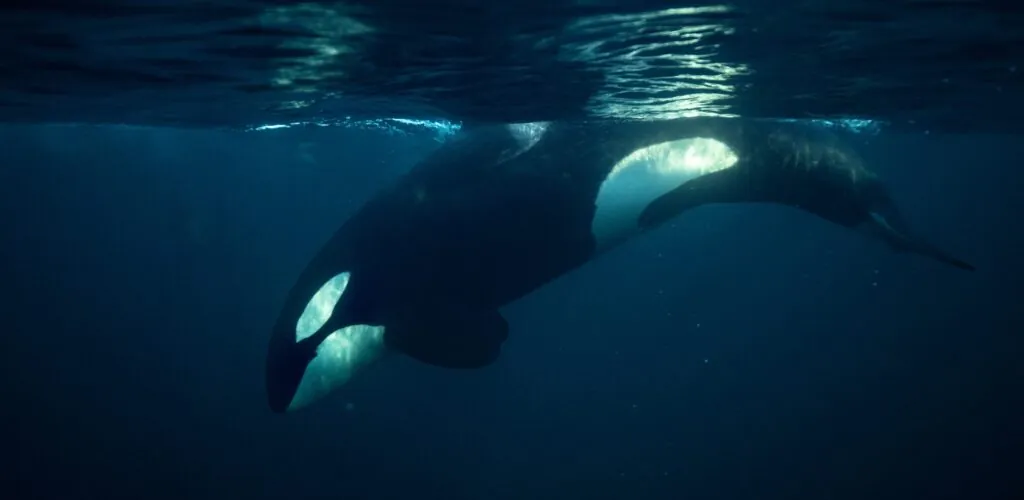
John Coe and Aquarius, two of the North-East Atlantic’s most famous orcas, have been photographed in Donegal Bay. The sighting, confirmed on 27 July 2026, is all the more significant because these two ageing males are thought to be the last remaining members still being observed from the West Coast Community, a unique population that frequents the coasts of Ireland and Scotland.
Two enormous dorsal fins rising from the waters of the Wild Atlantic Way: the scene lasted only a moment, but that was enough to thrill marine-mammal experts. Photographs taken in Donegal Bay enabled researchers to identify John Coe and Aquarius, two orcas that have been monitored for several decades around Ireland and western Scotland.
The sighting was reported by ORCA Ireland after the images had been analysed. For scientists and observers, every appearance by the pair provides new information about their movements and serves as a reminder of the vulnerability of a population now on the brink of extinction.
John Coe and Aquarius return to Donegal Bay
A sighting confirmed through photographs
The two orcas were observed in Donegal Bay on 27 July 2026. Photographs taken during their passage confirmed their identities through the shape of their dorsal fins and the markings on their bodies.
John Coe is the easier of the two to recognise. Listed under the code W01, he has a deep notch at the base of his dorsal fin, as well as a visible mark on his fluke. He was first observed in 1980, when he was already an adult. His exact age remains unknown, but specialists estimate that he could now be between 50 and 60 years old, or even older.
Aquarius, identified by the code W08, was added to the scientific catalogue in 2004. His distinguishing features are more subtle, including small notches along the edge of his dorsal fin. He is regularly seen alongside John Coe.
The last survivors of an exceptional population
An orca community linked to the Irish and Scottish coasts
John Coe and Aquarius belong to the West Coast Community, a small population of orcas observed exclusively in British and Irish waters. Its members are distinguished in particular by their large size and by the sloping shape of the white patch behind their eye.
When the Hebridean Whale and Dolphin Trust began monitoring this community in the 1990s, around ten individuals were recorded. Since 2016, only John Coe and Aquarius have been seen regularly. Researchers therefore believe that they may be the group’s last two living representatives.
No new calf has been documented since scientific monitoring began. As the last two individuals observed are ageing males, this particular population is expected to disappear with them.
A history marked by marine pollution
Extreme PCB levels discovered in a female
The decline of the West Coast Community is closely linked to marine pollution. In 2016, Lulu, one of the group’s females, was found dead after becoming entangled and then washing ashore on the island of Tiree, in the Hebrides.
Analysis of her tissues revealed a PCB concentration around 100 times higher than the toxicity threshold accepted for marine mammals. These persistent industrial pollutants can affect the immune system and reproduction of cetaceans.
Although Lulu had reached sexual maturity, examination of her body showed that she had never been pregnant. Together with the absence of any recorded births within the group, this finding strengthened the theory that the population had become unable to reproduce itself.
The appearance of John Coe and Aquarius in Donegal therefore carries a dual message. It demonstrates these animals’ extraordinary ability to travel, but also highlights the lasting consequences of pollutants that have nevertheless been banned for several decades.
Why does Donegal Bay attract orcas?
An important area for Ireland’s marine biodiversity
The two males range across an especially vast territory, stretching from the Hebrides to Ireland’s western coast. They have previously been reported in the Irish Sea, near Rathlin Island, in Dingle and Donegal bays, and along various stretches of the Scottish coastline.
Their presence in Donegal is therefore not entirely exceptional, but every sighting remains extremely rare. Orcas can travel several hundred kilometres in a short time and disappear for long periods.
Scientists are still working to understand their routes, the periods when they separate and how the two individuals eventually reunite. Sightings reported by local residents, fishermen and maritime professionals therefore play an important role in monitoring them.
Donegal Bay is also an especially rich environment. Dolphins, minke whales, humpback whales and basking sharks can be seen at different times of year along this part of the Wild Atlantic Way.
Can you see orcas in Ireland?
A possible encounter, but one that is extremely unpredictable
Orca sightings remain very rare in Irish waters. Even specialists who regularly spend time at sea may wait several years before seeing one. The recent presence of John Coe and Aquarius therefore provides no guarantee that they will remain in Donegal Bay.
It is also inadvisable to try to approach or pursue them by boat. Any encounter should take place from a distance, leaving the animals free to follow their own course. Photographs taken without disturbing their behaviour can then be sent to specialist organisations, including the Irish Whale and Dolphin Group or ORCA Ireland.
The shape of the dorsal fin, notches, scars and spots behind the eyes enable researchers to identify individuals. A single photograph with the correct date and location can therefore add to several decades of scientific monitoring.
An appearance as fascinating as it is fragile
The two orcas now carry the memory of their group
John Coe and Aquarius are not orcas that live exclusively in Ireland. They inhabit a vast marine territory linking the Irish coast with the Hebrides and western Britain. Their return to Donegal Bay illustrates the ecological continuity of this Atlantic area.
These two ageing males have also become symbols of a population disappearing before scientists’ eyes. Each time they appear, they carry with them the memory of a group that once consisted of several males, females and young.
In the wild waters of Donegal, their silhouettes make a striking sight. But behind the sense of wonder lies a more serious reality: when John Coe and Aquarius disappear, an entire orca community unique to Irish and British waters could vanish with them.