You need to head inland on Inis Mór to find its former lighthouse. At Oghil, above the small fields enclosed by dry-stone walls, a round limestone tower stands near the fort of Dún Eochla. This is An Teach Solais. Its light guided ships approaching Galway Bay from 1818 to 1857. From the mainland, placing it on high ground seemed logical. From the sea, it proved far less convincing.
At the beginning of the 19th century, the Aran Islands formed a natural barrier at the entrance to Galway Bay. A ship approaching from the Atlantic still had to identify the channels on either side of the archipelago. The Inishmore light was installed around 122 metres above sea level, beside a signal tower that was already in place. Ireland’s architectural heritage inventory attributes the lighthouse’s design to George Halpin Senior, then Inspector of Works and Lighthouses for the Ballast Board.
The first light was lit on 1 May 1818. Inside the lantern, a rotating mechanism carried oil lamps and reflectors that concentrated the light. As it turned, it alternated periods of light and darkness for observers at sea. This allowed mariners to distinguish it from the fixed lights at Loop Head to the south and Clare Island to the north. In the dark, the rhythm of the signal was as useful in identifying the lighthouse as its position on the chart.
The height was intended to make the light visible from afar. In clear weather, it gave it an unobstructed horizon. But when low cloud enveloped the ridge, the lantern could disappear even while visibility remained better closer to the water. From offshore, this single light also gave ships little indication of the position of the two channels around the islands. The navigation authorities repeatedly called for its location to be reconsidered.
The solution was to mark the two ends of the archipelago. In 1857, the lights at Eeragh in the north-west and Inis Oírr in the south-east took over. The Oghil tower then ceased to serve navigation. Locally, another issue remained. Fishermen in Cill Éinne Bay and Kilronan still needed a marker at the entrance to their anchorage. They eventually obtained a separate light on Straw Island, which entered service in 1878.
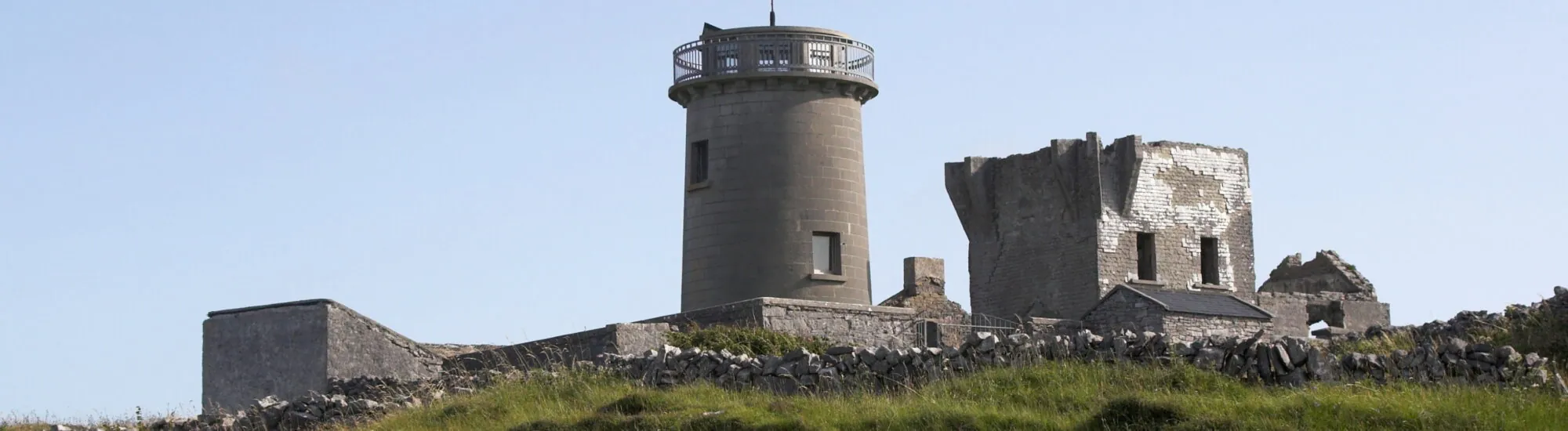
The tower is recognisable by its slightly tapered shaft and regular courses of grey limestone. The gallery surrounding the summit rests on stone corbels and has a cast-iron railing. Looking from the base upwards, you can make out the contrast between the tower’s thick walls and the lighter structure that surrounded the lantern. The national inventory also notes the survival of an internal cast-iron staircase, a documented feature of the building.
The former lighthouse was described as ruinous at the end of the 19th century, then renovated in 1993 for another use. It is now disused. Its silhouette nevertheless retains the features that identify an early 19th-century lighthouse, even though the function that justified its location disappeared long ago.
Combine a visit to the lighthouse with Dún Eochla, the neighbouring circular fort. The lighthouse serves as a landmark on the approach to the fort, reached by a grassy path heading east. The proximity of the two structures makes it possible to compare two uses of elevated ground. The stone enclosure occupies the high point, while the lighthouse used the view out to sea to carry its signal.
In clear weather, the lands of Oghil slope down in small fields towards the north coast, with Connemara on the far side of the bay. In mist, the landscape can close in within minutes. From the ridge, this change in visibility gives a very tangible sense of the problem faced by mariners in the 19th century. Allow time to stop for the landscape and exterior views, and respect access restrictions on site.
Essential information to help you plan your visit, including key landmarks, access information, and booking options.
53.1275, -9.7022
Disused lighthouse. No confirmed opening hours for interior visits.
Check the opening hours and admission requirements before you leave, especially during peak season or on Irish public holidays.
No official admission system has been identified for the tower.