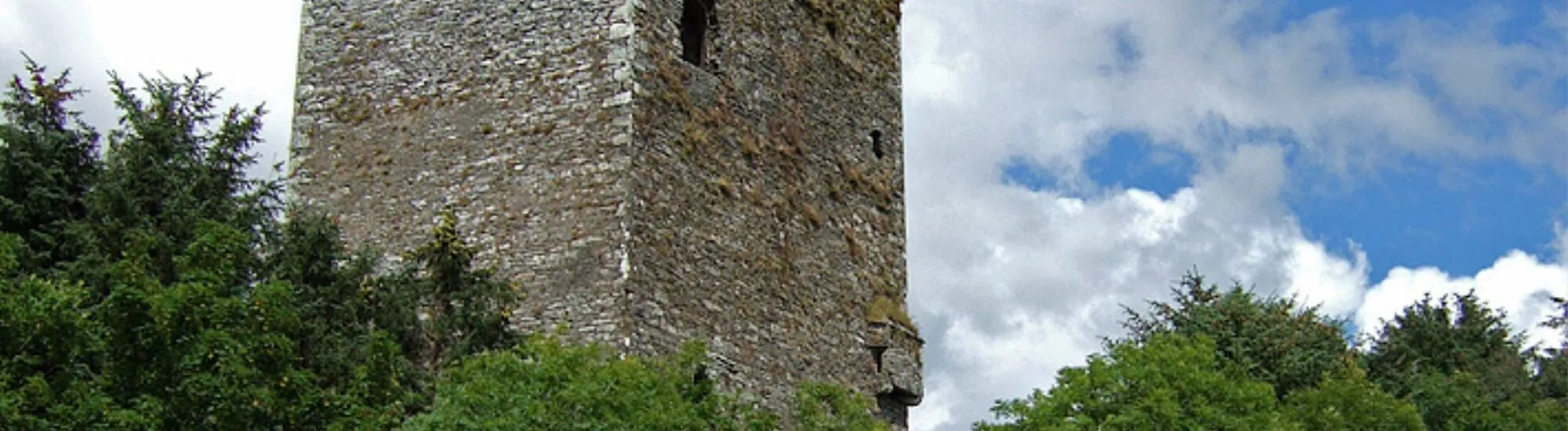
Nestled among the rolling green hills of County Cork, Ballinacarriga Castle is one of those hidden medieval gems that seem to spring straight from a Celtic tale. Built around 1585, this typically Irish tower house stands over the small village of Ballinacarriga, not far from Dunmanway. Its name comes from the Gaelic Baile na Carraige — “the village of the rock” — a poetic nod to a building firmly rooted in both its era and its stone foundations.
This castle, constructed at the end of the era of the great Gaelic lords, stands as a witness to the transition between two Irelands: the world of medieval clans and a country coming under the growing influence of the English crown.
The story of Ballinacarriga Castle unfolds during a pivotal period in Ireland, marked by rivalry between Gaelic clans and the advance of English power. Built around 1585 by the Hurley family, the castle symbolized the prestige and power of a local lineage deeply rooted in West Cork. The Hurleys, staunch Catholics, belonged to the traditional Irish nobility striving to assert their authority in the face of English colonization. Their family motto, whose coat of arms still adorns the stone, reflected a pride tinged with defiance.
At the start of the 17th century, Ireland entered an era of upheaval: the Nine Years’ War (1594–1603), followed by the Plantation of Munster, saw Irish lands redistributed to English settlers. Like many other Gaelic families, the Hurleys had their estates confiscated. Ballinacarriga then passed into the hands of Protestant families loyal to the crown, before being abandoned after the Cromwellian wars (1649–1653), when the Cork countryside was ravaged.
Despite the passage of time, the tower remains. It escaped the widespread destruction of the 18th century and stands today as a rare survivor among the family fortifications of late Renaissance Ireland. The stones of Ballinacarriga still whisper echoes of a time when faith, land, and honor shaped the lives of southwest Irish clans.
Ballinacarriga Castle belongs to the category of tower houses, those fortified towers built by Irish noble families between the 15th and 17th centuries. Rectangular in plan, it rises four stories high, each level connected by a spiral staircase. The walls, over a meter thick, served both to protect against attack and to shield from the often biting southwest Irish winds.
At its peak, the castle belonged to the Hurley family, a local Gaelic lineage. The main entrance, facing east, opens onto a small inner courtyard. Attentive visitors will spot the vertical arrow slits for archers, typical of the era, as well as several finely carved mullioned windows — a luxury for a defensive tower.
The site lies at the end of a small, typically Irish country lane, surrounded by rolling fields and wild hedgerows. On arrival, you’ll find no ticket office or crowds of tourists: here, entry is free and open — a rare treat in a world where everything seems monetized.
The castle stands proudly atop a gentle rise. From the outside, you can admire its massive silhouette, pierced by narrow windows and defensive openings. The first impression is striking: this solitary tower dominates an unchanging pastoral landscape, almost frozen since the 16th century. As you approach, you’ll notice the finely cut stones, the pointed arch doorway, and the sculpted frames with religious and heraldic motifs — reminders that Ballinacarriga was once a noble residence.
Inside, the castle still preserves its original spiral staircase, narrow and steep, carved into the thickness of the wall. The steps are worn but stable: it’s possible to climb to the upper floors (with care), where you’ll find fireplaces, arrow slits, and small living chambers. The atmosphere is both mysterious and peaceful: light filters through the window slits, playing across the contours of the grey stone walls.
From the top floor, the view is superb. You overlook the entire surrounding valley, with its fields, groves, and the distant hills of Dunmanway. On clear days, you can even spot the blue outlines of the West Cork mountains. It’s an ideal viewpoint for photographers, especially in the late afternoon when golden light bathes the ancient stones.
There are no explanatory panels or audio guides, but that’s part of Ballinacarriga’s charm: you explore at your own pace, undisturbed, in a silence broken only by the wind and birdsong. For history buffs, architecture lovers, or those seeking off-the-beaten-path sites, the visit offers a raw and authentic experience, very different from the restored and crowded castles of Killarney or Blarney.
It’s recommended to wear suitable footwear — the ground can be damp — and to avoid visiting on very rainy days, as the site is not sheltered. However, sunsets here are spectacular, bathing the tower in an orange glow that seems to bring its glorious past back to life.
What sets Ballinacarriga apart from other Irish castles are above all the stone carvings that decorate its walls. Above the first-floor windows, you can still see the Hurley and Castle family crests, as well as a carved date: 1585, most likely marking the end of construction.
But the most fascinating detail is the so-called “Passion Window”, a masterpiece of late Gothic sculpture. It features several religious symbols: a cross, a crown of thorns, a chalice, and the nails of the crucifixion. This blend of faith and local artistry reflects the Catholic fervor of a family who, on the eve of the Protestant Reformation, were already resisting English influence.
Despite its historical and architectural interest, Ballinacarriga Castle remains off the main tourist trails. There’s no visitor center or official guided tour, but you can access the site freely, as it’s maintained by the Office of Public Works (OPW).
This is a place beloved by history enthusiasts and photographers. The contrast between the grey stone and the vivid green of the Irish countryside gives every photo an almost painterly atmosphere. And for travelers seeking authenticity, it’s a perfect stop between Bandon and Bantry, far from the crowds of Kinsale or Cork City.
In the region, the castle is much more than a ruin: it’s part of the local identity. Residents often refer to the “Hurley of the Rock”, a nod to the meaning of Ballinacarriga. Local schools sometimes organize educational visits to introduce children to this discreet yet essential heritage.
Some locals even say that on full moon nights, you might glimpse a figure in a long cloak climbing the castle stairs. Legend or imagination? In Ireland, the line between the two is often blurred.
Ballinacarriga Castle is located about 7 km from Dunmanway, in the southwest of County Cork. It’s accessible via a small secondary road, well signposted from the R586. The site is open all year round and free to visit, but it’s advisable to wear suitable shoes, as the ground can be slippery.
The visit is brief — about thirty minutes is enough to explore the site — but it can easily be included in a West Cork touring loop, taking in Bantry House, Drombeg Stone Circle, and the Skibbereen coastline.
Essential information to help you plan your visit, including key landmarks, access information, and booking options.
51.70547523357687, -9.031603945497002
30 minutes
open daily
Check the opening hours and admission requirements before you leave, especially during peak season or on Irish public holidays.
free