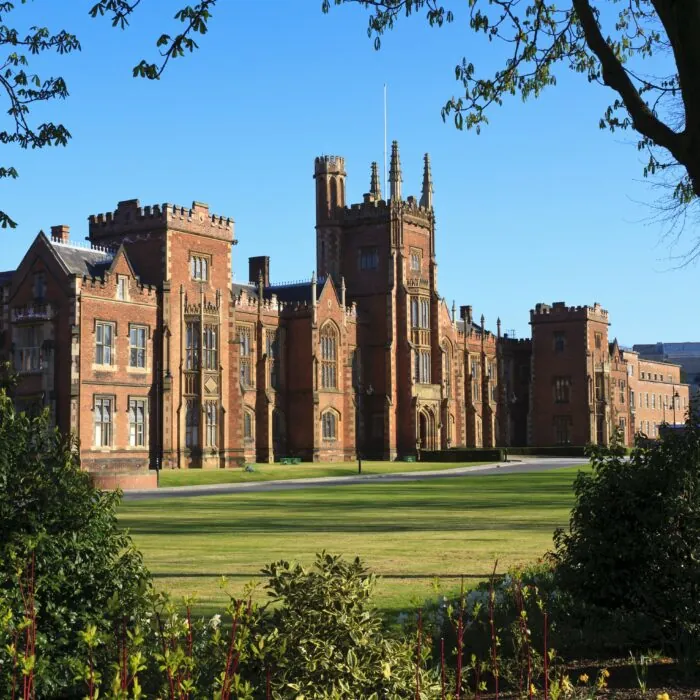


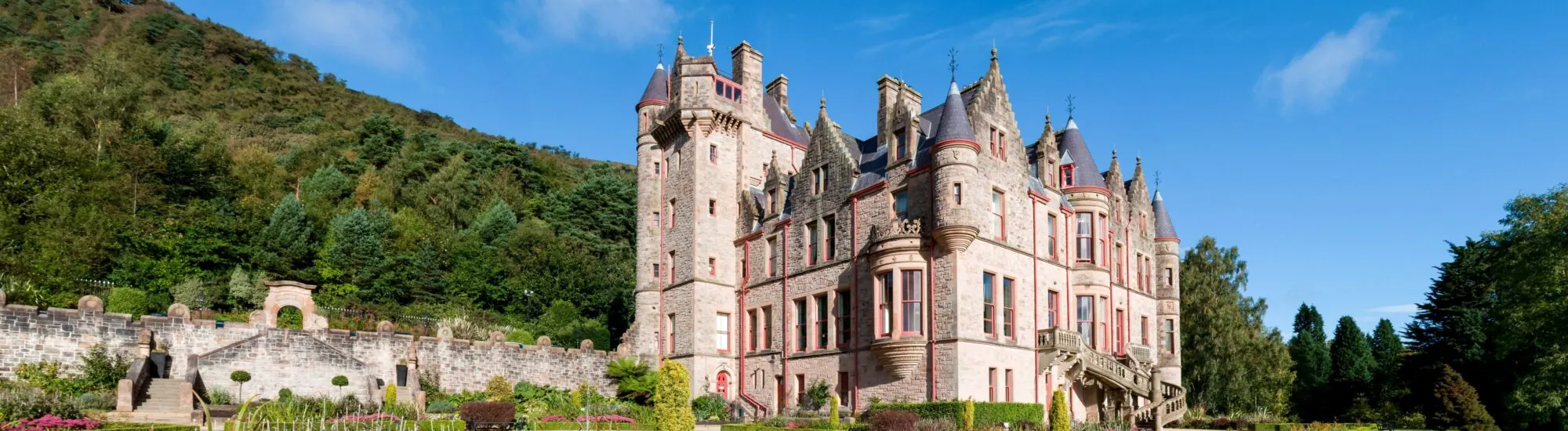
Set on the eastern slope of Cave Hill, around 120 metres above Belfast, Belfast Castle overlooks the city, Belfast Lough and the surrounding hills. Its Scottish Baronial architecture, well-kept gardens and extensive wooded estate make it one of the most popular free attractions in Northern Ireland’s capital.
The present castle was built in the 19th century, but its history stretches back to the first fortresses built in central Belfast. Today, the site welcomes visitors, private receptions and an information centre devoted to Cave Hill. It is also an excellent starting point for exploring the trails of Cave Hill Country Park.
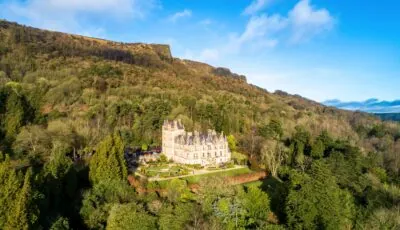
Belfast Castle – © kilhan
Belfast Castle stands out for its towers, gables, decorative chimneys and grand external staircase. Overall, it is more reminiscent of a Victorian aristocratic residence than a medieval fortress.
Entry to the building is free when its rooms have not been booked for a wedding, reception or private event. However, the castle is not laid out as a traditional museum with fully furnished rooms. The accessible areas mainly include the reception area, some communal rooms, the shop and the Cave Hill information centre.
The interior visit is fairly short. The site’s main appeal lies in its architecture, gardens, views and the walks available across the surrounding estate.
The first Belfast Castle was built by the Anglo-Normans in the late 12th century. It was not located on Cave Hill, but in what is now the city centre, near the site of Castle Place.
A second residence, built of stone and timber, was erected in 1611 for Sir Arthur Chichester, Baron of Belfast. It was destroyed by fire almost a century later. The family chose not to rebuild it on the same site.
In the 19th century, Belfast’s expansion and the growth of its industrial activity profoundly transformed the city centre. The third Marquess of Donegall then decided to create a new residence on the land of his former deer park, on the slopes of Cave Hill.
Construction of the present Belfast Castle began in 1862. The plans were drawn up by John Lanyon, son of the renowned architect Charles Lanyon. The attribution of the castle to Charles Lanyon, still common in some guidebooks, is therefore inaccurate.
John Lanyon adopted the Scottish Baronial style, which was highly popular in Victorian architecture. It draws freely on Scotland’s old fortified houses, using turrets, gables, parapets and asymmetrical forms.
The cost of the work exceeded the resources available to the Marquess of Donegall. His son-in-law, Lord Ashley, the future seventh Earl of Shaftesbury, contributed financially to the completion of the residence.
The Donegall family coat of arms can still be seen above the main entrance and on the north wall. Part of the Shaftesbury coat of arms was also added to the external staircase in 1894.
After the death of the third Marquess of Donegall in 1884, Belfast Castle and its estate passed to the Shaftesbury family. The family maintained close ties with north Belfast and took part in several local charitable initiatives.
On 26 July 1934, the castle and the surrounding land were gifted to the people of Belfast by the Earl of Shaftesbury. The residence gradually became a place for walks, receptions and entertainment.
Between 1945 and the 1970s, Belfast Castle hosted weddings, balls and afternoon teas, among other events. The building closed in 1978 to undergo an extensive renovation programme. It reopened on 11 November 1988 following work estimated at two million pounds sterling.
The castle remains the property of the city of Belfast. It receives more than 100 000 visitors a year and continues to host weddings, conferences and a range of cultural events.
The gardens laid out in front of the castle offer one of the estate’s finest viewpoints. Their lawns, clipped hedges and flowerbeds frame the stone façade and grand external staircase.
From the terraces, the view takes in north Belfast, the harbour and the waters of Belfast Lough. On a clear day, the panorama extends to the hills beyond the city.
The gardens are particularly popular with photographers and regularly provide the setting for weddings held at the castle. Their appearance changes with the seasons, with blooms naturally more abundant from spring to early autumn.
The basement of Belfast Castle houses the Cave Hill Visitor Centre. This free space presents the history of the hill, its archaeological heritage, wildlife and plant life. Information is available in several languages.
Cave Hill takes its name from the five cavities visible in its cliffs. The hill also has several archaeological remains that bear witness to ancient human settlement.
The centre helps visitors prepare for a walk in the park and gain a better understanding of the landscapes seen from the trails. A shop in the castle also sells souvenirs inspired by the landmark and Belfast.
Belfast Castle is surrounded by Cave Hill Country Park, a vast natural area of woodland, grassland and rocky slopes. Several routes allow visitors to explore the estate according to the time available and walkers’ abilities.
The Estate Trail forms a loop of around 3.9 kilometres through the lower, wooded parts of the park. Although more accessible, it still has a total ascent of around 134 metres.
The Cavehill Trail is a more demanding 7.2-kilometre loop. It reaches the higher parts of the hill and McArt’s Fort, with a total ascent of around 256 metres. Good footwear is recommended, as the paths can become slippery or muddy after rain.
The hill’s profile includes a feature known as Napoleon’s Nose. According to a tradition often recounted in Belfast, this silhouette may have helped inspire the sleeping giant in Jonathan Swift’s novel Gulliver’s Travels.
The estate is well suited to a family outing. Children can explore the gardens, information centre and the park’s most accessible trails.
Near the castle, the Cave Hill Adventurous Playground offers free swings, slides, seesaws, a climbing structure and a zip line. The playground is designed for children aged 3 to 14.
The Millennium Maze is around a five-minute walk north of the castle. This small plant maze, created in the early 2000s and later restored by volunteers, offers an additional activity for families.
The castle is home to the Tavern Coffee Shop, where visitors can enjoy a hot drink or a snack. The Cellar Restaurant also serves meals in the lower part of the building.
The café and restaurant have different opening hours from the castle. Booking may be useful for the restaurant, particularly at weekends or when an event is taking place on the estate.
Essential information to help you plan your visit, including key landmarks, access information, and booking options.
54.642889, -5.942167
30 minutes
The castle and gardens may close temporarily when a wedding or private event is taking place. Opening hours may also vary on UK public holidays.
Check the official Belfast Castle opening hours before your visit.
Check the opening hours and admission requirements before you leave, especially during peak season or on Irish public holidays.
No ticket or booking is required for a standard visit. Some events, meals and occasional activities may nevertheless incur a charge.