

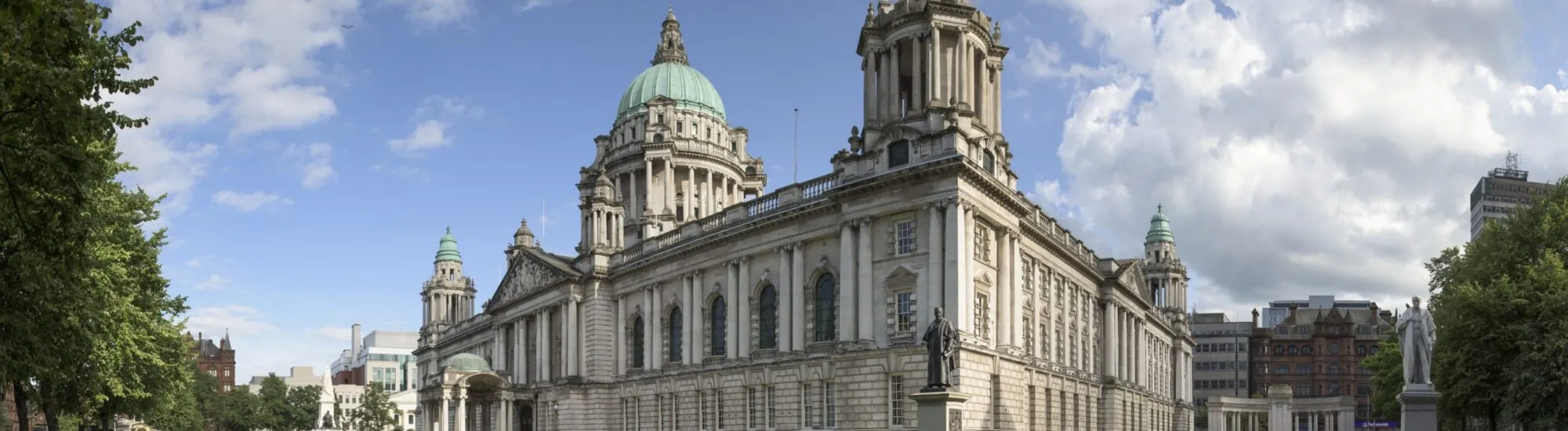
At the heart of Belfast, a green dome rises above the buses, shopfronts and constant bustle of Donegall Square. Belfast City Hall, home to the city council, is far more than a monumental town hall: its stones tell the story of the city’s industrial rise, the scars of the 20th century and the transformation of a city long divided.
With its spectacular architecture, ceremonial rooms, exhibition dedicated to Belfast’s history and gardens dotted with memorials, City Hall is an essential stop for understanding Northern Ireland’s capital. It is an accessible, informative and particularly photogenic visit.
Contrary to a commonly repeated belief, Belfast City Hall was not commissioned directly by Queen Victoria. In 1888, the sovereign granted Belfast official city status in recognition of its extraordinary economic and demographic growth. Municipal leaders then felt that the new city needed a building befitting its importance.
By the end of the 19th century, Belfast had become one of the British Empire’s major industrial centres. Its shipyards built liners and cargo ships, while its linen mills, factories, ropeworks and engineering workshops exported their products around the world.
The new town hall was built on the site of the White Linen Hall, once at the centre of the linen trade. The foundation stone was laid in 1898, and construction took eight years. The building officially opened on 1 August 1906.
The design was entrusted to the British architect Sir Alfred Brumwell Thomas. He conceived a neo-Baroque building, also described as Edwardian Baroque, whose imposing scale was intended to symbolise Belfast’s prosperity and confidence.
The project cost £369,000, a considerable sum at the time. Industrialist William Pirrie, managing director of the Harland & Wolff shipyards and a former Lord Mayor of Belfast, played an important role in bringing the project about. Craftsmen associated with the shipyards also contributed to the building’s interior decoration.
This connection with Harland & Wolff carries particular resonance in a city inseparable from the Titanic. A few years after City Hall opened, the same local expertise helped build the famous liner.
On the night of 4 to 5 May 1941, Belfast was hit by a heavy German bombing raid. A direct bomb hit destroyed almost all of City Hall’s Great Hall.
The hall was rebuilt in the early 1950s, with its original decoration preserved. Its historic stained-glass windows could be reinstated, having been removed as a precaution before the bombing and stored safely in County Down.
Belfast City Hall – © William
It is impossible to cross central Belfast without catching sight of its silhouette. Its light Portland stone façade contrasts with the verdigris hue of its vast central dome, whose copper has naturally oxidised over time.
The building is arranged around an inner courtyard and follows a symmetrical plan. Its corner pavilions, columns, sculpted pediments and secondary domes give the whole a near-palatial solemnity.
Inside, the atmosphere changes. The eye is drawn to the coloured marble, ornate balustrades, wood panelling and stained-glass windows. The grand staircase leads to the ceremonial rooms on the first floor, including the Great Hall, the Banqueting Hall and the Reception Room.
City Hall’s stained-glass windows are more than decorative. Some date from the building’s opening in 1906, while others were added to commemorate the events, communities and figures that have shaped Belfast.
They explore the city’s industrial heritage, social history, world conflicts, workers’ struggles and the evolution of Northern Irish society. In 2025, a new stained-glass window dedicated to the LGBTQ+ community joined the collection, reflecting a desire to represent a more diverse city.
Guided tours of Belfast City Hall are held daily in English. They last between 45 and 50 minutes and provide access to several areas usually reserved for municipal business.
The route may include the rotunda, grand staircase, Reception Room, Banqueting Hall, Great Hall and certain official rooms. As City Hall remains a working administrative building, the route may be altered if a meeting, ceremony or official event is taking place.
Individual tickets are sold at reception on the day. It is advisable to arrive early, particularly at weekends and during school holidays.
Located on the ground floor, the permanent exhibition offers a self-guided journey through the city’s history. Spread across several rooms and six main thematic areas, it traces Belfast’s development from a modest settlement on the banks of the Lagan into an industrial, then cultural, metropolis.
The exhibition covers linen mills, shipyards, political and religious divisions, the two world wars and the decades of the Troubles. More contemporary spaces also present the artists, scientists, sportspeople and residents who have contributed to Belfast’s influence.
A digital experience using projections, augmented reality and interactive games is available in several rooms until 31 March 2027. It makes the visit more accessible for families without obscuring the complexity of local history.
The lawns surrounding City Hall offer a breathing space in the city centre. On fine days, workers, students and visitors sit here for lunch or watch the activity in Donegall Square.
The gardens regularly host cultural events, ceremonies and seasonal installations. In winter, Belfast Christmas Market usually turns the area around the building into a village of illuminated chalets.
In front of the main façade stands the statue of Queen Victoria, by Sir Thomas Brock. Commissioned for her Diamond Jubilee in 1897, it was unveiled by Edward VII in 1903, even before City Hall was completed.
The sculpted figures around its pedestal evoke shipbuilding and linen spinning, among other industries, two activities that profoundly shaped both Belfast’s wealth and its social landscape.
The memorial dedicated to the Titanic does not depict a figure named “Thane”, as some older texts suggest. It is an allegorical sculpture by Sir Thomas Brock: a female figure personifying Death or Fate leans over two nymphs carrying the body of a drowned sailor.
Unveiled in 1920 and moved to the City Hall gardens in 1960, the original monument listed only 22 victims associated with Belfast.
The Titanic Memorial Garden, opened on 15 April 2012 for the centenary of the sinking, now complements this tribute. Its bronze plaques bear the names of the 1,512 victims recorded on the “Belfast List”, including both passengers and crew. It was the first memorial to bring all their names together in one place.
The gardens are also home to the Cenotaph, unveiled in 1929 in memory of those who died in the First World War, as well as several statues dedicated to Belfast’s industrial and political history.
Since 2024, two sculptures have paid tribute to Mary Ann McCracken, an abolitionist and social reformer, and Winifred Carney, a trade unionist, suffragist and Irish independence activist. Their presence provides an essential counterpoint to monuments long dominated by male sovereigns, industrialists and political leaders.
Mornings offer a quieter time to admire the details of the façade and explore the exhibition before groups arrive. At the end of the day, the light highlights the relief of the Portland stone and the dome’s green hue.
After nightfall, City Hall is regularly illuminated to mark events, support causes or accompany Belfast’s major celebrations. The colours change according to the municipal calendar, so this is not a fixed light display.
Allow around 30 minutes for the gardens, an hour for the exhibition and a further 45 to 50 minutes for the guided tour. A full visit therefore takes between two and three hours.
Belfast City Hall has automatic doors, lifts, accessible toilets and a Changing Places facility. The ground-floor exhibition is accessible to wheelchair users. Wheelchairs and a mobility scooter may also be available, subject to availability.
Visitors with specific requirements are invited to contact the team before their visit. For certain organised tours on the first floor, specific arrangements may be needed to ensure safe evacuation.
Essential information to help you plan your visit, including key landmarks, access information, and booking options.
54.596723, -5.930082
45 minutes
Guided tours:
Building: