

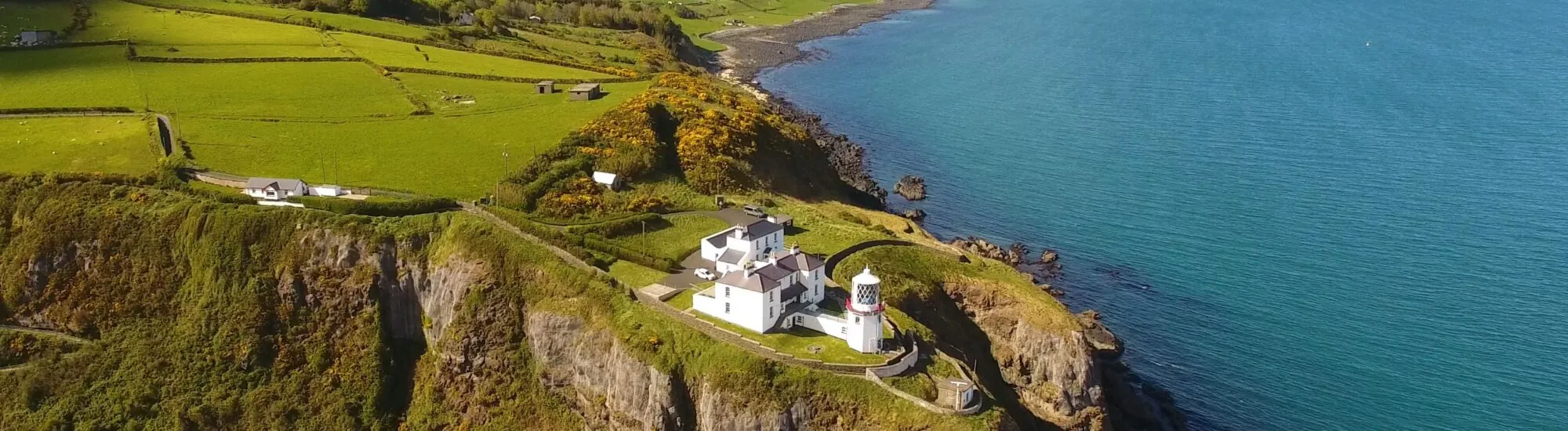
Just beyond Whitehead, the walk follows the rocks along Belfast Lough before climbing towards a white tower. From this headland in County Antrim, the view takes in ships travelling between Belfast Bay and the North Channel. In service since 1902, Blackhead Lighthouse can be viewed from outside. It can be reached on foot from the seafront when the path is open, or you can book one of the former keepers’ cottages to spend the night at the foot of the tower.
Blackhead Lighthouse marks the northern side of the entrance to Belfast Lough. At the end of the 19th century, the Commissioners of Irish Lights commissioned their engineer William Douglass to design a new light for vessels entering or leaving the bay. The 16-metre tower entered service on 1 April 1902. Thanks to the cliff on which it stands, its light is around 45 metres above high-water level.
The tower was originally red. It took on its present white colour in 1929. The first light was oil-powered and, in foggy conditions, an explosive signal took over to warn crews. According to the Commissioners of Irish Lights, the lighthouse was electrified in 1965, the fog signal was discontinued in 1972 and the keepers left the station in 1975, when it was automated. Today, the white light flashes every three seconds, with a nominal range of 27 nautical miles, or around 50 kilometres.
The lighthouse was already in service when the Titanic, built in Belfast, set sail in 1912. The Great Lighthouses of Ireland network lists it among the vessels said to have been guided by Blackhead’s light. The connection recalls the lighthouse’s role at a time when Belfast’s shipyards were launching some of the world’s largest ocean liners.
The Blackhead Path begins near Whitehead Yacht Club, at the end of Old Castle Road. By car, reach Whitehead via the A2 from Carrickfergus or Larne and look for the trail car park. You can also arrive by train at Whitehead station and walk to the seafront. The Great Lighthouses of Ireland network gives the distance between Whitehead and the lighthouse as around 2.4 km return. The walk begins alongside the water. Nearing the headland, steep steps lead to the viewpoint, making this short outing more challenging.
Available information differs regarding access to the final section. The trail page on OutmoreNI reports damage to the path and the railings around the point. Before planning the climb, check the route’s condition with Mid and East Antrim Council and follow the signs on site. If the passage is closed, turn back at the barrier. Whitehead’s seafront still offers views across the bay without taking the steps.
The tower remains in service and is not normally open to visitors. The appeal of the walk lies in the views across the bay and the lighthouse’s silhouette above the rocks. For another coastal outing, the Gobbins path, on the Islandmagee peninsula, is a separate visit with its own access and booking requirements.
The Irish Landmark Trust rents out three whole properties beside the tower. House 1 sleeps up to five people, House 2 up to seven, and the Cutter up to four. These houses are equipped for self-catering. They also retain details of the keepers’ lives, including a whistle system used to wake the person due to take the next watch.
When choosing your accommodation, check access, bedroom layouts and availability directly with the Irish Landmark Trust. From these houses perched above the channel, you can watch ships pass from shelter from the wind, then see the light resume its rhythm as dusk falls.
Essential information to help you plan your visit, including key landmarks, access information, and booking options.
20 Blackhead Path, Carrickfergus, County Antrim, Northern Ireland, Tourist sites in Ireland
54.766941492425936, -5.6892918639784735
The tower is not normally open to visitors. Check the condition of the coastal path before setting off and follow the signs on site.
Check the opening hours and admission requirements before you leave, especially during peak season or on Irish public holidays.
The coastal path is free when open. The keepers’ cottages must be booked separately through the Irish Landmark Trust, which lists prices according to the property and dates.