

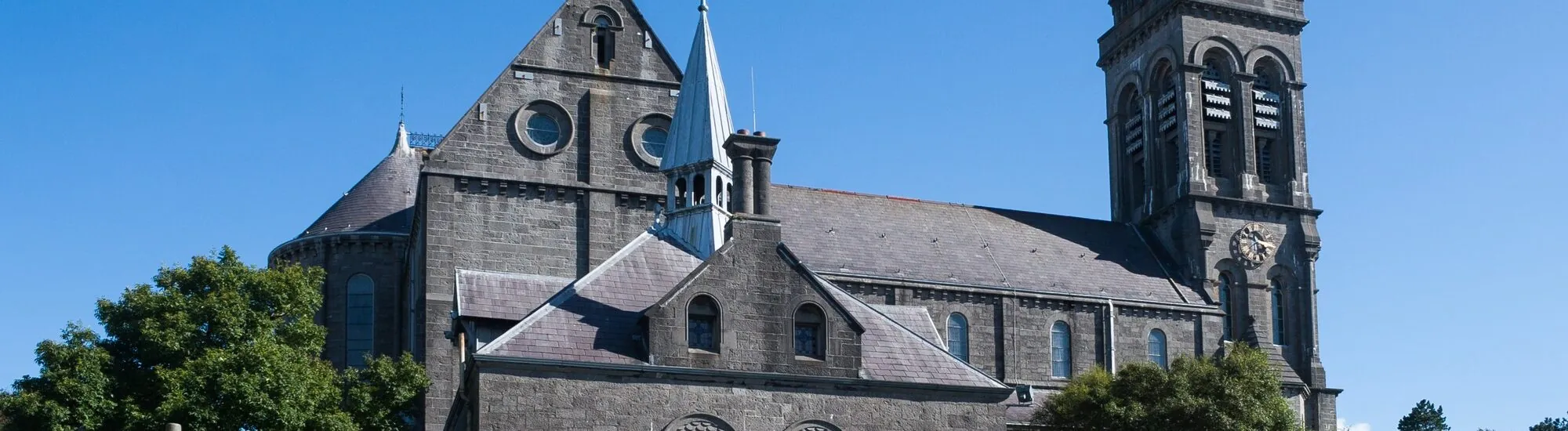
From Temple Street, the tower of the Cathedral of the Immaculate Conception rises above the rooftops of Sligo. As you approach, look at the round-arched openings and the stone masses surrounding the bell tower. This 19th-century Catholic cathedral owes its silhouette to George Goldie, who chose an architecture inspired by Norman Romanesque. It remains an active place of worship. Even a stop outside offers a chance to read the building, while a visit outside service times may allow you to discover its nave and stained-glass windows, when access permits.
The project dates back to the 1860s. The cathedral replaced St John’s Catholic pro-cathedral, an earlier building that appears in the historic town atlas. The new building opened in July 1874, a date recorded by the Dictionary of Irish Architects. Diocesan documentation distinguishes this opening from the consecration, which took place in 1897. These two dates mark different stages in the building’s life. For visitors, 1874 remains the simplest reference point for placing the building in Sligo during the second half of the 19th century.
The plans were drawn up by George Goldie. The National Inventory of Architectural Heritage highlights the use of dressed limestone and the clarity of its forms. The bell tower plays a particular role in the townscape. It can be spotted before the doorways and windows come into view. Begin your visit from a little distance, then move closer to compare the size of the blocks, the surrounds of the openings and the changing rhythm between the tower’s levels.
The Cathedral of the Immaculate Conception is the Catholic seat of the Diocese of Elphin. Nearby stands St John’s Cathedral, which belongs to the Church of Ireland. The two buildings form part of the urban landscape, with different silhouettes and histories. To find the Catholic cathedral on a map, search for its full name or the Temple Street address. On the ground, Goldie’s tall tower serves as a landmark. A walk between the two buildings makes it possible to compare their setting and scale without going far out of your way.
The Irish architectural inventory lists the cathedral among examples of the Norman Romanesque Revival. To recognise this influence, look at the rounded shape of the arches and the way the stone masses fit together. The building is easier to read from a street corner. The tower, transept arms and lower volumes of the chapels stand out more clearly from there than when standing directly in front of the entrance.
Inside, when the doors are open to visitors, take time to look along the axis of the nave. Goldie’s design provides for an aisleless nave and a semicircular apse. Then compare this view with those from the sides. The transept arms open up the space and make it possible to spot stained-glass windows set high up. The parish website gives an example in the west transept, depicting King David. Compact binoculars may help you make out details in the glass, if the light and visiting conditions allow.
The layout of the apse also deserves attention. Beyond the main chancel space, the surveys identify a chapel extending from the apse and chapels opening off the transept arms. Moving from the nave to a side view reveals how these secondary spaces relate to the main volume. From outside, their lower height makes them easy to pick out, even when the nave is inaccessible. It is a useful way to trace in the masonry the design described in the architect’s records.
From the town centre, head towards the John Street and Temple Street area. Allow around twenty minutes to look at the exterior, and longer if the nave is accessible. The parish notes restoration works, while the diocese publishes service times. For a sightseeing visit, confirm access with the parish office and plan to come outside times of worship. Mass information can help you choose a suitable time, while the parish bulletin notes any local changes.
To extend your walk, head back down towards the Garavogue or continue to Sligo Abbey. The medieval Dominican priory and the 19th-century cathedral represent two very different periods in Sligo’s religious heritage. If you only have a short window, begin with a walk around the cathedral’s exterior and save the interior visit for a time when access has been confirmed.
Essential information to help you plan your visit, including key landmarks, access information, and booking options.
Temple Street, Sligo, County Sligo, Republic of Ireland, Tourist attractions in Ireland
54.26948, -8.47885
Tourist opening hours are not confirmed. Check the parish bulletin for service times and call the office before an interior visit, particularly during restoration works.
Check the opening hours and admission requirements before you leave, especially during peak season or on Irish public holidays.
The façade can be viewed free of charge from public space. No interior admission fee is published in the sources consulted.
Find the location, find a good restaurant, or find your next place to stay.
Distances as the crow flies from the visited location.
The map is currently unavailable.
Our selection of places within 15 km of this location, listed from closest to farthest. Distances are given as the crow flies; actual travel times may be longer.