

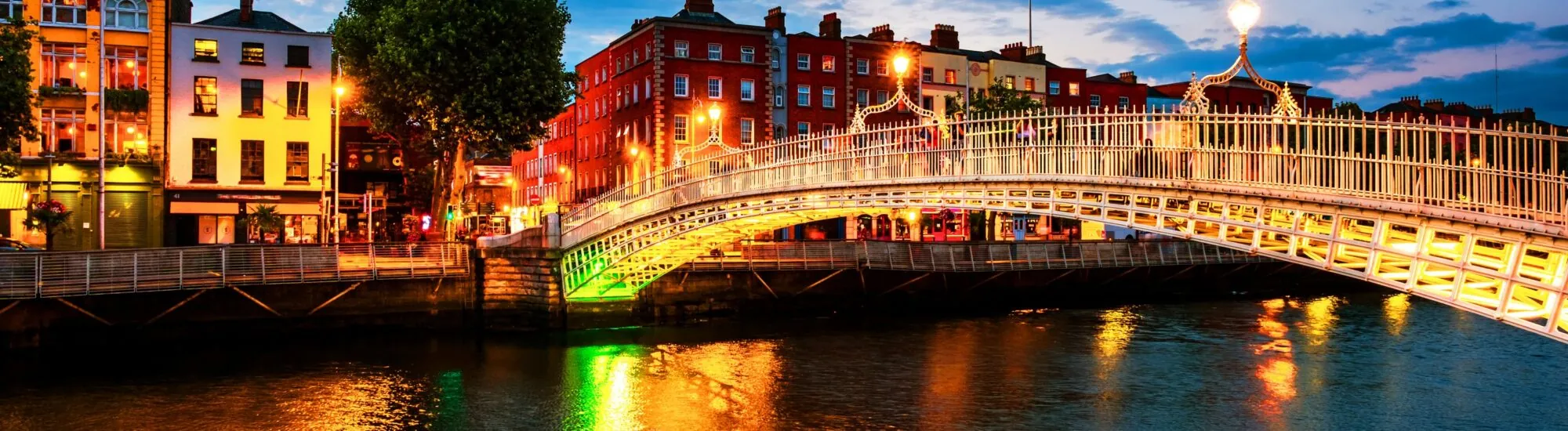
Recognisable by its white silhouette and delicate arches, the Ha’penny Bridge is one of Dublin’s most iconic landmarks. This pedestrian footbridge spans the Liffey in the heart of the Irish capital, between the lively Temple Bar district and the shopping streets on the north bank.
Opened in 1816, the Ha’penny Bridge is Dublin’s oldest bridge designed specifically for pedestrians. Thousands of people cross it every day, often unaware of the surprising origin of its nickname.
The Ha’penny Bridge in Dublin – © susanne2688
The Ha’penny Bridge links Lower Liffey Street, on the Liffey’s north bank, with Wellington Quay, by Merchant’s Arch and Temple Bar. It does not lead directly onto O’Connell Street, but provides a quick route to this major city-centre thoroughfare.
The crossing takes only a few minutes. Even so, it offers pleasant views of the quays, colourful façades and the other bridges in central Dublin. The waters of the Liffey, whose level changes with the tides, give the scene a different character throughout the day.
Reserved entirely for pedestrians, the bridge is heavily used by both locals and visitors. It serves as a tourist attraction, meeting point and practical crossing between two particularly lively parts of the capital.
Before the bridge was built, local residents crossed the Liffey here on small ferries operated by William Walsh. As these boats had fallen into serious disrepair, the authorities asked their owner either to repair them or build a bridge.
William Walsh chose the latter option. He was granted permission to erect a pedestrian footbridge and charge a toll for a set period. The structure was made at the Coalbrookdale Foundry in Shropshire, England, before being transported by boat to Dublin and assembled on site.
The bridge officially opened on 19 May 1816. It became Ireland’s first iron bridge and Dublin’s first crossing reserved exclusively for pedestrians.
After the first ten days, during which crossing was free, pedestrians had to pay a toll of half a penny. This was the same price previously charged for using William Walsh’s ferries.
Turnstiles were installed at both ends of the bridge to control crossings. Locals soon began calling the footbridge the Ha’penny Bridge, a contraction of half penny bridge.
The toll was later raised to one and a half pence. It was eventually abolished in 1919, when the city council took control of the bridge. Crossing has been free ever since, but the nickname remains firmly embedded in Dubliners’ everyday language.
When it opened, the structure was commonly known as Wellington Bridge, in tribute to Arthur Wellesley, the first Duke of Wellington. Born in Dublin, he is particularly known for his victory over Napoleon at Waterloo in 1815.
Contrary to what some accounts of the bridge suggest, the Duke of Wellington was not an Irish Prime Minister. He was a British soldier and statesman who served twice as Prime Minister of the United Kingdom in the 19th century.
The structure’s current official name is Liffey Bridge, or Droichead na Life in Irish. In practice, this name is rarely used: locals, guides and visitors almost always refer to the Ha’penny Bridge.
Despite its light appearance, the Ha’penny Bridge rests on a metal structure that was remarkably ingenious for its time. It consists of a single cast-iron arch spanning the Liffey without an intermediate support in the river.
Its openwork railings, curves and decorative details give it a more elegant appearance than the road bridges around it. The lamps positioned along the footbridge also contribute to its visual identity, especially after nightfall.
The bridge is sometimes described as a wrought-iron structure. It is, however, more accurate to call it a cast-iron footbridge, even though different metal components have been used or replaced during its restorations.
After almost two centuries of footfall, harsh weather and successive repairs, the Ha’penny Bridge showed significant signs of wear. Dublin City Council began a full restoration in 2000.
More than a thousand components forming the railings were numbered, dismantled and sent to Northern Ireland for repair. Around 85% of the original metalwork was retained.
The project also made it possible to install a non-slip surface, replace the old lighting and improve access points. After around a year of work and an investment of €1.25 million, the bridge reopened on 21 December 2001.
As on many European bridges, couples have taken to attaching padlocks to the railings before throwing away the key in the Liffey. While the gesture is intended to be romantic, it gradually weakens the structure and damages the bridge’s historic features.
The city authorities regularly remove these padlocks to protect the structure. It is therefore best to keep declarations of love to a photograph and not attach anything to the railings.
The bridge can of course be photographed while crossing it, but its silhouette is best seen from the quays. The north bank, near Lower Liffey Street and Bachelor’s Walk, offers a fine view of its arch and the buildings of Temple Bar.
From the south bank, Wellington Quay also provides an opportunity to photograph the bridge with the façades on the opposite bank in the background. In the morning, generally lighter footfall makes photography easier.
At nightfall, the bridge lights and the lights of the quays are reflected in the Liffey. This nighttime atmosphere offers a more romantic side to the landmark, although the area around Temple Bar is often very lively at this time.
On the south bank, Merchant’s Arch leads directly into Temple Bar. The district is home to pubs, restaurants, small shops and several cultural venues. Its atmosphere is particularly lively in the evening.
Following the quays eastwards, you can reach O’Connell Bridge and then O’Connell Street. On the north bank, Lower Liffey Street quickly leads towards Henry Street and its many shops.
The Ha’penny Bridge can therefore easily be included in a walk around central Dublin. A visit is brief, but its history, architecture and central location make it far more than a simple crossing over the Liffey.
To learn more about its history, see the bridge’s profile on the heritage website Bridges of Dublin.
Want to extend your visit without having to rush around? Here are a few well-located places to stay near the must-see attractions.
Essential information to help you plan your visit, including key landmarks, access information, and booking options.
Bachelors Walk, Temple Bar, Temple Bar
53.346306, -6.263085
15 minutes
Compare tickets, guided tours, and excursions available through our partner platforms.