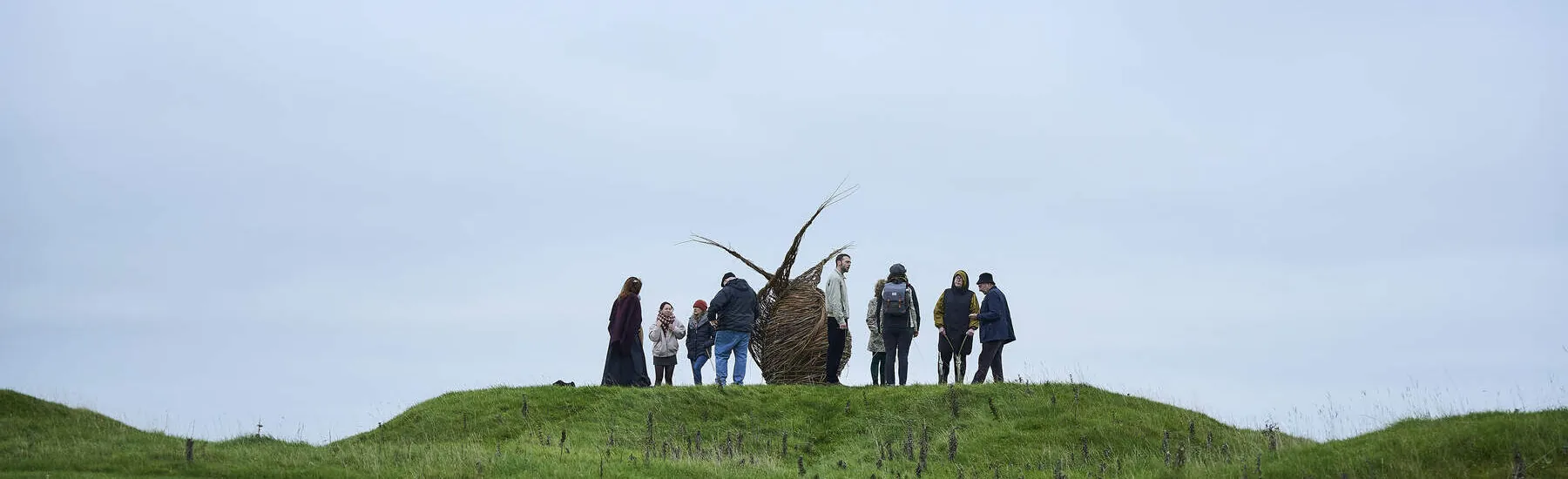
At first glance, the Hill of Ward is little more than a windswept, green hill in County Meath, just a few kilometers from the small town of Athboy. Yet beneath this apparent simplicity lies one of the most powerful sites in Irish mythology and culture. This is where the ancient Samhain rituals took place—the Celtic festival marking the end of the harvest and the beginning of the dark season. On this hill, the sacred fire was lit, destined to ignite every hearth in Ireland.
The hill takes its name from Tlachtga, daughter of the druid Mug Ruith—a mythological figure both powerful and tragic. According to legend, she died here after giving birth to triplets, and her name has been forever linked to the site. The memory of Tlachtga still lingers, giving this unassuming rise a spiritual aura that draws researchers, folklore enthusiasts, and curious travelers alike.
The Hill of Ward was not only a ritual space; it also served as a place of assembly and authority. Much like the Hill of Tara, where Ireland’s kings received their legitimacy, Tlachtga was a spiritual center. The ceremonies held here united clans around a single fire and a shared belief: that the sacred flame protected the people and ensured the continuity of the cycle of life and death. This fire was not just a symbol—it was seen as a true cosmic force, connecting the living to their ancestors and the unseen world.
Every October 31st, as night fell, all fires in Ireland were extinguished. The country symbolically plunged into darkness before the druids lit the first fire on the Hill of Ward. From there, torches were carried to other hills and villages to rekindle the hearths. In this way, the entire community was bound by the same flame—a shared energy of renewal and protection.
The fire of Tlachtga also served to ward off evil spirits. Samhain was considered a liminal night when the veil between the living and the dead grew thin. The souls of ancestors could return, but malevolent creatures also roamed. The fire thus had a dual purpose: to illuminate and protect, while welcoming benevolent ancestors.
Though these rituals belong to a distant past, they have never truly faded from collective memory. In County Meath, many local traditions recall the role of the Hill of Ward, and each year symbolic ceremonies are held to honor this history. The sacred fire is rekindled—not as a druidic ritual, but as a cultural gesture connecting present and past.
Visiting the Hill of Ward means immersing yourself in an atmosphere rather than a spectacular setting. The hill preserves archaeological traces, notably a large circular enclosure with several banks and ditches, evidence of its ceremonial role. The surrounding landscape is stunning, with open views over the plains and neighboring hills, helping you understand why the ancient Celts saw this place as a point of connection between earth and sky.
It’s important to know that the site remains very understated. Unlike Newgrange or the Hill of Tara, there’s no visitor center or detailed signage. It’s a raw, almost untouched place, where the power comes from its simplicity and silence. Many visitors describe a unique atmosphere—a sense of walking in the footsteps of rituals that deeply shaped Ireland’s identity.
In recent years, the Hill of Ward has regained visibility thanks to the Púca Festival, held in Athboy and Trim. This festival celebrates Halloween in its most Irish sense—as a continuation of Samhain. One of the highlights is the symbolic walk to the hill and the lighting of a commemorative fire, echoing the sacred flames of the druids.
This is the perfect time to visit, as guides share the history and legends of Tlachtga, musicians enliven the evenings, and the atmosphere becomes truly magical. It’s an event that attracts both locals and visitors eager to experience ancestral Ireland at Halloween.
The Hill of Ward is about 50 km northwest of Dublin and just a few kilometers from Trim. The easiest way to get there is by car, as public transport is limited. The site is on private land but accessible during ceremonies and organized guided tours. Outside these times, it’s best to check with local tourist offices.
Entry to the hill is generally free, as it’s not a conventional tourist site. However, for guided tours during the Púca Festival, the fee is around €25 per adult, often including transport from Athboy. Times vary according to the festival schedule, with several departures per day. Outside the festival, there’s no official timetable—the site is freely accessible but limited by its private nature.
Some preparation is needed: sturdy shoes, weather-appropriate clothing, and a camera to capture the beautiful scenery. Don’t expect on-site services like cafés or shops—it’s best to plan a stop in Athboy or Trim for food and refreshments.
Essential information to help you plan your visit, including key landmarks, access information, and booking options.
Wardstown, Athboy
53.62444519855298, -6.886112693984022
1 hour
the land is private. Please seek prior permission. The site is open during public events.
Check the opening hours and admission requirements before you leave, especially during peak season or on Irish public holidays.
free except during the Púca Festival