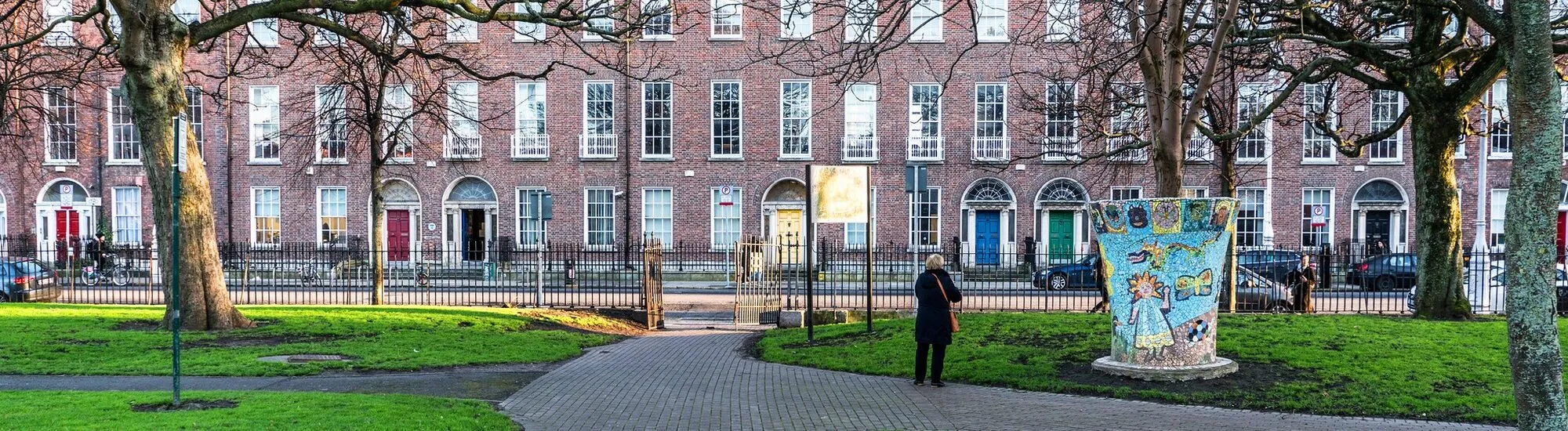
At Mountjoy Square, just a few streets from O’Connell Street, the best view is sometimes the simplest. Stop at one corner of the square and follow the roofline with your eyes. Brick façades, windows and doors echo one another around an enclosed garden. This regularity gives one of north Dublin’s great Georgian squares its distinctive character. Yet a walk around it reveals a history marked by disruption. Behind the façades, grand houses gave way to subdivided accommodation and rebuilding, while the private garden became a neighbourhood park.
In the late 18th century, Luke Gardiner, the future Viscount Mountjoy, developed part of the family estate north of the Liffey. The layout of Mountjoy Square dates from 1789, according to the National Inventory of Architectural Heritage. The houses surrounding the park were built between 1792 and 1818, while the central garden was laid out in 1802. These dates tell the story of a project that unfolded over several decades. The square forms part of a broader urban scheme, visible by following Gardiner Street towards the river and the area around the Custom House.
To understand what sets it apart, begin with its proportions. While several of Dublin’s Georgian squares are rectangular, Mountjoy Square was designed as a symmetrical square. The rows of houses use a similar palette of materials and share a continuous parapet line. Then, from the pavement, look at eye level. The doors, their surrounds and glazed fanlights give each house its own character. A walk along all four sides reveals both the overall design and the variations that are lost when viewing the square solely on a map.
The city’s architectural conservation report charts the losses suffered by the square in the 20th century. The south and west sides saw the most extensive demolitions, particularly from the 1970s onwards. More of the historic fabric survives on the north and east sides. If time is short, start there, then continue west to compare the streetscapes. This history explains how rebuilding was able to restore the square’s visual continuity, with buildings from different periods standing within the same row.
The report also notes that the playwright Seán O’Casey lived at number 35 in 1921. The former building was demolished. It inspired the setting of The Shadow of a Gunman, a play in which the intimacy of a Dublin home is overtaken by the War of Independence. The reference lends another dimension to the walk. Behind the succession of doors were rooms, neighbours and shared staircases. Literature helps evoke this density of life, which a view of the façades can only partly convey.
To photograph an entire row, step back towards the railings and frame it along its length. For details, move closer to the doorsteps from the pavement and observe the relationship between the granite steps, brickwork and wrought iron. The houses border a lived-in square. Walking around the outside lets you enjoy the architecture without stepping onto the doorsteps.
The central garden entered public ownership in 1938. The wrought-iron railings and granite base still show the separation between garden and street envisioned in the Georgian plan. From outside, observe how the railings curve around the corners. Inside, the paths and lawns offer oblique views of the houses. A granite sundial and two mosaic tree surrounds punctuate the walk. Commissioned by Pavee Point Traveller & Roma Centre, these mosaics evoke the lives of Irish Travellers.
Dublin City Council lists a playground, tennis courts and an all-weather football pitch. The city has also drawn up a conservation plan to guide the garden’s restoration and use. If you are visiting for a particular facility, check its availability before setting out. Visitors primarily interested in the architecture can follow the pavements around the entire square, even when the park railings are closed.
Allow around 25 to 40 minutes to walk around the façades and cross the garden at your own pace. The council lists the park as wheelchair accessible. To extend your walk, continue to North Great George’s Street and the James Joyce Centre. The street offers another view of the proportions of Georgian houses in a more compact setting. Further west, near Parnell Square, the Garden of Remembrance provides another stop. The route thus links two public gardens and several streets where the history of the north side can be read from the pavement.
Want to extend your visit without having to rush around? Here are a few well-located places to stay near the must-see attractions.
Essential information to help you plan your visit, including key landmarks, access information, and booking options.
Mountjoy Square, Dublin, County Dublin, Republic of Ireland, Tourist sites in Ireland
53.356488473923, -6.257511875116
The park opens at 10am. It closes at 5pm in January and December, 5.30pm in February and November, 8.30pm in April and September, 9.30pm in May and August, and 10pm in June and July. In March, it closes at 6.30pm before the clocks change, then at 7.30pm. In October, it closes at 7.30pm before the clocks change, then at 6.30pm. Some gates may begin closing earlier.
Check the opening hours and admission requirements before you leave, especially during peak season or on Irish public holidays.
Free access to the square and public garden.