

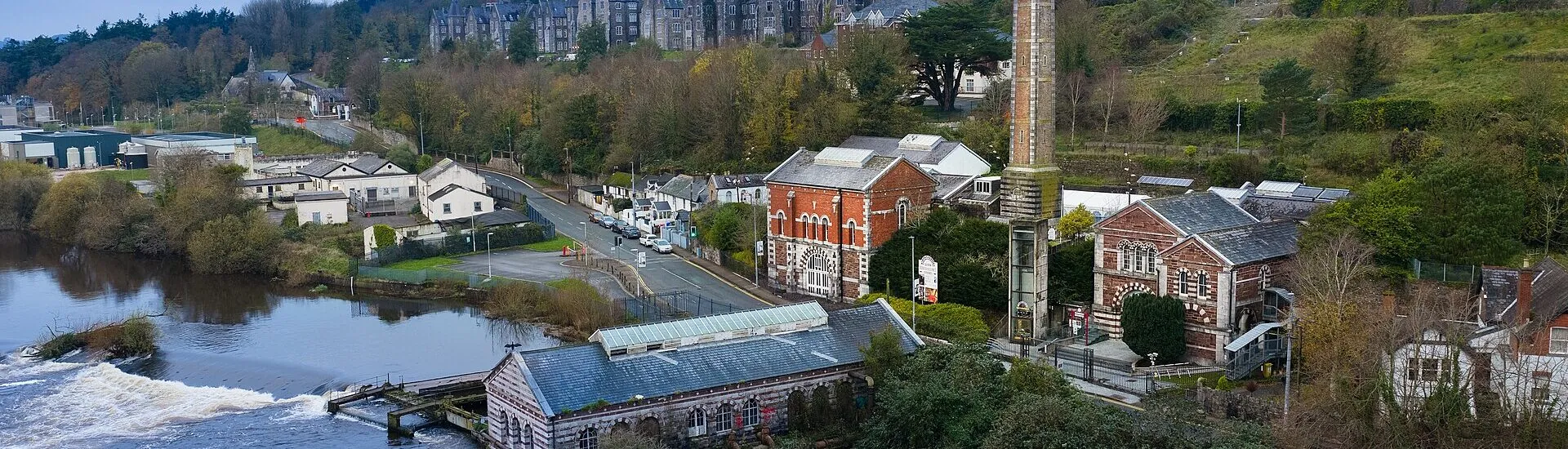
West of Cork city centre, on the north bank of the Lee, Old Cork Waterworks Experience tells a story less familiar than that of the city’s churches and prisons: the story of drinking water. Set within a remarkable Victorian industrial complex, this former pumping station reveals how Cork had to transform its infrastructure to support its growth in the 19th century and meet a vital public-health challenge.
The visit combines industrial heritage, large-scale machinery, Victorian architecture and educational displays. It is a particularly interesting stop for those looking to complement a visit to Cork with a site that differs from the city centre’s major landmarks.
The visitor route takes in several historic buildings arranged around a cobbled courtyard overlooking the Lee. The complex retains some of the equipment that supplied Cork with water, including imposing steam engines and boilers used during the industrial period.
The displays are not aimed solely at mechanical engineering enthusiasts. Interactive areas explain the role of water, energy and resources, while the site’s history places these installations within Cork’s development. Self-guided and guided visits are available depending on current arrangements, along with visitor materials and audiovisual content.
Old Cork Waterworks has a strong educational focus. Its interactive areas, activities exploring science and the environment, and occasional events make the site accessible to children. The venue also regularly hosts educational programmes and events dedicated to science, water or heritage.
The site’s history dates back to the 1760s. Engineer and architect Davis Ducart identified this stretch of Lee Road as particularly well suited to a water-supply network: the river provided an abundant resource upstream from the city and beyond the reach of tidal influence. The Cork Pipe Water Company was established, and the first installation was completed in 1768.
At the time, a water wheel powered the system, and water was stored in reservoirs before being distributed through wooden pipes. Access, however, remained deeply unequal: wealthier residents could pay for a subscription, while much of the population relied on often inadequate cisterns and public fountains.
In the 19th century, urban growth and health problems made modernising the network essential. Following the Cork Improvement Act of 1852, the municipal authorities took over the system. In 1857, the architect Sir John Benson was commissioned to design a far more ambitious installation, capable of improving the population’s water supply.
Turbines, cast-iron pipes, new reservoirs and steam engines gradually transformed the Waterworks. The equipment continued to evolve until the early 20th century. The large Lancashire boilers and engines installed in the early 1900s still form one of the visit’s most striking features today.
After the old machinery ceased to be used, the complex could have disappeared or lost its coherence. Instead, an extensive restoration programme carried out in the early 2000s preserved the buildings and gave them a new purpose. The site opened to the public in its current form in 2006.
This repurposing is particularly successful because it preserves the site’s character: the industrial spaces, machinery and relationship with the Lee remain at the heart of the experience. Some turbines have even been restored to generate hydroelectricity, creating a meaningful link between technical heritage and contemporary thinking on energy.
The site lies outside the very centre but fits easily into a day exploring west Cork. Fitzgerald Park, University College Cork and Cork City Gaol are all in the same area. Their proximity makes it possible to create a coherent itinerary combining industrial heritage, green spaces, the university and social history.
Above all, Old Cork Waterworks offers a different perspective on Cork. Beyond the image of pubs, the port and religious monuments, it reveals a city facing very practical challenges: providing clean water for a growing population, tackling health problems and adopting the technologies of the Industrial Revolution.
Want to extend your visit without having to rush around? Here are a few well-located places to stay near the must-see attractions.
Essential information to help you plan your visit, including key landmarks, access information, and booking options.
Lee Road, Cork
51.895, -8.5093