
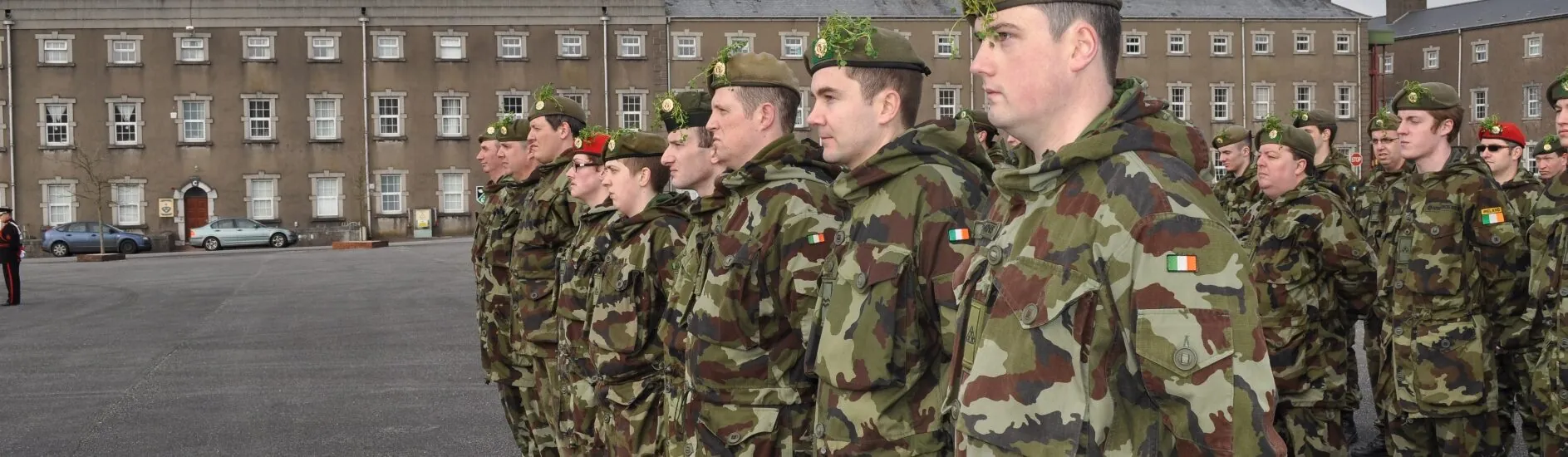
Located within Collins Barracks, Cork’s Military Museum offers an insight into Irish military history from a site that has itself played a part in it. The barracks, still associated with the Irish Defence Forces, overlooks the northern side of the city and preserves the memory of the soldiers, regiments and major political upheavals that shaped modern Ireland.
The museum is more discreet than Cork city centre’s major attractions. That is precisely what makes it worthwhile: it offers a specialist perspective on history, particularly for visitors interested in the military, conflicts, the revolutionary period and the connections between Cork and the armed forces.
The collections explore different aspects of military life: uniforms, insignia, documents, photographs, personal belongings and memorabilia associated with units and soldiers connected to Cork. The aim is not simply to display equipment, but to place these items within the lives of the men and women who lived through the political and military changes of their time.
A visit is generally shorter than one to a major national museum. It does, however, reward taking the time to read and look closely at the objects, as much of its interest lies in the individual stories they help to bring to light.
The museum will particularly appeal to visitors who already know the broad outlines of Irish history and wish to explore Cork’s role in greater depth. It usefully complements sites more focused on the city’s political, prison or civic history.
The museum cannot be separated from the place that houses it. Collins Barracks forms part of Cork’s extensive military heritage. The presence of a major garrison in the city recalls Cork’s strategic position as a major port in the south of Ireland and an important crossroads for people and goods.
Through changes of regime, the site’s military role has unfolded in very different contexts: the British period, the Irish Revolution, independence and then the organisation of the new State’s Defence Forces.
Like many Irish military installations, the barracks are closely bound up with the political transition of the early 20th century. This physical continuity, despite the change in authority and flag, is one of the site’s most compelling aspects: the same buildings can be read through several, at times opposing, chapters of Irish history.
Cork occupies a distinctive place in the events surrounding the struggle for independence. The city and county are associated with many figures and operations of the revolutionary period, while the Civil War also left a deep mark on the south of the country.
A military museum offers a different approach to this history from that provided by political biographies. Uniforms, equipment and archives are reminders that major historical events also played out through individual lives, postings, commitments and breaks with the past.
Small military museums often rely on an accumulation of items whose value lies as much in their provenance as in their appearance. Medals, photographs, documents and personal belongings preserve the memory of units and soldiers who might otherwise be reduced to a few lines in historical accounts.
Collins Barracks lies north of the city centre. A visit can complement an exploration of the Shandon area and Cork’s hillside neighbourhoods. Above all, it offers a way to step beyond the most familiar tourist routes.
It is not necessarily an attraction to put at the top of the list on a first day in Cork. For a stay of several days, however, or for travellers with a keen interest in Irish history, the museum adds another layer of depth and provides an insight into an essential aspect of the city’s past.
Want to extend your visit without having to rush around? Here are a few well-located places to stay near the must-see attractions.
Essential information to help you plan your visit, including key landmarks, access information, and booking options.
Old Youghal Road, Cork
51.9078, -8.4619