


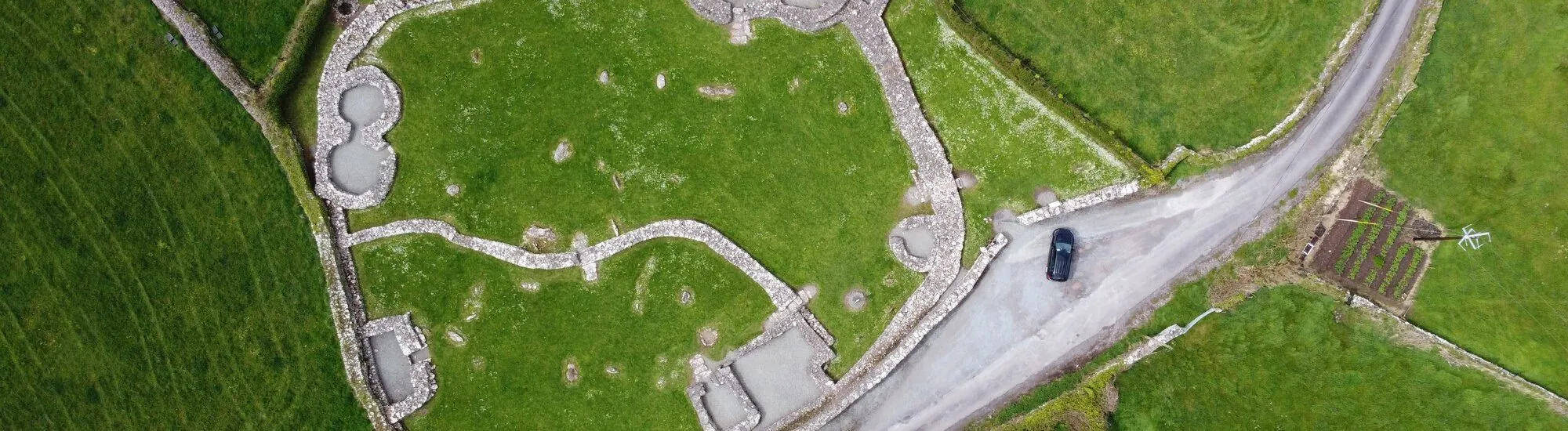
East of Ballyferriter, a stone enclosure preserves the layout of a small monastic community: the foundations of an oratory, the curves of former dwellings and stones carved with crosses. Reask, also known as An Riasc, reveals itself as much by looking at the ground as by lifting your gaze. Its large carved stone catches the eye first; around it, the remains gradually piece together a place where people prayed, worked and lived.
The Irish name An Riasc refers to a marshy place. The site lies around 1.5 kilometres east of Ballyferriter, in the western part of the Dingle Peninsula. The community’s precise origins remain poorly understood: no reliable account identifies its founder. It was occupied from the early centuries of Irish Christianity, and its remains date from the Early Middle Ages.
Excavations carried out by Thomas Fanning between 1972 and 1975 revealed the site’s layout. An enclosing wall and an internal division marked out spaces for worship and everyday life. To begin your visit, study this layout: it helps make sense of the small structures of which only the lower sections remain today.
The foundations of the clocháns, these circular stone structures, recall the community’s dwellings. Some are paired, forming shapes that are easier to make out when you step back a little. Alongside the religious remains, archaeologists also identified craft activities and a kiln used for drying grain.
Fragments of amphorae and imported pottery also point to connections with the continent. This detail changes how the place is viewed: this small settlement in western Ireland took part in exchanges that extended far beyond its immediate surroundings. A stop at the local museum offers a chance to continue this exploration through objects recovered during the excavations.
The large standing stone on the left as you enter is the highlight of the visit. Dingle Peninsula Tourism dates it to the second half of the 6th century and states that it remains in its original position. Take time to examine the cross, then look for the inscription “DNE” on its left-hand side as you face it. These letters abbreviate the Latin Domine, meaning “Lord”.
To appreciate the carving, gently change your angle from the accessible areas. Subtle relief can sometimes be seen more clearly from the side. Look without rubbing the stone or trying to bring out the lines with water, chalk or any other substance.
Reask also served as a burial place. The ancient cemetery was followed by later funerary use, notably for children who died unbaptised. This aspect calls for a respectful approach to the remains: the open spaces between the walls are not merely traces of a lost settlement.
From the road linking Ballyferriter and Dingle, access is signposted by a small lane on the Dingle side of Bric’s pub and brewery, also known as Beoir Chorca Dhuibhne. The road is narrow. The local tourism body notes that there is a small space to park one car beside the monument, and that the lane is unsuitable for large coaches.
Reask is a national monument in the care of the Office of Public Works. There are no guided tours on site. Please respect the displayed guidance, the masonry and the burial areas. To plan your journey, consult the official Heritage Ireland page.
Músaem Chorca Dhuibhne offers an educational resource devoted to Reask. It invites visitors to draw the enclosure, identify the paired structures and find the letters on the carved stone. You can prepare for your visit with this English observation guide: a few hands-on activities make the foundations much easier to understand.
The Ballyferriter museum is the most direct continuation of the visit, with objects and stones from the site. To compare religious architecture, continue to the Gallarus Oratory, whose preserved form helps bring a small oratory to mind. Kilmalkedar Church offers another complex to explore, with its ruined church and inscribed stones.
Want to extend your visit without having to rush around? Here are a few well-located places to stay near the must-see attractions.
Essential information to help you plan your visit, including key landmarks, access information, and booking options.
An Riasc, Ballyferriter, Dingle Peninsula, County Kerry, Republic of Ireland, Tourist attractions in Ireland
52.1675152, -10.3875848
free