

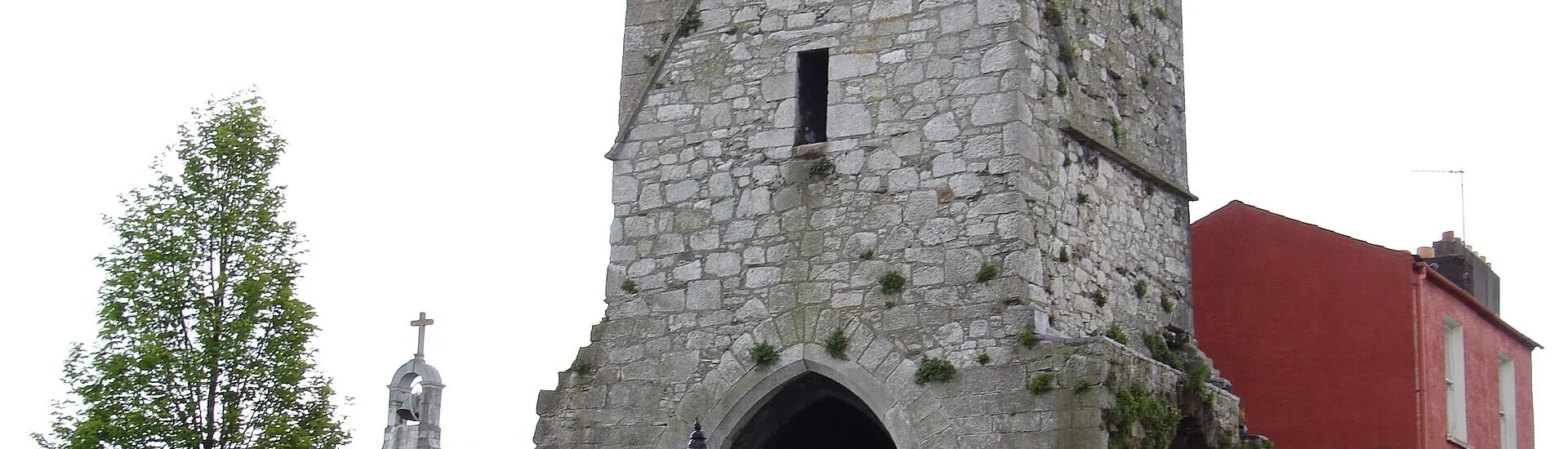
Amid the streets of Cork’s South Parish stands a stone tower that seems almost forgotten by the modern city. Yet Red Abbey is one of Cork’s most valuable medieval remains: its tower is the principal surviving feature of a former Augustinian foundation that once occupied a significant part of the area.
The monument is modest and cannot be visited like the great ruined abbeys found in the Irish countryside. Its interest lies elsewhere: Red Abbey offers a rare direct connection with medieval Cork, much of whose legacy has vanished or now lies buried beneath the modern city.
Red Abbey stands in the area around Red Abbey Street, south of Cork’s historic centre. Now isolated amid the urban fabric, its tower once belonged to a much larger church that formed part of a substantial religious complex.
Visiting the site essentially means viewing the monument from its surroundings and understanding what it once represented. Do not expect to explore cloisters, dormitories or an intact church. To appreciate Red Abbey, you must instead mentally reconstruct the lost complex around this solitary tower.
The contrast between the ancient masonry and the surrounding buildings is part of the site’s charm. While many Irish monastic ruins are set in the countryside, Red Abbey is a reminder that Cork, too, has a medieval heritage deeply embedded in the contemporary city.
Red Abbey is associated with a medieval Augustinian foundation. The archaeological evidence available in Cork dates the complex to the Middle Ages, with the surviving tower generally thought to date from the 14th century.
At that time, the building visible today was only one part of a much larger ensemble. Around the church were the various spaces needed for the religious community’s life: sleeping quarters, communal rooms, a kitchen, outbuildings, cellars and a cloister.
Red Abbey would therefore have formed a genuine religious enclave within Cork’s landscape. The solitary tower seen today gives only a very partial impression of the importance the complex once held.
The church followed a cruciform plan. The tower stood at the crossing, where its different sections met. The chancel extended eastwards, the nave westwards, while the transepts occupied the north and south sides.
The tower was therefore not designed as a standalone building at all. Rather, it was the architectural heart of a much more imposing church. The gradual disappearance of the buildings around it is what gives it its strikingly isolated silhouette today.
Imagining these lost volumes completely changes how the monument is perceived. What initially looks like a simple medieval tower becomes the last vertical element of a religious complex that once shaped this part of Cork.
Like many Irish religious foundations, Red Abbey had a turbulent history after the Middle Ages. Religious and political upheavals gradually altered the complex’s function, while Cork was undergoing significant urban transformation.
Over the centuries, much of the site’s buildings disappeared. The city expanded, the area became more densely built, and the space once occupied by the religious foundation was gradually absorbed into the urban fabric.
The tower survived these changes, while the nave, chancel, transepts and conventual buildings vanished from the landscape. This partial survival explains the particularly unusual appearance of the monument today.
Red Abbey’s value becomes even clearer when looking at Cork’s archaeology. In the historic centre, many medieval remains are now buried beneath modern streets and buildings. Traces of the old walled town are themselves often far less visible than in other European cities.
Red Abbey therefore possesses an increasingly rare quality: it makes this period immediately tangible. The stone, the tower’s proportions and its presence in the landscape lend physical reality to a medieval city that often has to be reconstructed from archaeological excavations, old maps or underground remains.
That is also what distinguishes Red Abbey from Cork’s more recent monuments. It is not merely another historic building, but a visible fragment of a city that has largely disappeared.
Red Abbey also provides an opportunity to explore the South Parish, an area less visited than Cork’s main shopping streets. The neighbourhood retains several layers of the city’s urban and religious history, offering a different side of the tourist centre.
The tower’s presence among modern streets perfectly illustrates this layering of periods. Within a few minutes’ walk, you move from contemporary Cork to places directly associated with the city’s earliest centuries of development.
Red Abbey is therefore particularly well suited to a walk focused on historic heritage, rather than as a visit in its own right.
Red Abbey does not require several hours to visit. The monument is relatively compact, and the experience chiefly consists of observing the tower and understanding its historical context.
For enthusiasts of history, archaeology and medieval architecture, however, it is a particularly worthwhile detour. A few minutes in front of the tower are enough to add an important piece to Cork’s historical puzzle.
The site becomes even more meaningful when paired with Christchurch and St Peter’s. Together, these monuments reveal several landmarks of the old city and show just how present medieval Cork remains beneath today’s urban landscape: sometimes in the form of buried remains, sometimes through a handful of altered buildings and, at Red Abbey, through an imposing stone tower that continues to defy the centuries.
Want to extend your visit without having to rush around? Here are a few well-located places to stay near the must-see attractions.
Essential information to help you plan your visit, including key landmarks, access information, and booking options.
Red Abbey Street, Cork
51.89407, -8.47236