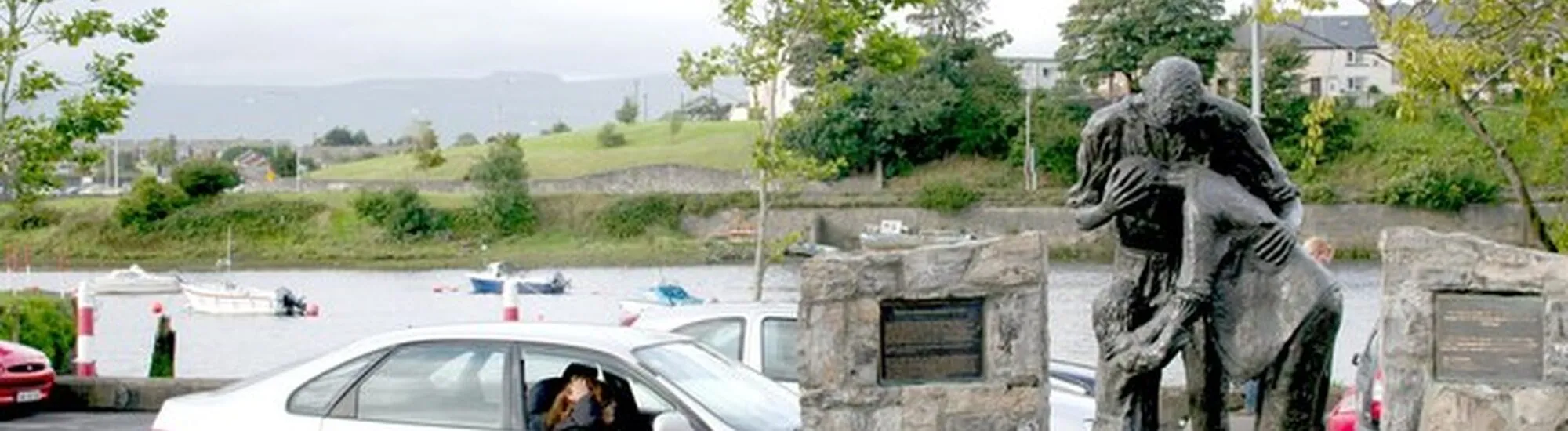
On Sligo’s quayside, a bronze child reaches out towards the water. Behind her, two adults stand close together. The Sligo Famine Family Memorial is defined by the contrast between the child’s gesture and the parents’ posture. Erected in 1997, Niall Bruton’s monument commemorates the families driven to leave by the Great Famine. A plaque reproduces an extract from a letter sent to a son who had left for America. Take the time to read it after looking at the figures and the quay towards which they turn.
Start by viewing the group from the front, then move to one side. The sculpture brings three figures together on a single plinth, yet each occupies the space differently. The two adults draw close and seem to seek comfort. The little girl stretches out her hand, drawing the eye beyond the group towards the harbour. Its meaning shifts when you take the location into account. You see both a family in distress and the direction their departure might have taken.
The monument was installed in 1997 as part of the commemorations marking the 150th anniversary of the Great Famine. The Famine memorials directory distinguishes it from other works commissioned in Sligo that year, notably at the cemetery of the former workhouse near St John’s Hospital. If you are looking for the bronze family, Lower Quay Street is where you need to go. The quayside monument recalls emigration. Sligo’s other memorial sites also tell the story of those who remained.
The plaque refers to a letter dated 2 January 1850, signed by Owen Larkin and addressed to his son in America. The father describes the deaths of relatives, eviction and a lack of money. He awaits a reply and places his hopes in the bond that endured across the Atlantic. According to Discover Ireland, he did not know that his son had already died. Read the plaque on site. The practical nature of the request—for a reply by return post—adds another dimension to the distance suggested by the sculpture.
Discover Ireland estimates that around 30,000 people left Sligo Harbour between 1847 and 1851. This figure relates to a period of departures and helps convey the harbour’s role in the crisis. For people in the north-west, reaching a quay was one stage of a journey whose outcome also depended on the crossing. The monument invites you to consider these departures on the scale of a family, while the figure places them within a collective history.
These departures took place in the context of the Irish Great Famine, when potato blight struck the crops on which many households depended. Owen Larkin’s letter offers an insight into the crisis’s other dimensions. A family could lose access to land, lack an income and see loved ones leave, all at once. In Sligo, the proximity of the water makes visible the rupture between those who boarded ships and those who waited for news.
The Carricks provides a documented example of these crossings. Having left Sligo for Quebec, the ship was wrecked off Cap-des-Rosiers, in Gaspésie, in 1847. In 2019, Parks Canada confirmed that human remains discovered in Forillon National Park were linked to the wreck. This episode connects Sligo’s quays with another coastline, where traces of the voyage are still being studied.
The monument stands near the Quay Street car park. From Hyde Bridge, head downstream towards the quays. As you approach the car park, look for the three figures on their plinth and the nearby plaque. Allow five to fifteen minutes, depending on how long you spend reading. The memorial can be seen outdoors from the public space. If you are visiting as a family, the child’s gesture offers a simple starting point for discussing departure and the bonds that still connected families despite the distance.
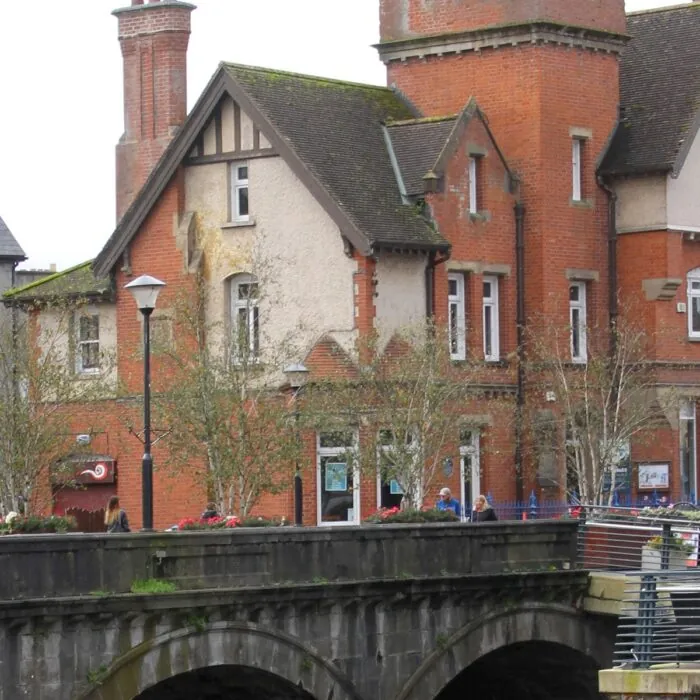
You can make this stop the first stage of a walk along the Garavogue. On your way back towards the centre, cross the bridge and explore the streets around O’Connell Street. To continue with an indoor visit, The Model gallery, on The Mall, offers another perspective on the region through its collections and exhibitions. If you would rather follow the thread of the town’s history, head to Sligo Abbey. These stops can be combined on foot, taking you from the harbour to the historic centre in a single outing.
Want to extend your visit without having to rush around? Here are a few well-located places to stay near the must-see attractions.
Essential information to help you plan your visit, including key landmarks, access information, and booking options.
Lower Quay Street, Sligo, County Sligo, Republic of Ireland, Tourist sites in Ireland
54.27370, -8.47700
Outdoor monument, visible from the public space. No visiting hours.
Check the opening hours and admission requirements before you leave, especially during peak season or on Irish public holidays.
Free access to the memorial.