

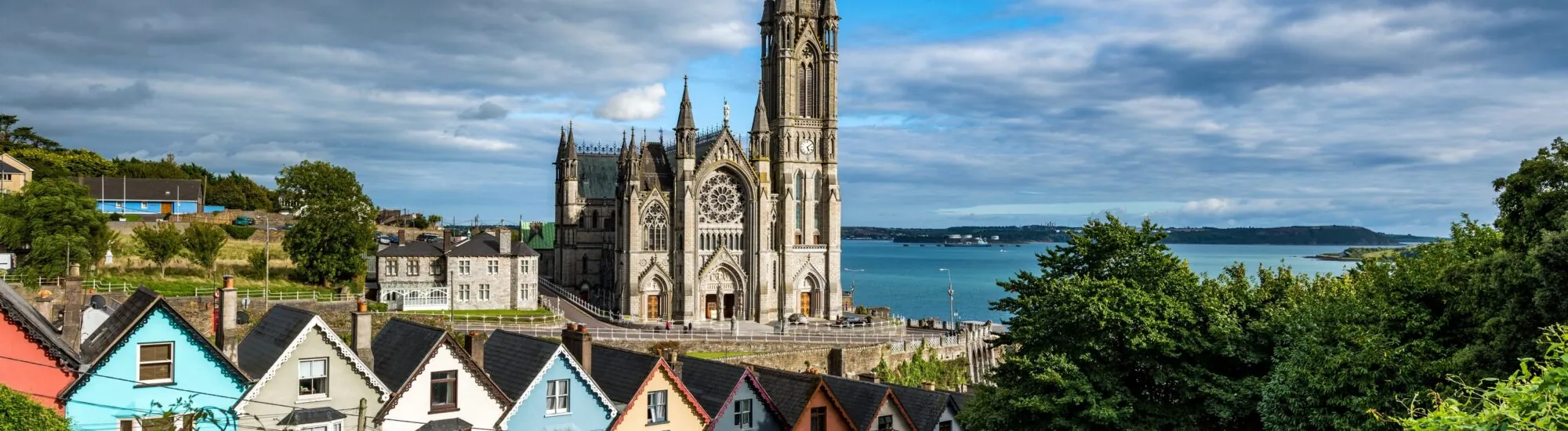
Overlooking Cobh’s colourful houses and the waters of Cork Harbour, St Colman’s Cathedral is one of Ireland’s most spectacular neo-Gothic landmarks. Its slender spire, visible from much of the harbour, rises to around 91 metres and is among the tallest in the country.
Built from 1868 onwards, the cathedral reflects Cobh’s growing importance in the 19th century. The town, then known as Queenstown, had become a major transatlantic port and one of the principal departure points for Irish emigrants heading to North America.
Cobh and St Colman’s Cathedral – © susanne2688
In the mid-19th century, Cobh underwent a profound transformation. Its harbour welcomed merchant ships, military vessels and numerous transatlantic liners. Millions of Irish people were leaving their country, often for good, and a significant number boarded ships from the quays of Queenstown.
The town already had a small parish church serving as a pro-cathedral, but Bishop William Keane wanted to provide the Diocese of Cloyne with a more prestigious building. Preparations for the project ran from 1857 to 1867 and received financial support from local residents, the diocese and Irish communities in the United States and Australia.
The foundation stone of the new cathedral was laid on 30 September 1868. The construction work was expected to be particularly challenging: the site was steep and had to be extensively levelled before it could support a building of this scale.
Contrary to a view sometimes put forward, the cathedral was not built specifically to receive emigrants in transit. Its creation was above all intended to provide a true seat for the Diocese of Cloyne and a place of worship suited to the growth of Queenstown.
The first plans were entrusted to Edward Welby Pugin and George Ashlin. Pugin was an English architect from a family closely associated with the Gothic Revival, while Ashlin was an Irish architect born in County Cork.
George Ashlin quickly assumed primary responsibility for the project. He later worked with Thomas Aloysius Coleman, whose drawings contributed to the completion of the tower and spire.
Work progressed slowly because of its complexity, changes made to the plans and the considerable increase in costs. The roof was completed in 1879 and the first Mass was celebrated that same year, although several parts of the building remained unfinished.
Construction of the spire did not begin until 1911. Stonemasons spent four years working on high scaffolding exposed to the winds of the harbour. The main exterior work was completed in 1915, nearly half a century after the foundation stone was laid.
The cathedral was solemnly consecrated on 24 August 1919. The total cost of the project came to around £235,000, a considerable sum at the time and far beyond the original estimates.
The cathedral is neo-Gothic in style, strongly inspired by the great churches of France. Its Latin-cross plan is arranged around a long nave of seven bays, two transepts, side chapels, a choir and an apse.
Outside, pointed arches, pinnacles, gargoyles and stone carvings heighten the impression of verticality. The west façade and transepts feature large rose windows, while the spire towers above all of Cobh.
The exterior walls incorporate, among other materials, blue Dalkey granite and Mallow limestone. The roof was covered with Belgian slate, while different varieties of marble and granite were used to decorate the interior.
The nave is striking for its height, balance and finely judged proportions. Colourful stained-glass windows, mosaics, marble sculptures, ornate confessionals and the high altar draw the eye. Many Irish and European artists and craftspeople contributed to this particularly ambitious decoration.
The cathedral remains dedicated to Catholic worship. Visitors can explore it outside services, provided they respect the silence and spiritual character of the place.
The tower of St Colman’s Cathedral houses a carillon of 49 bells. It is the only complete instrument of its kind in Ireland, and the largest carillon in Ireland and Great Britain by number of bells.
The largest bell is named St Colman and weighs around 3.6 tonnes. The instrument is played from a console in the belfry, with a manual keyboard and pedalboard.
It operates entirely mechanically. Every movement made by the carillonneur is transmitted to the bell clappers, without electrical assistance. This feature requires remarkable coordination and allows the musician to control the volume and nuances of each note.
During the recital season, the Garden of Remembrance, opposite the main entrance, is one of the best places to listen to the carillon. At certain performances, a video system installed in the cathedral also allows visitors to watch the musician at work.
The cathedral’s construction coincided with the golden age of Queenstown harbour. Between the 19th and early 20th centuries, the town became one of Ireland’s main gateways to the United States, Canada and Australia.
From ships leaving Cork Harbour, the lofty spire of St Colman remained visible long after the quays and houses had disappeared from view. For many emigrants who never returned to their native country, it was one of their last images of Ireland.
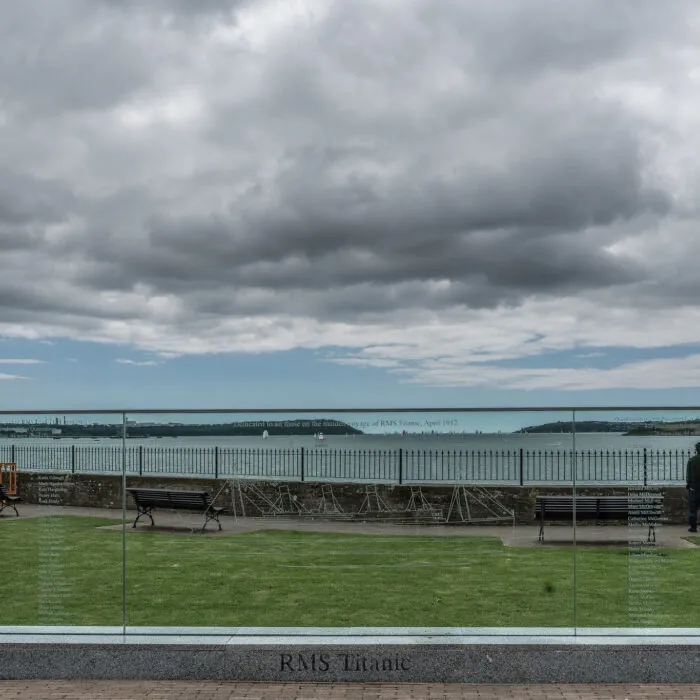
The cathedral has therefore become both a geographical and emotional landmark. Its silhouette still connects Cobh’s two defining faces: a bright harbour town facing the ocean, and a place of remembrance deeply marked by departures, the Titanic and the sinking of the Lusitania.
The cathedral can be seen from much of the town centre and waterfront. Its elevated position means it features in numerous panoramic views of Cobh and Cork Harbour.
The best-known viewpoint is on West View. This steep street is lined with a row of colourful houses known as the Deck of Cards. From the small public park, the cathedral appears to rise directly behind the rooftops, creating one of Ireland’s most photographed scenes.
Visitors should nevertheless remain in public areas: the best-known views lie in the immediate vicinity of private properties. There is no need to cross a fence or enter a garden to take a fine photograph.
The waterfront offers a broader perspective. From the quays, the railway station or certain boats travelling around the harbour, the silhouette of St Colman’s rises above the town like a stone lighthouse watching over Cork Harbour.
Want to extend your visit without having to rush around? Here are a few well-located places to stay near the must-see attractions.
Essential information to help you plan your visit, including key landmarks, access information, and booking options.
5 Cathedral Pl, Kilgarvan, Cobh, County Cork, Republic of Ireland, Tourist Attractions in Ireland
51.851442, -8.293644
45 minutes
St Colman’s Cathedral is an active cathedral. It is generally open free of charge during the day, outside Masses, weddings, funerals and other celebrations. However, the parish does not publish fixed visitor opening hours, so it is best to check before making a special journey.
Usual Mass times:
Carillon recitals are held on most Sundays at 4.30 pm, from May to September. They last around one hour, and the schedule varies from week to week.
Parish office: open Monday, Tuesday, Wednesday and Friday from 9 am to 5 pm, with a closure between 1 pm and 2 pm. Closed on Thursdays.
Visit the official St Colman’s Cathedral website to check service times and any closures.
Check the opening hours and admission requirements before you leave, especially during peak season or on Irish public holidays.
Admission to St Colman’s Cathedral is free. No ticket is required to see the nave, stained-glass windows, choir and the main works visible from areas open to the public.
Donations are appreciated and help to maintain the cathedral. The regular carillon recitals held during the summer season are also free.
Group visits can be arranged on request. Availability, visiting arrangements and any fees must be confirmed directly with the parish office.
Compare tickets, guided tours, and excursions available through our partner platforms.