Viator


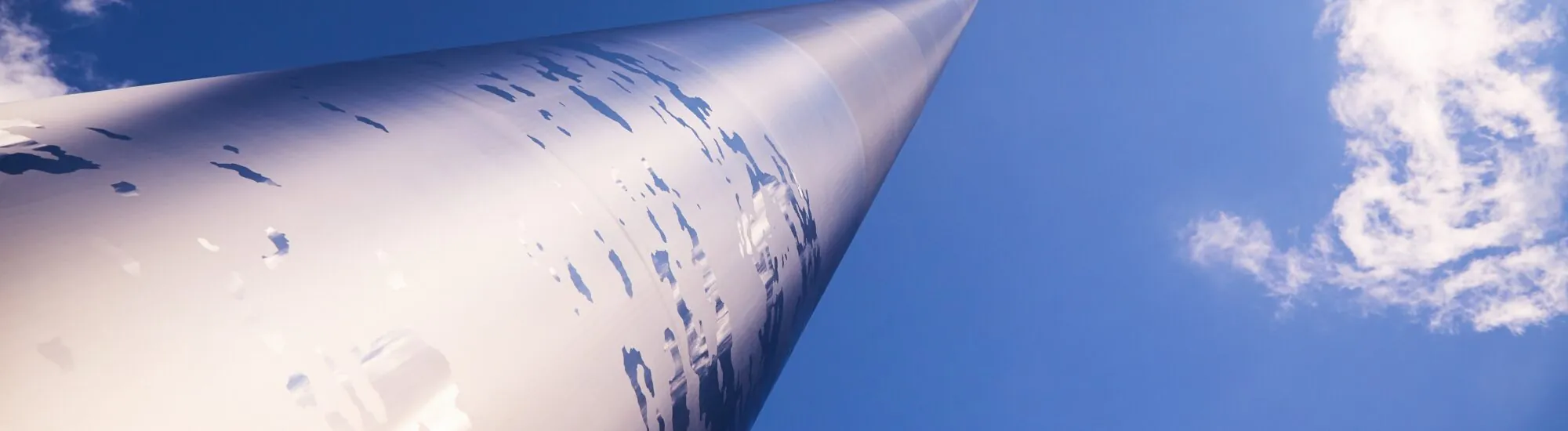
It is impossible to walk through central Dublin without looking up at it. Rising from the middle of O’Connell Street, the Spire of Dublin is a vast stainless-steel needle that seems to vanish into the Irish capital’s sky. At 120 metres tall, it towers above the surrounding buildings and is now one of Dublin’s most recognisable landmarks.
Its minimalist appearance, however, conceals a history closely entwined with that of the city. The Spire was not placed here by chance: it stands on the exact site of Nelson’s Pillar, a British monument that dominated O’Connell Street for more than 150 years before being destroyed by explosives in 1966.
Unveiled in 2003 and officially named the Monument of Light, the Spire embodies the new face of O’Connell Street. Loved by some and considered cold or enigmatic by others, it has become inseparable from Dublin’s skyline in just a few years.
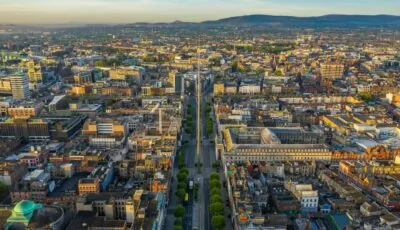
Aerial view of O’Connell Street in Dublin – © Irish Drone Photography
The Spire stands in the heart of O’Connell Street, one of central Dublin’s main thoroughfares. Its central position and height mean it can be seen from many places nearby.
Walk up O’Connell Street from the Liffey and its immense metallic silhouette gradually takes over the streetscape.
The monument is just a few steps from the General Post Office, the famous GPO associated with the 1916 Easter Rising, as well as several statues dedicated to major figures in Irish political history.
The Spire is therefore an excellent landmark for exploring the city centre. Henry Street, one of Dublin’s main shopping streets, opens out almost at its feet, while Temple Bar and Trinity College are easily reached on foot from O’Connell Street.
The Spire’s story truly begins in the late 1990s, when Dublin embarked on a major redevelopment programme for O’Connell Street.
Since 1966, a symbolic void had remained in the middle of the avenue. For more than a century and a half, this site had been occupied by Nelson’s Pillar, an immense column dedicated to the British admiral Horatio Nelson.
Following its destruction, several projects and artworks occupied, or were proposed for, the area, but none truly succeeded in replacing the former monument in the urban landscape.
As the new millennium approached, a competition was finally organised to create a new monumental landmark for O’Connell Street.
The winning proposal came from Ian Ritchie Architects: an exceptionally slender stainless-steel needle, deliberately contemporary and with no statue or historical figure at its summit.
The monument was given the name Monument of Light, although Dubliners would mainly adopt the far simpler name: the Spire.
To understand why the Spire stands here, it is necessary to go back to the early 19th century.
After the British victory at the Battle of Trafalgar in 1805, a project was launched in Dublin to pay tribute to Admiral Horatio Nelson, who died during the battle.
The foundation stone of Nelson’s Pillar was laid in 1808. The monument opened to the public on 21 October 1809, exactly four years after Trafalgar.
The structure was impressive for its time. A Doric granite column measuring around 37 metres was topped by a roughly four-metre-high statue of Nelson, made from Portland stone by the sculptor Thomas Kirk.
Inside, a spiral staircase of 168 steps allowed visitors to reach a viewing platform offering an exceptional panorama of Dublin.
The monument quickly became one of the capital’s great landmarks. With the arrival of the trams, the area around it also became an important interchange and meeting place.
The phrase “I’ll meet you at the Pillar” even became part of everyday Dublin life.
Nelson’s presence in central Dublin gradually became politically problematic.
When the column was built, Ireland was part of the United Kingdom. The situation changed radically during the 20th century with the 1916 Easter Rising, the War of Independence and the creation of the Irish Free State.
O’Connell Street itself became one of the principal sites of remembrance for Irish nationalism. The GPO, a few dozen metres from Nelson’s Pillar, had served as the rebels’ headquarters during the Easter Rising.
In this new context, the sight of a hero of British naval power continuing to dominate one of the independent capital’s main avenues came to seem increasingly anachronistic to part of the population.
Various proposals to alter, move or replace the monument were discussed over the decades.
But Nelson ultimately remained in place until 1966.
On the night of 8 March 1966, just weeks before commemorations marking the fiftieth anniversary of the Easter Rising, an explosion rang out in the heart of Dublin.
A charge placed inside Nelson’s Pillar destroyed the upper part of the monument. The admiral’s statue collapsed along with part of the column.
The attack was carried out by a small group of republican activists. Liam Sutcliffe, a former IRA member, later admitted taking part in the operation.
Fortunately, the explosion caused no casualties.
The remaining structure was nevertheless considered dangerous. A few days later, the Irish Army carried out its controlled demolition.
After more than 150 years overlooking O’Connell Street, Nelson thus disappeared from Dublin’s landscape for good.
Not all of the monument disappeared, however.
The head of Nelson’s statue survived the explosion and subsequently had a particularly eventful history. It was notably recovered and used for a time by students at the National College of Art and Design in various actions and staged events.
It later joined the municipal collections.
Contrary to what some older guidebooks still state, it is no longer kept at the Civic Museum on South William Street. Nelson’s head is now at the Dublin City Library and Archive on Pearse Street.
It is a remarkable remnant of the monument that once occupied the Spire’s exact location.
The disappearance of Nelson’s Pillar left a void in the middle of O’Connell Street for several decades.
Various ideas were proposed for this particularly symbolic site.
At the end of the 20th century, the Anna Livia fountain, created by sculptor Éamonn O’Doherty, was installed on O’Connell Street. It was not, however, a direct replacement comparable to the former Pillar, and was later moved.
The transformation of O’Connell Street in the late 1990s ultimately revived the question of a major urban landmark.
Ian Ritchie Architects’ proposal won the competition organised for the new millennium.
It was nevertheless necessary to wait until 2003 for the Spire to take its permanent place above Dublin.
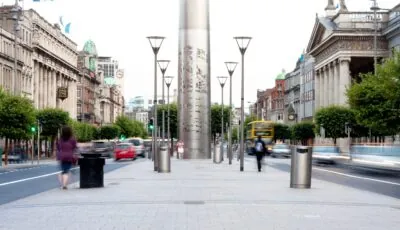
The Spire on O’Connell Street – John Flanagan – cc
The Spire’s apparent simplicity conceals an engineering feat.
The monument rises 120 metres. It takes the form of an exceptionally elongated cone, gradually narrowing as it rises towards the sky.
At its base, the structure measures around 3 metres in diameter. At the top, it is only around fifteen centimetres across.
The Spire is made up of several stainless-steel sections assembled to create its continuous silhouette.
Its surface is not entirely uniform. The lower section has a textured finish that reflects the light and movement of the street, while the steel becomes progressively smoother higher up.
Depending on the time of day, the weather and the position of the sun, the monument can take on an entirely different appearance: almost matt grey beneath cloud, gleaming in a break in the weather, or tinted with the colours of the sky at sunrise and sunset.
Its official name, Monument of Light, comes into its own at nightfall.
The upper part of the Spire is illuminated, turning its tip into a point of light visible in the sky above the city centre.
The light further emphasises its role as an urban landmark.
Day or night, its height means it can be seen from several surrounding streets. For a traveller discovering Dublin for the first time, it quickly becomes a very simple way to find O’Connell Street again.
Like many contemporary works installed in public spaces, the Spire has never won universal approval.
Some appreciate its simplicity and its ability to create an instantly identifiable landmark without glorifying a political or military figure.
Others, by contrast, criticise its abstract nature, its cost or its apparent lack of historical meaning.
Dubliners, never short of imagination when it comes to renaming their monuments, quickly gave it several humorous nicknames.
Among the best known is “Stiletto in the Ghetto”, literally the “stiletto heel in the ghetto”. It is also known as the “Nail in the Pale” and the “Spike”.
These nicknames form part of a long Dublin tradition of playfully reinterpreting the capital’s statues and monuments.
Unlike Nelson’s Pillar in the past, it is impossible to go up the Spire.
The monument has no public viewing platform, lift or interior exhibition space.
It is therefore entirely free to see from O’Connell Street.
To step back and appreciate its height, it can be worthwhile heading down towards O’Connell Bridge or, conversely, viewing it from the upper part of the avenue.
The nearby GPO also makes it possible to take photographs bringing together two radically different monuments: the history-laden neoclassical architecture of the General Post Office and the Spire’s immense contemporary needle.
The Spire’s location makes it an excellent starting point for exploring central Dublin on foot.
The GPO is immediately nearby and is a major stop for understanding the history of the 1916 Easter Rising.
Walking down O’Connell Street towards the Liffey, you will pass several monuments dedicated to major figures in Irish history before reaching the statue of Daniel O’Connell and O’Connell Bridge.
On the other side of the river, Trinity College, Temple Bar and the city centre’s main shopping streets are all close at hand.
In the other direction, Parnell Square and the northern part of central Dublin can also be reached in a few minutes.
More than twenty years after it was installed, the Spire has ultimately achieved what its designers set out to do: recreate a major landmark in the middle of O’Connell Street. And even those who do not like it must acknowledge one thing: with its 120 metres of steel pointing towards the sky, it has become impossible to imagine central Dublin without it.
Essential information to help you plan your visit, including key landmarks, access information, and booking options.
53.349797, -6.260255
Compare tickets, guided tours, and excursions available through our partner platforms.