
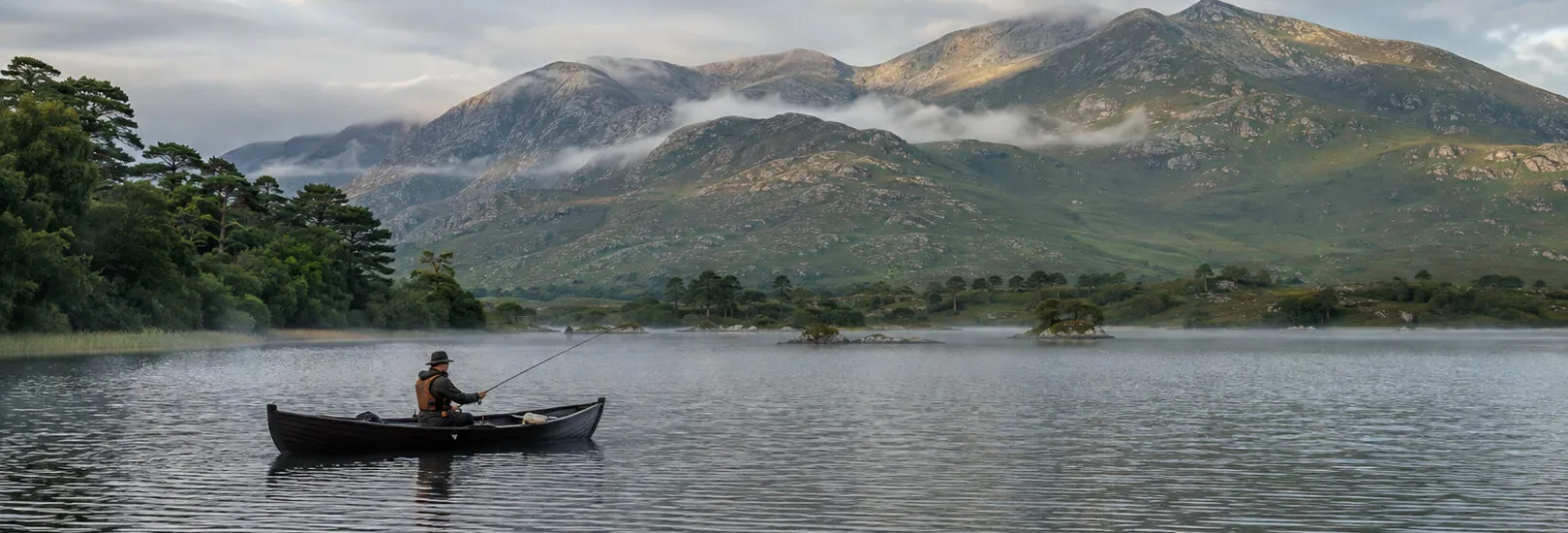
At the foot of the Kerry mountains, the Lakes of Killarney provide a spectacular setting for fishing in Ireland. Surrounded by ancient woodland, peaks and historic sites, their waters are home to wild brown trout and Atlantic salmon, among other species. Fishing is concentrated mainly on Lough Leane, but also takes place on Muckross Lake and Upper Lake.
Fishing in Killarney National Park cannot, however, be undertaken on a whim. The rules vary according to the species sought, the time of year and how the lake is accessed. A national licence is required for salmon and sea trout, while private boating is strictly regulated within the park.
The Lakes of Killarney form a vast natural network fed by the surrounding rivers and mountains. Their waters then flow into the River Laune, which reaches the Atlantic Ocean near Killorglin. This connection allows salmon to make their way upstream to the lakes during their migration.
Lough Leane, also known as Lower Lake, is the largest and most popular with anglers. It stretches out before Ross Castle and contains several islands, including Innisfallen Island. Its shallow bays and relatively accessible shores are prized for trout and salmon fishing.
Muckross Lake, sometimes called Middle Lake, has deeper waters and a particularly wooded setting. It is overlooked by Torc Mountain and separated from Lough Leane by the Muckross Peninsula. Fishing here is more discreet.
Wilder and more secluded, Upper Lake extends through the mountains in the western part of the park. Its more challenging access and rapid exposure to changing weather make it better suited to anglers with a guide or a thorough knowledge of the area.
The Lakes of Killarney are best known for their natural populations of brown trout. Most catches tend to be modest in size, but the waters of Lough Leane are also home to ferox trout, large predatory fish that feed on other fish, among other prey.
These ferox trout can reach considerable sizes. They are mainly sought by trolling with artificial lures in the deeper parts of the lake. Their slow growth and ecological value call for a particularly responsible approach, based on catch and release wherever possible.
Atlantic salmon are the other main species sought. The fish travel up from the ocean via the River Laune before reaching Lough Leane and the watercourses of the Killarney catchment. Results vary considerably according to rainfall, river levels and the progress of the migration.
Fly-fishing is particularly well suited to brown trout. In spring and summer, different insect hatches can trigger periods of surface activity. Olives, chironomids and sedges are among the insect families traditionally observed across the Killarney lakes system.
Trolling is more commonly used to target salmon and large ferox trout. It makes it possible to cover the wide expanse of Lough Leane and explore different depths. This method does, however, require a good knowledge of the lake, its shallows and its sometimes very rapid changes in weather.
Shore fishing is possible in certain accessible areas, but remains more limited. Vegetation, private property, sudden drop-offs along some banks and the protection of several habitats reduce the number of suitable spots. It is essential to follow signs and not cross private property without permission.
Fishing from a boat is common on Lough Leane, but launching a private boat in the national park is regulated. The National Parks and Wildlife Service states that no new private boating permits are currently being issued, although it is possible to apply to join a waiting list.
For travellers, the simplest option is therefore to book an outing with a local guide or operator holding the necessary permissions and insurance. A guide also provides a better understanding of fishing areas, suitable techniques and the rules in force on the day of the trip.
Wearing a life jacket is essential. The lakes may appear calm from the shore, but winds can rise quickly between the mountains. Water temperatures remain low, even in summer, and some areas have abrupt changes in depth.
Brown trout fishing on the Lakes of Killarney is generally unrestricted, with no national licence or specific fishing permit required. This freedom does not, however, give anglers the right to access private property or use a boat without permission.
A national salmon fishing licence is, however, required when targeting salmon or sea trout. This requirement applies even when fish must be released. The licence, catch logbook and any identification tags must be kept with the angler while fishing.
In 2026, the River Laune is among the Irish fisheries open to harvesting, subject to national and local quotas. As regulations may change during the year, it is essential to check the status of the Laune catchment before each outing on the official Inland Fisheries Ireland website.
The season traditionally indicated for brown trout on the Killarney lakes and Laune system runs from 15 February to 12 October. Conditions generally become more favourable between April and September, when insect activity increases and temperatures become milder.
The salmon season generally runs from 17 January to 30 September on the Laune and Killarney lakes system. The most promising runs are often seen from early summer to September, though their strength depends heavily on river flow.
For the 2026 season, national regulations allow a maximum of seven salmon or sea trout over 40 centimetres per angler on watercourses open to harvesting. Only one fish may be kept between 3 April and 31 May. From 1 June to 31 August, the national limit is three fish per day, within the annual quota. From 1 September, all salmon and sea trout over 40 centimetres must be released.
These national limits do not confer an automatic right to keep fish. Local restrictions, quotas or a catch-and-release requirement may still apply. The official rules in force on the day must therefore take precedence over any general information.
Trout fishing from an authorised public area generally does not require the purchase of a permit for the Lakes of Killarney. Costs increase when booking a boat, guide or equipment.
A national licence is required to fish for salmon or sea trout. Several options are available, from a one-day licence to an annual licence. Official prices may change: expect to pay around €36 for a one-day licence, €50 for 21 days and €100 for an annual licence covering all districts. The licence does not include a boat, equipment or guide services.
The price of a guided outing depends on its duration, the number of participants, the equipment provided and the type of fishing sought. Before booking, it is advisable to confirm that the operator holds the required permissions to navigate and operate commercially within the national park.
The lakes lie within a national park and a UNESCO-recognised biosphere reserve. Fishing must therefore remain compatible with habitat conservation, the peace of wildlife and the protection of wild fish populations.
Catch and release is strongly recommended, particularly for ferox trout and large breeding fish. Fish should be handled for as little time as possible, with wet hands, and kept in the water while the hook is removed whenever conditions allow. Barbless hooks reduce injury and make for a quicker release.
Tackle, boots and any equipment that comes into contact with water must be checked, cleaned and thoroughly dried before moving from one lake or river to another. This precaution helps limit the spread of invasive species and pathogens. No litter, fishing line or hooks should be left on the shore.
Main areas: Lough Leane, Muckross Lake and Upper Lake.
Target species: brown trout, ferox trout, Atlantic salmon and, more occasionally, sea trout.
Trout fishing: generally free on the lakes in areas where access is permitted.
Salmon and sea trout fishing: national licence required, including when fishing exclusively on a catch-and-release basis.
Private boat: permission required; according to the national park, no new private boating permits are currently available.
Park ranger contact: +353 64 663 5215.
Permit enquiries: [email protected].
Advice: contact the park rangers or Inland Fisheries Ireland before heading out to confirm permitted areas, current regulations and any temporary restrictions.
Essential information to help you plan your visit, including key landmarks, access information, and booking options.