Viator


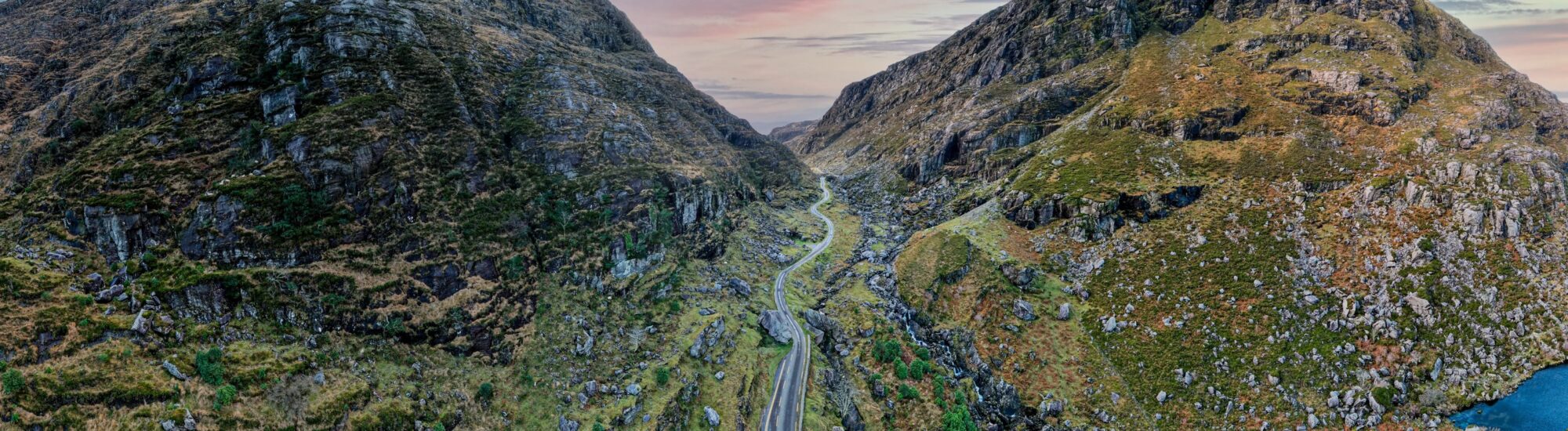
Between the MacGillycuddy’s Reeks and Purple Mountain, a narrow road winds past five small lakes, crosses old stone bridges and climbs to a pass overlooking the Black Valley. The Gap of Dunloe is one of County Kerry’s most spectacular landscapes, around 20 minutes from Killarney.
This glacial valley, approximately 11 kilometres long, can be explored on foot, by bike, by horse-drawn carriage or on an excursion combining a boat trip with overland transport. The road is also open to cars, but its narrow width and the constant presence of walkers, cyclists, horses and sheep make driving difficult.
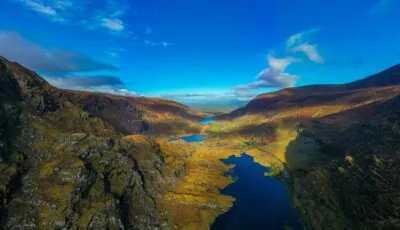
The Gap of Dunloe – © Ire DronePhotography
The Gap of Dunloe is a mountain pass separating the MacGillycuddy’s Reeks to the west from the Purple Mountain massif to the east. It lies on the edge of Killarney National Park and is one of the main routes into the Black Valley.
Its English name comes from the Irish Dún Lóich, which is associated with an ancient fort in the area. Here, the word gap refers to an opening or passage between mountains.
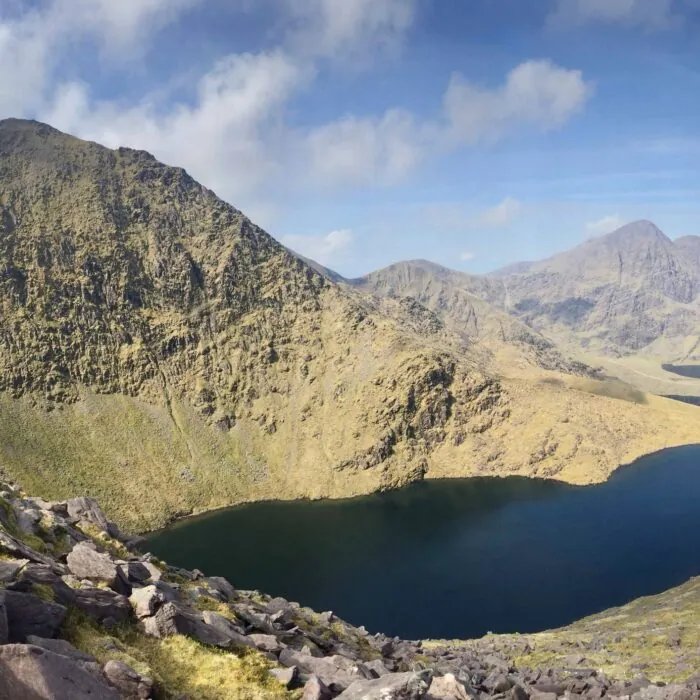
The present-day landscape was largely shaped by glaciers. Their movement carved out a narrow valley with steep sides, dotted with lakes and boulders. The small River Loe links the various bodies of water before flowing northwards.
The Gap of Dunloe is not an enclosed site and has neither gates nor official opening hours. It is a public road running through a mountain setting of natural areas, farmland and private property.
Travelling through the pass from Kate Kearney’s Cottage towards the Black Valley, the road runs alongside five small lakes: Coosaun Lough, Black Lake, Cushnavally Lake, Auger Lake and Black Lough.
These bodies of water should not be confused with Killarney’s three large lakes: Lough Leane, Muckross Lake and the Upper Lake. The latter are crossed on boat trips between Ross Castle and Lord Brandon’s Cottage, but they are not located within the pass itself.
The colour of the lakes in the Gap of Dunloe changes with the light, cloud cover and water depth. It can shift from silvery grey to deep blue, becoming almost black when the mountains are reflected on the surface.
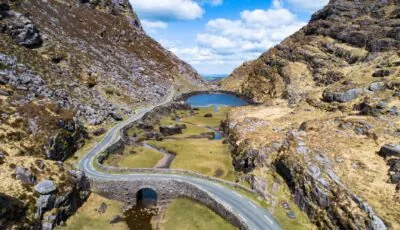
The Wishing Bridge stands between Coosaun Lough and Black Lake. This small stone bridge is one of the most photographed spots along the route.
According to local tradition, a wish made while crossing the bridge is said to come true. As is often the case in Irish folklore, versions differ: some accounts specify that the wish must be made in silence, while others insist that it must never be revealed.
The bridge is on the road used by vehicles and horse-drawn carriages. Walkers should therefore take care before stopping to take a photograph.
There are four main ways to explore the Gap of Dunloe. Walking lets you take your time, while cycling is suited to visitors comfortable with uphill and downhill riding. Jaunting cars, Kerry’s traditional horse-drawn carriages, offer a guided experience. Finally, combined excursions generally pair a crossing of the Killarney lakes with a journey through the pass.
The best option depends on your fitness, the time you have available and your arrangements. As the Gap of Dunloe is a linear route, you should plan your return journey before setting off.
There is no official Visitor Centre at the entrance to the pass. Kate Kearney’s Cottage is a restaurant, bar and shop at the northern end of the route. It serves as a landmark and meeting point for several providers, but is not part of the national park.
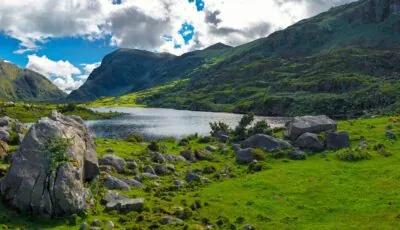
The landscapes of the Gap of Dunloe – © Lyd Photography
The full route between Kate Kearney’s Cottage and Lord Brandon’s Cottage is approximately 11 kilometres long. It follows a narrow tarmac road with no real pavement, but is generally pleasant to walk.
The walk presents no particular technical difficulty. However, it includes several climbs, some of them quite steep. Allow approximately two and a half to three and a half hours, depending on your pace and the number of stops.
The Head of the Gap, the highest point on the road, is around 6 kilometres from Kate Kearney’s Cottage. A return walk to the summit is therefore nearly 12 kilometres. The “6-kilometre circuit” sometimes mentioned refers only to the outward journey, not to a complete loop.
From the Head of the Gap, the road descends towards the Black Valley and Lord Brandon’s Cottage. This section is quieter, but takes you a considerable distance from the starting point. Without a boat, shuttle or second vehicle, you will need to return the same way.
The simplest option is to set off from Kate Kearney’s Cottage, reach the Head of the Gap and retrace your steps. This allows you to see the main lakes and the Wishing Bridge without arranging additional transport.
To cover the 11 kilometres in one direction, you can book an excursion including transfers or use two vehicles. One is then left near Kate Kearney’s Cottage and the other on the Ross Castle side, depending on your chosen direction and boat crossing.
The traditional option often begins with a shuttle from Killarney, followed by a walk or horse-drawn carriage ride through the Gap of Dunloe. A boat then travels to Ross Castle across Killarney’s three lakes. Some providers offer the route in reverse.
Boat timetables are fixed, and sailings depend on water levels and weather conditions. You should therefore book the full excursion rather than rely on an improvised connection.
A horse-drawn carriage in the Gap of Dunloe – © Gabriel Cassan
Kerry’s horse-drawn carriages are known as jaunting cars, and their drivers as jarvies. They have travelled through the Gap of Dunloe since tourism began in Killarney and are now part of the area’s cultural landscape.
Departures generally take place near Kate Kearney’s Cottage. Depending on the option chosen, the carriage goes to the Head of the Gap, the Black Valley or Lord Brandon’s Cottage. The full journey can take between two and three hours, depending on the route, stops and traffic conditions.
Prices are not fixed across the site and vary according to distance, number of passengers and provider. Always ask for the total price, the destination and what is included before getting in. Booking in advance is recommended during high season.
For a responsible experience, choose an identifiable operator, observe the horse’s general condition and avoid rides when weather conditions seem excessively hot or difficult.
The boat does not travel through the Gap of Dunloe itself. It generally links Ross Castle, near Killarney, with Lord Brandon’s Cottage, south of the pass.
The crossing takes in Lough Leane, Muckross Lake and the Upper Lake. It also follows narrow channels and passes beneath several bridges. The journey offers remarkable views of the national park’s islands, forests and mountains.
At Lord Brandon’s Cottage, visitors continue through the Gap of Dunloe on foot, by bike or by horse-drawn carriage. In the other direction, the boat provides a return to Ross Castle after crossing the pass from Kate Kearney’s Cottage.
A full excursion including transfers, the overland route and the boat trip generally takes five to six hours. As options and prices vary between companies, check the details before booking.
Cars are not prohibited in the Gap of Dunloe. The road is public, and some local residents need to use it to reach their homes or land.
However, driving through it in a car is not recommended during the busiest hours. The road is sometimes too narrow for two vehicles to pass each other easily. It is also used by walkers, cyclists, horse-drawn carriages, horses and sheep.
Drivers must proceed at walking pace, give priority to more vulnerable road users and be prepared to reverse to a passing place. Never pressure a horse or overtake it without the jarvey’s agreement.
If you are determined to drive the road, choose early morning or late afternoon, when there are fewer organised tours. Avoid wide vehicles and do not attempt it if you are not confident on narrow Irish roads.
Cycling allows you to cover the entire Gap of Dunloe more quickly while enjoying the scenery. The route is fully tarmacked, but some climbs are steep and the descents require good braking control.
An electric bike can make the ascent easier, provided it has sufficient battery range. Whatever bike you use, take care around walkers and horses. Make your presence known calmly and do not overtake a horse-drawn carriage on a narrow stretch.
Cyclists can include the pass in a longer loop via the Black Valley and Moll’s Gap. This route requires good fitness and careful preparation, particularly because of the elevation gain, distances and changeable weather.
The Gap of Dunloe runs through a landscape dominated by Old Red Sandstone, a rock that makes up much of the mountains of south-west Ireland. Glaciers widened the valleys, smoothed some outcrops and left boulders behind as they retreated.
To the west rise the MacGillycuddy’s Reeks, the mountain range that includes Carrauntoohil, Ireland’s highest peak. To the east, Purple Mountain overlooks the Killarney lakes and the pass.
Sheep roam freely on the road and slopes. However, the animals remain the responsibility of farmers: do not feed them or attempt to approach them. Dogs must be kept on a lead at all times.
The northern entrance to the Gap of Dunloe is near Kate Kearney’s Cottage, approximately 13 kilometres from Killarney. Parking spaces are available in the area, but capacity can quickly be reached in summer.
Parking does not automatically give access to a visit or horse-drawn carriage ride. Kate Kearney’s Cottage is a private business, not an official national park centre. Observe the signs and any conditions displayed on site.
If you choose a combined excursion, it is often easier to leave your car in Killarney or at Ross Castle and use the shuttle included with your booking. Check the meeting point specified by the provider carefully.
Although the route follows a tarmac road, good walking shoes are still recommended. Bring a waterproof jacket, a warm layer, water and something to eat.
The Gap of Dunloe is very exposed to wind, and showers can arrive quickly. Clouds sometimes descend over the Head of the Gap, greatly reducing visibility. Sun protection is also useful on clear days.
Mobile phone coverage can be patchy in the Black Valley. Download your map, keep the provider’s contact details and check boat timetables before beginning the route.
Main starting point: Kate Kearney’s Cottage, Beaufort, County Kerry, Ireland.
Access to the road and the walk is free. Horse-drawn carriage rides, boats and transfers are charged for and operated by independent companies. There is no single price for the whole site.
Allow around two and a half to three and a half hours to walk the 11 kilometres in one direction. A full excursion combining a transfer, the Gap of Dunloe and a lake crossing generally takes five to six hours.
To find out about available options, you can consult the Gap of Dunloe Tours website or compare operators listed by Irish tourism bodies.
How long is the Gap of Dunloe?
The route between Kate Kearney’s Cottage and Lord Brandon’s Cottage is approximately 11 kilometres long. The Head of the Gap is nearly 6 kilometres from the northern starting point.
Can you visit the Gap of Dunloe for free?
Yes. Access to the road and the walk is free. Only horse-drawn carriage rides, boat trips and transfers are charged for.
Can you drive through the Gap of Dunloe?
Yes, the road is public. However, driving is not recommended during busy hours because of its narrowness and the presence of many walkers, cyclists, horses and horse-drawn carriages.
Essential information to help you plan your visit, including key landmarks, access information, and booking options.
Dunloe Upper, Killarney National Park, Killarney National Park
52.025444, -9.635833
3h00
Compare tickets, guided tours, and excursions available through our partner platforms.