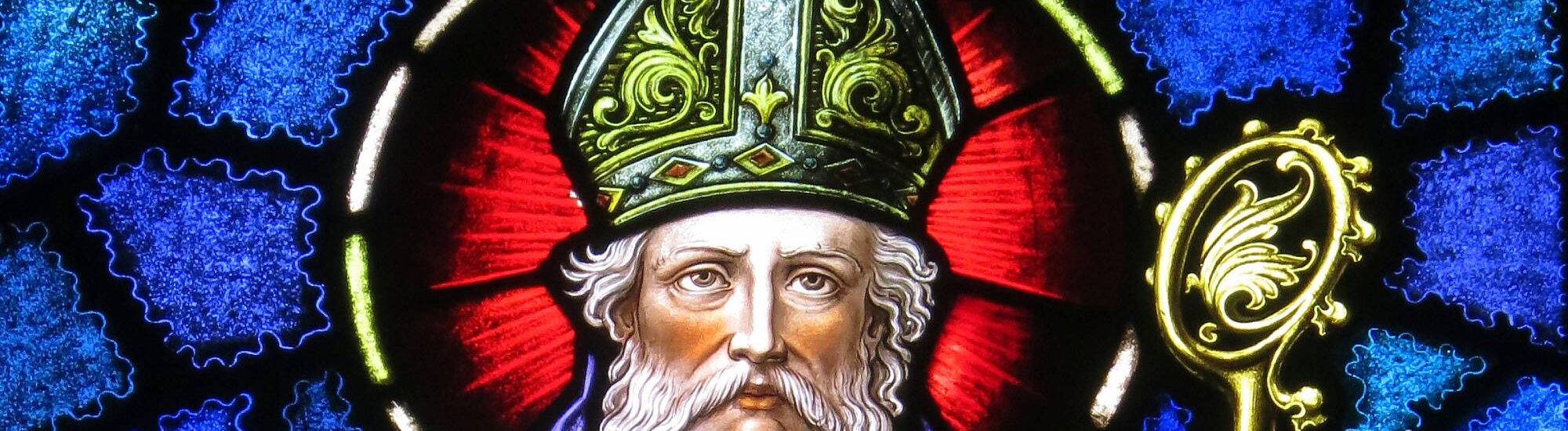
The idea has everything going for it. On the one hand, the classic version has Saint Patrick being born somewhere in insular Brittany, in the area of Roman Britain, with Scotland, Wales or the west of England among the possible clues. On the other hand, a more recent hypothesis links him to Bonaban, near Saint-Malo, in Armorican Brittany. An attractive, romantic, almost cinematic theory. But as soon as we leave the charm of the story behind and enter the sources, the scene changes: Patrick’s Armorican origins remain a minority theory, while the reference syntheses continue to place him in Roman Brittany, without being able to specify his exact place of birth.
The facts about Saint Patrick are slim, which explains why the debate has lasted so long. In practice, it’s certain that the man really did exist.
Historians rely mainly on two texts considered authentic: the Confessio and the Letter to Coroticus. In the Confessio, Patrick presents himself as the son of Calpornius, a deacon, and the grandson of Potitus, a priest.
He points out that his father lived in Bannavem Taburniae and that the family home was near there, where he was captured at the age of sixteen. The Confessio.ie website, an authority on Patrick’s writings, points out that there are several theories for identifying this place, but none of them is decisive. Here’s the crux of the matter: Patrick gives a toponym, not a definitive location.
Another passage is crucial. Patrick recounts how, after his escape, he found himself once again “with [his] parents in Brittany”, as he had long wanted to return there because of his attachment to his homeland. At the same time, he says he would also like to go to Gaul to see the brothers.
This opposition between Brittany and Gaul is one of the most troublesome arguments and discredits the Armorican thesis: if Patrick distinguishes his country of origin from Gaul, it becomes difficult to make him a native of mainland Brittany, which then belongs to the Gaulish world. This is precisely why many historians believe that his own voice carries more weight than later rereadings.
There’s often a little misunderstanding in mainstream formulations. To say that Patrick was “Scottish” is already a shortcut. The reference notices explain instead that he was born in Brittany, i.e. in Roman Britain, and that several areas have been proposed: present-day Scotland, south Wales, north-west England, even south-west England.
Scotland is therefore not a locked-in truth, but one of the classic candidates within the British framework. This changes everything: the Bonaban hypothesis doesn’t replace a Scottish certainty, it competes with an already blurred ensemble, albeit mostly located in insular Brittany.
In other words, the real duel is not “Scotland versus Bonaban”. Above all, the real debate is between a traditional reading, based on Roman Brittany, and an alternative hypothesis that attempts to reread some of Patrick’s words as Armorican clues. It’s more subtle, less spectacular, but much more faithful to the real state of the case.
The best-known hypothesis in favor of Bonaban was popularized by the Reverend Marcus Losack. In this reading, the Bonaban estate, near Saint-Malo, would preserve the memory of Patrick’s place of origin.
Losack relies on a local tradition according to which an older building on the site belonged to Patrick’s father, Calpornius. He also links the supposed ancient name of the place, Bonavenna de Tiberio, to the Bannavem Tiburniae mentioned by Patrick. He adds that the Foclut wood mentioned in the Confessio could correspond to an ancient forest in the region, called Quokelunde in the tradition he mobilizes.
Presented in this way, the theory has a real narrative elegance. It puts on the map a precise name, a castle, a shoreline, a route of capture by Irish pirates. It transforms a historical enigma into an ongoing story. That’s exactly what makes it so attractive. But this narrative force is not scientific validation. The sources that present the theory present it as a new and stimulating proposition, not as a demonstration accepted by consensus.
The main problem with the Bonaban hypothesis is methodological. It combines several fragile elements: a late local tradition, similarities in place names, often obscure ancient texts and geographical identifications that are not unanimously accepted. However, in ancient history, accumulating clues does not automatically mean producing proof. This is precisely what several academic critics of the thesis have pointed out. In The Irish Times, Elva Johnston points out that such speculations, written centuries after Patrick, should not outweigh the testimony of the saint himself. In another exchange published by the same newspaper, historian Dáibhí Ó Cróinín even refers to “flimsy evidence” to support a Breton origin.
The Confessio.ie website takes a similar line, albeit with a more sober tone. It presents Patrick as coming from a Roman-Breton family, and points out that many aspects of his background are part of Roman Britain and, possibly, of a training partly acquired in Gaul. This caution is important: specialists admit that there are grey areas, but they are part of a general British framework, not part of an already acquired shift towards Armorican Brittany.
Bonaban is obviously not an imaginary place. The official heritage site of the French Ministry of Culture describes the Château de Bonaban in La Gouesnière, and points out that the present château dates from 1776, built on the ruins of an earlier edifice, within an important seigneury founded in the 13th century. This record therefore shows real historical depth, but is not proof of a Roman-era family settlement belonging to Patrick’s father. Clearly, Bonaban has a history, yes; that this history can be traced back exactly to the Calpornius estate, not proven.
The press reports which relay Losack’s theory do mention the supposed Roman remains discovered in the basement in the 19th century, then lost during subsequent renovations. It’s an intriguing, almost frustrating detail, because it keeps the “what if” alive. But as long as these remains are neither preserved, nor published in a usable way, nor robustly linked to Patrick, they remain suggestive elements, not decisive pieces. History loves mysterious basements; historians prefer verifiable evidence.
To write that St. Patrick “came from Bonaban, not Scotland” would be going too fast today. To write that he was “surely Scottish” would be no more accurate. What we can seriously say is that Patrick is generally held to be a native of Roman Brittany, that his exact place of birth is unknown, that Scotland is among the classic hypotheses, and that Bonaban corresponds to a modern theory, interesting but not validated by the majority of specialists.










 4.33/5 (3 votes)
 3.75/5 (1,012 votes)